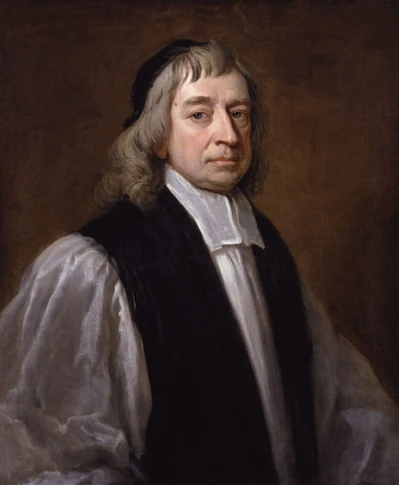
Henry Compton
| Name | Henry Compton |
| Title | Bishop of Oxford; Bishop of London |
| Gender | Male |
| Birthday | 1632-01-01 |
| nationality | Great Britain |
| Source | https://www.wikidata.org/wiki/Q2347142 |
| pptrace | View Family Tree |
| LastUpdate | 2025-11-26T23:20:56.226Z |
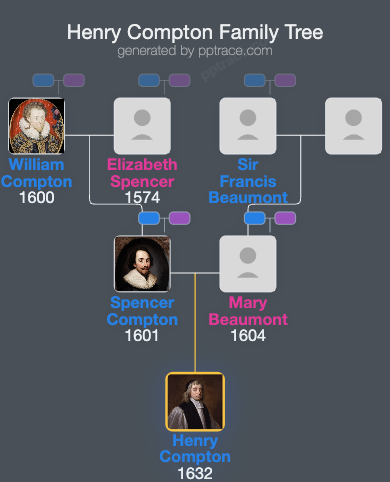
Family Tree
Tap  to expand more relatives
Introduction
Henry Compton (circa 1632 – 7 July 1713) was an English Anglican bishop who served as Bishop of London from 1675 until his death in 1713. He was born as the sixth and youngest son of William Compton, the 2nd Earl of Northampton.
Compton received education at The Queen’s College, Oxford, but left in 1654 without obtaining a degree. Subsequently, he traveled in Europe. After the Restoration of Charles II in 1660, Compton joined the military as a cornet in his brother Charles’s troop of the Royal Regiment of Horse. He later left the military to pursue a career in the church, undertaking further studies at both Cambridge University and Oxford University. He graduated with a Doctor of Divinity (D.D.) degree in 1669.
He held multiple ecclesiastical positions, including the rectorships of Cottenham and Witney. Compton was appointed Bishop of Oxford in 1674 and was translated to the see of London in 1675. In the same year, he was also appointed Dean of the Chapel Royal. Additionally, he became a member of the Privy Council and was responsible for the education of Princess Mary and Princess Anne.
Compton was known for his liberal approach toward Protestant dissenters, aiming to encourage reunification with the established church. He conducted several conferences with clergy within his diocese and sought to influence opinion through correspondence with prominent foreign Protestant theologians, such as Jean Claude, a French Protestant divine, and Le Moyne, a professor at the University of Leiden. In 1676, under the instruction of Lord Danby, Compton conducted an ecclesiastical census of the population, which became known as the Compton Census.
While sympathetic to Protestant dissenters, Compton held a firm stance against Roman Catholicism. Upon the accession of James II in 1685, he lost his seat on the Privy Council and his position as Dean of the Chapel Royal. In 1686, he was suspended by James’s Ecclesiastical Commission for refusing to suspend John Sharp, rector of St Giles’s-in-the-Fields, due to Sharp’s anti-papal preaching. The suspension was lifted in September 1688, shortly before the Commission was abolished.
During the Glorious Revolution, Compton supported William III and Mary II, participating in the invitation to William to invade England, and he performed the coronation ceremony of William and Mary. He was also appointed as a commissioner for revising the liturgy and was involved in the political arrangements of the time.
Under Queen Anne, Compton continued to be a member of the Privy Council and participated in the negotiations for the union between England and Scotland. Despite his ecclesiastical prominence, he was disappointed when his claims to the primacy of the church were overlooked on two occasions.
Henry Compton died at Fulham on 7 July 1713 and was buried at All Saints Church, Fulham.
In addition to his ecclesiastical career, Compton was a noted botanist. He also published theological works and translations, including a translation from Italian of the biography of Donna Olympia Maladichini, an influential church figure during Pope Innocent X’s papacy (published in 1667), and a translation from French titled "The Jesuits' Intrigues" (published in 1669).