
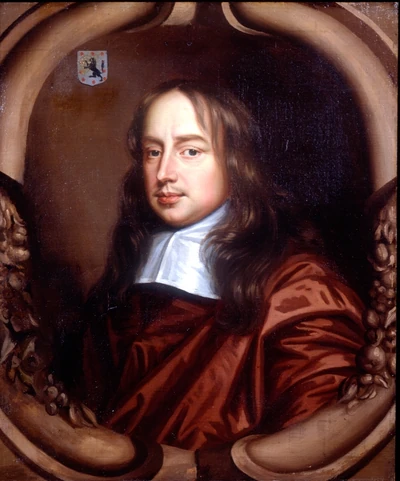
William Pierrepont
| Name | William Pierrepont |
| Title | English politician |
| Gender | Male |
| Birthday | 1607-00-00 |
| nationality | Kingdom of England |
| Source | https://www.wikidata.org/wiki/Q8016890 |
| pptrace | View Family Tree |
| LastUpdate | 2025-11-26T23:21:31.466Z |
Family Tree
Tap  to expand more relatives
Introduction
William Pierrepont (circa 1607 – 17 July 1678) was an English politician who served intermittently in the House of Commons between 1640 and 1660. He was known for supporting the Parliamentary cause during the English Civil War.
Pierrepont was the second son of Robert Pierrepont, 1st Earl of Kingston-upon-Hull, and his wife Gertrude Talbot, daughter of Hon. Henry Talbot of Burton Abbey, Yorkshire. He matriculated at Emmanuel College, Cambridge, in 1624 and was admitted to Lincoln's Inn on 1 April 1627. In 1638, he was appointed Sheriff of Shropshire.
In April 1640, Pierrepont was elected as Member of Parliament for Shropshire in the Short Parliament. Subsequently, in November 1640, he was elected MP for Great Wenlock in the Long Parliament. During the Civil War, he aligned with the parliamentary side and was involved in negotiations with King Charles I at Oxford in 1643. He also served on the committee for both kingdoms and represented the parliamentary faction during the deliberations at Uxbridge in 1645.
Historian Clarendon noted that after 1645, Pierrepont's stance supposedly shifted from moderation to increased bitterness. However, he continued to advocate for peace, demonstrating willingness to resume negotiations with the king in 1647, and in 1648, he sought peace at Newport on behalf of Parliament. His efforts at Newport brought him some censure from Oliver Cromwell, but he was nonetheless thanked by Parliament for his service.
Pierrepont retired from active politics shortly afterward, primarily due to his disapproval of the purging of the House of Commons by Colonel Pride and the proceedings against King Charles I. Despite his moderate position, he maintained a personal friendship with Cromwell. In 1654, he was elected MP for Nottinghamshire in the First Protectorate Parliament. He declined to sit in the 1656 Parliament and refused a seat in the Protectorate's House of Lords.
Following Oliver Cromwell’s death and Richard Cromwell's succession, Pierrepont played a subtle yet influential role in shaping government policy. After Richard Cromwell's fall, Pierrepont was briefly part of the council of state in early 1660 but refused to take his seat when the restored Rump Parliament reinstated the secluding members. He was elected MP for Nottinghamshire in the Convention Parliament of 1660, during which he is believed to have helped save some parliamentary leaders’ lives.
At the 1661 general election, Pierrepont was defeated and subsequently withdrew from public life. He died in 1678.
Regarding his family, Pierrepont married Elizabeth Harries, daughter of Sir Thomas Harries, Bart., of Tong Castle, Shropshire. They had five sons and five daughters. His eldest son, Robert Pierrepont (died 1666), was the father of Robert Pierrepont, 3rd Earl of Kingston-upon-Hull; William Pierrepont, 4th Earl of Kingston-upon-Hull; and Evelyn Pierrepont, 1st Duke of Kingston-upon-Hull. Gervase Pierrepont (1649–1715), their third son, was created Baron Pierrepont in 1701. His daughters included Frances Pierrepont (born 1630, died 1695), who married Henry Cavendish, 2nd Duke of Newcastle; Grace Pierrepont, who married Gilbert Holles, 3rd Earl of Clare; and Gertrude Pierrepont (1641–1727), who married George Savile, 1st Marquess of Halifax.
References for this biographical entry include historical records and genealogical sources related to the Pierrepont family.
