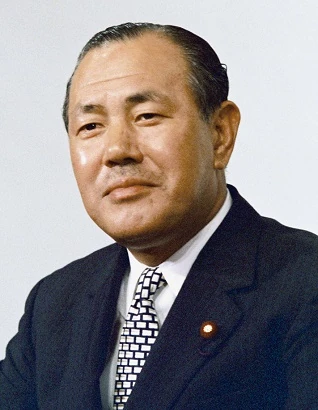
Kakuei Tanaka
| Name | Kakuei Tanaka |
| Title | Japanese politician (1918-1993) |
| Gender | Male |
| Birthday | 1918-05-04 |
| nationality | Japan |
| Source | https://www.wikidata.org/wiki/Q297644 |
| pptrace | View Family Tree |
| LastUpdate | 2025-11-17T06:46:40.417Z |
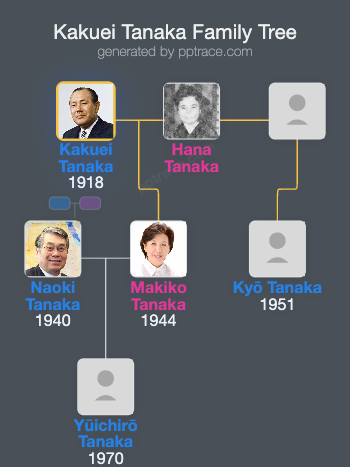
Family Tree
Tap  to expand more relatives
Introduction
Kakuei Tanaka (田中 角栄, Tanaka Kakuei) was born on May 4, 1918, in Furata (now Kashiwazaki), Niigata Prefecture, Japan. He was the second son of Kakuji Tanaka and his wife Fume, in a family involved in farming, horse and cattle trading, and shrine carpentry through his grandfather Sutekichi. His family experienced economic decline due to failed business ventures and personal issues such as gambling and excessive drinking by his father. Tanaka contracted diphtheria at age two, which affected his speech, but he later recovered through self-practice.
He completed higher elementary education at age fourteen but was unable to pursue further academic studies due to family poverty. He worked as a manual laborer and moved to Tokyo in 1934, aiming to work under Viscount Masatoshi Ōkōchi. In Tokyo, Tanaka worked as an apprentice in construction and attended engineering schools part-time before joining a construction company in 1936. He founded his own architectural firm in 1937 after an influential encounter with Ōkōchi but was drafted into the Japanese Army in 1939.
Tanaka served in Manchuria during World War II, reaching the rank of superior private, and was discharged in October 1941 due to illness. After recovering, he restarted his construction business, which benefited from government contracts during the war, especially when he obtained lucrative projects in Korea.
In 1942, Tanaka married Hana Sakamoto, a woman seven years his senior who had a daughter from a previous marriage. The marriage produced two children, a son Masanori (born 1942, died 1947) and a daughter Makiko (born 1944). He merged his construction business with Sakamoto Construction, forming Tanaka Construction Company in 1943. During the Pacific War, his company secured multiple military-related contracts, including a notable project in Korea.
Tanaka entered politics following World War II. He was first associated with the Japan Progressive Party, contributing financially and running as a candidate in the 1946 election but was not successful. By 1947, his campaign efforts improved, and he was elected to the National Diet as a representative of the Democratic Party. He cultivated support in rural areas and became known for visiting remote villages. He joined the Democratic Liberal Party (DLP) in 1948 and was appointed Vice Minister of Justice, but his political career was interrupted when he was arrested in December 1948 on charges related to accepting bribes from coal interests. This arrest led to a temporary decline in his political influence.
Tanaka's political career progressed over subsequent years as he built up a faction within the Liberal Democratic Party (LDP). He served in various cabinet positions, including Minister of Postal Services and Telecommunications (1957–1958), Minister of Finance (1962–1965), and Minister of International Trade and Industry (1971–1972). His organizational and financial skills allowed him to establish a significant political faction, which became the largest within the LDP.
In 1972, Tanaka succeeded Eisaku Sato as Prime Minister of Japan, serving until 1974. His administration prioritized infrastructure development, notably through his "Plan to Remodel the Japanese Archipelago," though it was eventually halted due to inflation and the 1973 oil crisis. In 1972, he established diplomatic relations with the People's Republic of China.
Throughout his political career, Tanaka was implicated in several corruption scandals, including the Lockheed bribery scandal in 1976, which led to his arrest and a four-year prison sentence in 1983. He remained free on appeal until his death on December 16, 1993. Despite legal issues, he maintained political influence through his faction, earning the nickname "Shadow Shōgun" due to his continued role as a political power broker. A stroke in 1985 contributed to the decline of his faction, which later fell under the leadership of Noboru Takeshita in 1987.