George Wythe Randolph
| Name | George Wythe Randolph |
| Title | Confederate Army general, grandson of Thomas Jefferson (1818-1867) |
| Gender | Male |
| Birthday | 1818-03-10 |
| nationality | United States of America |
| Source | https://www.wikidata.org/wiki/Q325998 |
| pptrace | View Family Tree |
| LastUpdate | 2025-11-29T00:59:59.027Z |
Family Tree
Tap  to expand more relatives
Introduction
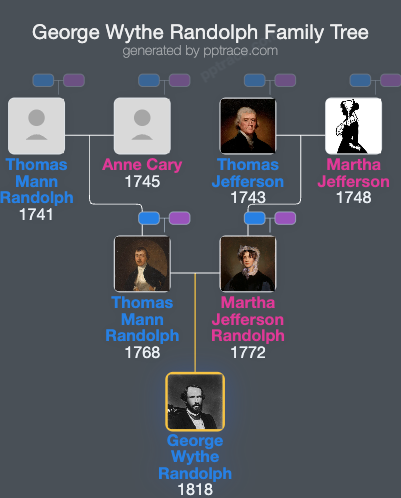
George Wythe Randolph was born on March 10, 1818, at Monticello near Charlottesville, Virginia. He was the youngest son of Martha Jefferson Randolph, daughter of Thomas Jefferson, and Thomas Mann Randolph, Jr., a Virginia governor. Randolph's ancestry included notable figures such as Pocahontas, Edmund Randolph, William Randolph, Isham Randolph of Dungeness, Richard Randolph, and Thomas Randolph of Tuckahoe. His family was part of the First Families of Virginia.
Randolph received a private education suitable for his social class. He attended preparatory schools in Cambridge, Massachusetts, under Joseph Coolidge, and in Washington, D.C., with the aim of distancing him from Virginia family politics and troubles. His father had accumulated significant debt, which led to the foreclosure of the family estate after his term as Virginia governor ended. In 1826, Randolph's brother Thomas Jefferson Randolph purchased the Edgehill plantation at a foreclosure auction.
From 1831 to 1839, Randolph served as a midshipman in the United States Navy, during which he sailed aboard the USS John Adams and USS Constitution in the Mediterranean Sea. Concurrently, he studied at the University of Virginia in Charlottesville, likely during periods of recovery from tuberculosis, which he contracted during his naval service.
Randolph studied law under an established Virginia lawyer, possibly with guidance from George Tucker, a professor at the University of Virginia and biographer of Thomas Jefferson. Tucker, who had written on economics and slavery, retired in 1845 and moved to Philadelphia. Randolph was admitted to the bar in 1840 and practiced law in Charlottesville. He and his wife, Mary Elizabeth (Adams) Pope, married on April 10, 1852. Mary was a widow and also descended from Virginia First Families. They had no children.
Randolph was involved in community activities, founding the Richmond Mechanics' Institute and serving as an officer in the Virginia Historical Society. Following John Brown’s raid at Harper's Ferry in 1859, Randolph organized the Richmond Howitzers artillery unit, which was among the volunteers Virginia sent to stabilize the town.
During the lead-up to the Civil War, Randolph affiliated with the secession movement. He represented the City of Richmond at the Virginia Secession Convention of 1861. Despite a failed initial vote on secession, he supported the move. After South Carolina's attack on Fort Sumter on April 12, 1861, and Lincoln’s call for volunteers, Randolph’s unit, the Richmond Howitzers, was mobilized and saw initial action, including firing on USS Yankee in May 1861.
Randolph was commissioned as a major and became commander of the Richmond Howitzers. His battalion participated in several engagements, notably the Battle of Big Bethel in June 1861, his unit’s only engagement as a battalion during the war. He was promoted to colonel on September 13, 1861, when the artillery companies were organized into a regiment, initially called the 2nd Regiment Virginia Artillery, later the 1st Regiment Virginia Artillery.
On February 12, 1862, Randolph was promoted to brigadier general. In March 1862, he was appointed as the Confederate States Secretary of War by President Jefferson Davis, a position he held from March 24, 1862. During his tenure, Randolph implemented reforms in procurement, drafted a conscription law, and bolstered the Confederacy's defensive positions, particularly in the western and southern regions. He was involved in controversies regarding the use of hidden shells in warfare and argued that such explosives, if used defensively, did not contravene the laws of war.
Due to health issues related to tuberculosis, Randolph resigned from his position as Secretary of War on November 17, 1862. Despite his resignation, he was elected as a state senator representing Richmond, serving in the Virginia Senate until the conclusion of the Civil War. He was officially mustered out of military service on December 18, 1864.
After the Civil War, Randolph traveled to Europe in 1864 with his family to receive medical treatment, passing through England and southern France. He took the oath of allegiance to the United States following the war, though further details of his postwar life are limited. Randolph died on April 3, 1867.