Zeng Zhongsheng
| Name | Zeng Zhongsheng |
| Title | Chinese Communist revolutionary |
| Gender | Male |
| Birthday | 1900-06-10 |
| nationality | — |
| Source | https://www.wikidata.org/wiki/Q8290225 |
| pptrace | View Family Tree |
| LastUpdate | 2025-10-01T10:19:17.408Z |
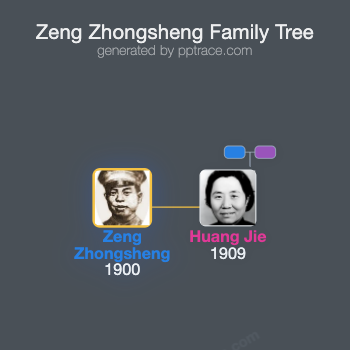
Family Tree
Tap  to expand more relatives
Introduction
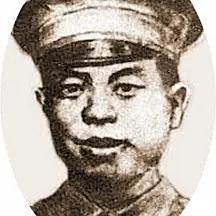
Zeng Zhongsheng (June 10, 1900 – mid-August 1935), originally named Zeng Zhongsheng, was born in Dongxiang Prefecture, Xingning County (now Zixing City), Hunan Province. In his early years, he received education and in autumn 1917, he was admitted to the Seventh United Middle School in Chenzhou, Hunan. In 1922, Zeng Zhongsheng served as a staff officer in the Guangxi Army for a year, and in 1925, he was admitted to the 4th class of the Whampoa Military Academy. That same year, he joined the Chinese Communist Party and actively participated in the Northern Expedition, serving as the head of the Political Department of the Vanguard Command of the 8th Army of the National Revolutionary Army, responsible for political work and party organization development within the troops.
In October 1926, after the success of the Northern Expedition in capturing Wuhan, Zeng Zhongsheng became the chief editor of the "Hankou Republican Daily."
Following the "April 12" counter-revolutionary coup in 1927, he actively allied with the left wing of the Kuomintang, participating in the struggle against Chiang Kai-shek. In September of the same year, he was dispatched to study at Sun Yat-sen University in Moscow, Soviet Union. During his time in Moscow, Zeng Zhongsheng attended the Sixth National Congress of the Chinese Communist Party held in 1928. Upon returning to China, he successively held positions including director of the Military Department's Staff Office of the CCP Central Committee, secretary of the Nanjing Municipal Committee of the CCP, member of the Central Military Commission, and Minister of the Armed Work Department.
In September 1930, Zeng Zhongsheng, acting as a CCP Central Committee envoy, entered the Anhui-Hubei-Henan Soviet Area, serving as secretary of the CCP Anhui-Hubei-Henan Special Committee and chairman of the Military Committee. During the first "encirclement and suppression" campaign by the Kuomintang, he decisively organized the temporary CCP Special Committee and Military Committee, leading the anti-encirclement struggle. Under his command, the Red Army adopted guerrilla tactics, mobilized broad popular support, and achieved multiple victories in regions such as Jinjiazhai, Mabu, and Dongsixianghuoling, repelling enemy attacks. He also presided over the development of various construction policies, established military-political schools, reformed the Red Army, and promoted the development of the base area.
By 1931, Zeng Zhongsheng continued to lead the anti-encirclement campaigns, achieving victories in Murjialou, Xinji, and Shuangqiao Town, among other locations. The base area in Anhui-Hubei-Henan gradually strengthened and expanded, with the military forces increasing in size. Historical records note that he confronted and resisted the erroneous leadership and internal struggles caused by Zhang Guotao, demonstrating firmness and resilience.
In 1932, Zeng Zhongsheng followed the Fourth Front Army of the Red Army in retreating from the Anhui-Hubei-Henan area, serving as the chief of staff of the Northwest Revolutionary Military Committee and participating in the establishment of the Sichuan-Shaanxi Soviet Base. During this period, he wrote significant military theoretical works including "Key Points in Fighting the Sichuan Army," "Essential Principles of Guerrilla Warfare," and "Operational Strategies Against the 'Suppression' Troops," making important contributions to revolutionary military thought.
In 1933, as the Fourth Front Army stabilized its position in the Sichuan-Shaanxi region, Zeng Zhongsheng continued to strengthen military and political work. His writings summarized advanced strategic ideas such as people's wars and mobile warfare, having a profound influence on the formation of Mao Zedong’s military thought. However, starting in 1933, Zeng Zhongsheng was manipulated by Zhang Guotao using the label of "Rightist," resulting in imprisonment and persecution, with repeated blows against him.
In June 1935, as the main Red Army and the Fourth Front Army united, he showed a willingness to cooperate and requested an investigation; however, his proposal was obstructed. In August 1935, CCP investigations revealed that he had been secretly murdered by Zhang Guotao, and he died at the age of 35. His death was officially classified as a clandestine killing, occurring in the Zhekou region of Sichuan. In 1945, the Central Committee of the Chinese Communist Party fully exonerated and rehabilitated him. In 1988, the Central Military Commission of the People's Republic of China recognized Zeng Zhongsheng as one of the 36 outstanding military figures of the Chinese People's Liberation Army.