Douglas Jay, Baron Jay
| Name | Douglas Jay, Baron Jay |
| Title | British politician (1907-1996) |
| Gender | Male |
| Birthday | 1907-03-23 |
| nationality | United Kingdom |
| Source | https://www.wikidata.org/wiki/Q5301661 |
| pptrace | View Family Tree |
| LastUpdate | 2025-11-26T13:02:11.668Z |
Family Tree
Tap  to expand more relatives
Introduction
Douglas Patrick Thomas Jay, Baron Jay, PC, was a British politician affiliated with the Labour Party. He was born on March 23, 1907, and died on March 6, 1996.
Education and Early Life:
Douglas Jay received his education at Winchester College before attending New College, Oxford. During his time at Oxford, he was awarded the Chancellor's English Essay prize in 1927 and graduated in 1929 with a First Class degree in Literae Humaniores, commonly known as "Greats." He was a Fellow of All Souls College from 1930 to 1937.
Career:
Initially, Jay worked as an economics journalist. He contributed to The Times from 1929 to 1933, The Economist between 1933 and 1937, and the Daily Herald from 1937 to 1941. Subsequently, he worked as a civil servant in the Ministry of Supply and the Board of Trade. Starting in 1943, he served as a personal assistant to Hugh Dalton.
Political Involvement:
Although Jay maintained a belief in democratic socialism from an early age, he did not join the Labour Party until the winter of 1933–34, becoming a member of the Paddington constituency party. As a journalist, he was a senior figure in the XYZ Club, a secret organization in London's City area dedicated to providing Labour with financial intelligence. Alongside figures such as Evan Durbin and Hugh Gaitskell, he contributed to integrating Keynesian economic principles into Labour Party thinking, particularly regarding price determination.
In 1937, Jay published his first book, "The Socialist Case," in which he wrote, "in the case of nutrition and health, just as in the case of education, the gentleman in Whitehall really does know better what is good for people than the people know themselves." This statement was used by Conservative opponents to typify his views, leading to the paraphrased phrase "the man in Whitehall knows best." Early in his career, Jay was skeptical of planning and bureaucracy but did not equate planning with socialism. Instead, he viewed Labour's objectives as involving the reduction of unearned income rather than abolishing the market economy. His perspectives evolved over time, influenced by the wartime success of rationing.
Parliamentary Career:
Jay was elected as the Member of Parliament for Battersea North in a by-election in July 1946. He held this seat until the constituency was abolished in 1983. During his time in Parliament, he served in several key governmental roles:
- Economic Secretary to the Treasury (1947–1950)
- Financial Secretary to the Treasury (1950–1951)
- President of the Board of Trade (1964–1967)
His tenure at the Board of Trade was noted for his advocacy of regional development and opposition to currency devaluation. His opposition to closer European integration contributed to his removal from the position in 1967. Harold Wilson, the Prime Minister at the time, cited the need to avoid conflicts within the cabinet as the reason for Jay's dismissal, also noting Wilson’s belief that no ministers over age 60 should be in the cabinet.
In 1951, Jay was sworn into the Privy Council.
Views on Europe:
Jay was an active critic of the United Kingdom's entry into the European Communities. By 1970, he was the first prominent politician to argue that, given the bipartisan support for membership in Britain, a national referendum should be held to determine the country's European future. He campaigned for a 'no' vote in the 1975 referendum.
Honors:
On October 8, 1987, Jay was made a life peer, given the title Baron Jay of Battersea in Greater London.
Family:
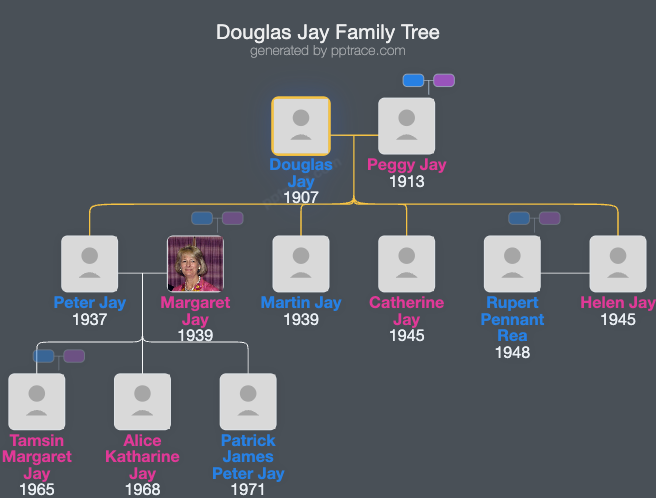
In 1933, he married Peggy Jay, a local government councillor. The marriage ended in divorce. They were the parents of economist Peter Jay, who married Margaret Callaghan, daughter of James Callaghan, with whom Douglas Jay had served in government. He had twin daughters, Helen and Catherine, who gained prominence in the 1960s. His second wife was Mary Thomas, who had served as his assistant private secretary at the Board of Trade.
Publications:
- The Socialist Case (1937)
- Who is to Pay for the War and the Peace? (1941)
- Socialism in the New Society (1962)
- After the Common Market (1968)
- Change and Fortune (1980) – autobiography
- Sterling: A Plea for Moderation (1985)
References:
Leigh Rayment's Historical List of MPs; Hansard contributions (1803–2005).