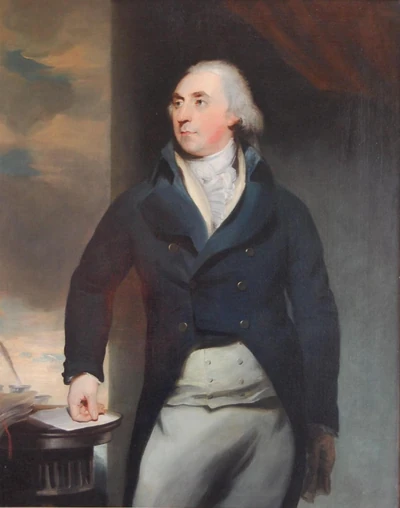
William Ponsonby, 1st Baron Ponsonby
| Name | William Ponsonby, 1st Baron Ponsonby |
| Title | British politician |
| Gender | Male |
| Birthday | 1744-09-15 |
| nationality | Q215530 |
| Source | https://www.wikidata.org/wiki/Q8016998 |
| pptrace | View Family Tree |
| LastUpdate | 2025-11-26T23:28:05.691Z |
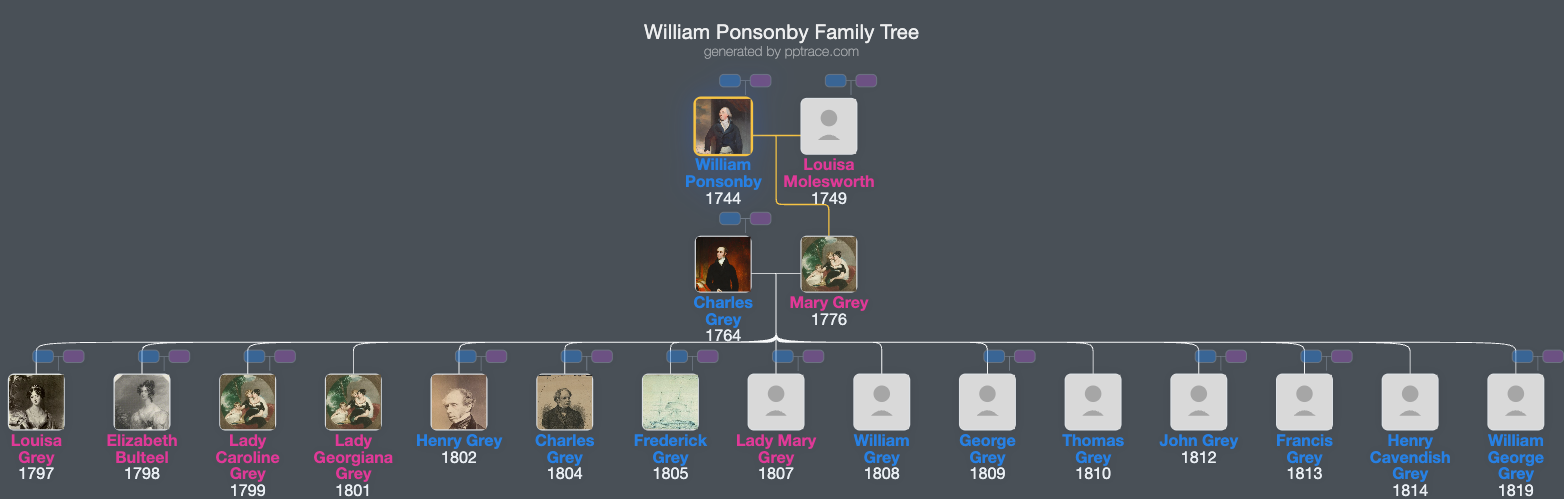
Family Tree
Tap  to expand more relatives
Introduction
William Brabazon Ponsonby, 1st Baron Ponsonby (of Imokilly), was born on 15 September 1744 and died on 5 November 1806. He was a prominent Irish politician affiliated with the Whig party. His father was Hon. John Ponsonby, who served as the Speaker of the Irish House of Commons, and his mother was Lady Elizabeth Cavendish, daughter of the 3rd Duke of Devonshire.
Ponsonby received his education at Pembroke College, Cambridge. His political career began with his representation of Cork City from 1764 to 1776, followed by Bandonbridge from 1776 to 1783. He was part of a significant family grouping in the Irish House of Commons, controlling between ten and fourteen parliamentary seats, making it the second-largest informal grouping.
In 1784, Ponsonby was appointed as a Privy Counsellor of Ireland and served as Joint Postmaster-General of Ireland until 1789. During the regency crisis of 1788–89, he supported the Prince of Wales against William Pitt the Younger. Following this political stance, he was dismissed from his role in the Post Office. Subsequently, his political alignment shifted more firmly toward Charles James Fox, and he, along with his brother George Ponsonby, worked to unify various small Irish Whig groups into an opposition faction. Their efforts aimed to reassert the influence of landowning classes over the crown.
Ponsonby advocated for Catholic Emancipation, considering it a strategic move to ensure a loyal Irish population amid radical agitation and concerns over foreign invasion. In 1794, political opportunities arose when Pitt formed a coalition with the Portland Whigs and Earl FitzWilliam became Lord Lieutenant of Ireland. Ponsonby was on the verge of becoming Irish Secretary and had sat on the Treasury bench. However, in 1795, he influenced FitzWilliam to dismiss John Beresford over alleged corruption—an action that contributed to FitzWilliam’s rapid removal from office and Ponsonby’s return to opposition.
He was an outspoken opponent of the union between Ireland and Great Britain. In the 1783 general election, he initially ran for Newtownards but opted to represent County Kilkenny from 1783 until the union in 1801. After the union, he became a member of the Whig opposition in the Westminster House of Commons, voting against the Addington and Pitt administrations. His political influence waned by 1803, with his brother George Ponsonby assuming leadership of the Irish Whigs.
In 1806, during the brief period when Fox's faction returned to office as part of Grenville's Ministry of All the Talents, Ponsonby’s health was deteriorating. His wife petitioned for a peerage in recognition of his opposition to the Regency Bill and the Irish Union, as well as his support for the Whigs. Consequently, Ponsonby was created a peer of the United Kingdom on 13 March 1806, titled "Baron Ponsonby, of Imokilly in the County of Cork." He was known generally as Baron Ponsonby of Imokilly.
He died in Seymour Street, London, on 5 November 1806, and was buried in Ireland.
Ponsonby was characterized by contemporary and later observers, including Edmund Burke, as having a "manly, decided character" with a "clear and vigorous understanding." He was interested in sports and maintained an extensive hunting establishment at Bishopscourt, his seat in County Kildare. Reports indicate he lived in a hospitable and princely manner but could also be easily irritated if his status and pretensions were overlooked.
In 1769, he married Louisa Molesworth, the 4th daughter of the 3rd Viscount Molesworth, and his second wife, Mary Usher. They had five children, four sons and one daughter. Notable among his children were:
- John Ponsonby, 1st Viscount Ponsonby, a diplomat.
- Hon. Sir William Ponsonby, a senior military officer killed at the Battle of Waterloo.
- Richard Ponsonby, who became bishop of Killaloe and Kilfenora in 1828, then of Derry in 1831, and later of Derry and Raphoe in 1834.
- George Ponsonby, who served as a Member of Parliament and Junior Lord of the Treasury.
- A daughter, Mary, was married to Charles Grey, 2nd Earl Grey, who served as Prime Minister.
His descendants include notable figures such as Edward Wood, 1st Earl of Halifax, Sir Alec Douglas-Home, and Prince William of Wales.