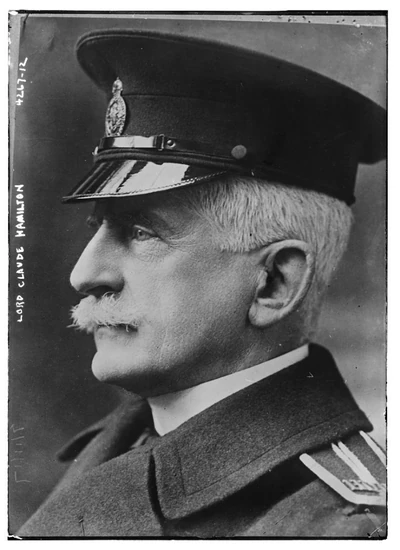
Lord Claud Hamilton
| Name | Lord Claud Hamilton |
| Title | British politician (1843-1925) |
| Gender | Male |
| Birthday | 1843-02-20 |
| nationality | United Kingdom of Great Britain and Ireland |
| Source | https://www.wikidata.org/wiki/Q2679435 |
| pptrace | View Family Tree |
| LastUpdate | 2025-11-26T23:29:49.724Z |
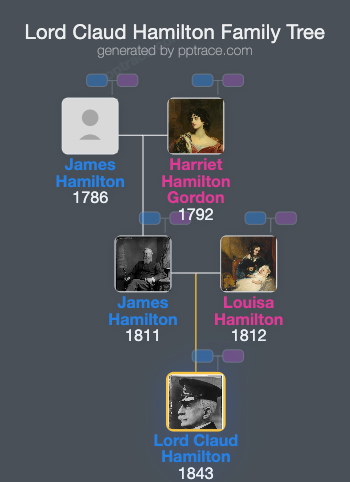
Family Tree
Tap  to expand more relatives
Introduction
Rt. Hon. Lord Claud John Hamilton was born on 20 February 1843 and died on 26 January 1925. He was a British aristocrat, a Member of Parliament (MP), and a railway director during the Victorian era.
Early Life
Claud John Hamilton was born at the Priory in Stanmore, Middlesex. He was the second son of James Hamilton, 2nd Marquess of Abercorn, who later became the 1st Duke of Abercorn, and Lady Louisa Jane Russell, the daughter of the 6th Duke of Bedford. He received his education at Harrow School.
Military Career
Hamilton began his career in the British Army. He purchased a commission as Ensign and Lieutenant in the Grenadier Guards on 27 May 1862. He was promoted to Lieutenant and Captain on 8 August 1865, before selling his commission on 8 June 1867. On 10 July 1867, he was appointed Lieutenant-Colonel Commandant of the Prince of Wales's Own Donegal Militia, succeeding his uncle Lord Claud Hamilton (1813–1884). He was later appointed Honorary Colonel of the battalion on 17 January 1891, succeeding his elder brother, James Hamilton, 2nd Duke of Abercorn.
Political Career
Hamilton represented several constituencies as a Conservative MP. He served as MP for Londonderry City from 1865 to 1868, during which time he was appointed a Lord of the Treasury in Benjamin Disraeli's first ministry. He then served as MP for King's Lynn from 1869 to 1880, MP for Liverpool from 1880 to 1885, for Liverpool West Derby from 1885 to 1888, and for Kensington South from January 1910 to 1918. He was an aide-de-camp to Queen Victoria from 1887 to 1897 and was appointed to the Privy Council in 1917.
In addition to his parliamentary duties, Hamilton was actively involved in public service. He was appointed a Lord of the Treasury in 1868. His political career spanned several decades, representing various constituencies and serving under different capacities.
Railway Involvement
His principal contribution to British public life was as a director of the Great Eastern Railway (GER). He joined the company as a director in 1872, became vice-chairman in 1874, and served as chairman from 1893 until 1922. The GER operated from London's Liverpool Street station to major eastern towns and cities, including Cambridge, Norwich, Ipswich, Chelmsford, and Colchester. Hamilton traveled extensively on the network, observing its operations. Under his leadership, the company's shares increased from 76 (post-1866 bankruptcy) to par in 1896, with dividends reaching 6% in 1901. In 1900, the GER named its first class of 4-4-0 express passenger locomotives after him, designated the "Claud Hamilton" type.
Personal Life
On 20 July 1878, Lord Claud Hamilton married Carolina Chandos-Pole, daughter of Edward Sacheverell Chandos-Pole and Lady Anna Caroline Stanhope, daughter of the 5th Earl of Harrington. They had two children:
1. Gilbert Claud Hamilton (1879–1943), who participated in the Second Boer War. He married Enid Awa Elgar in 1911. After her death in 1916, he married Mary Blair in 1916.
2. Ida Hamilton (1883–1970), who married Hugh Duncombe Flower in 1909; the marriage ended in divorce in 1923.
Health and Death
Hamilton underwent major surgery in November 1924. He died at his residence at 28 Cambridge Square, London, on 26 January 1925, at the age of 81. He was buried in Richmond Cemetery.
Legacy
A memorial was erected by his daughter Ida Flower in 1925 in memory of Lord Claud Hamilton. It is located on the south wall of St John's-Hyde Park Church, London, W2.
Ancestry information and references are available, including entries from Leigh Rayment's Historical List of MPs and sources such as Thom's Irish Who's Who. Portraits of Lord Claud Hamilton are held at the National Portrait Gallery, London.