Sargent Shriver
| Name | Sargent Shriver |
| Title | American diplomat, politician and activist (1915-2011) |
| Gender | Male |
| Birthday | 1915-11-09 |
| nationality | United States of America |
| Source | https://www.wikidata.org/wiki/Q317248 |
| pptrace | View Family Tree |
| LastUpdate | 2025-11-17T06:45:09.249Z |
Family Tree
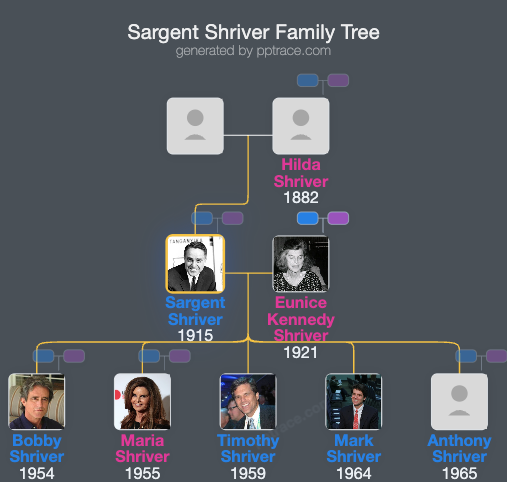
Tap  to expand more relatives
Introduction
Robert Sargent Shriver Jr. was born on November 9, 1915, in Westminster, Maryland. He was the younger of two sons of Robert Sargent Shriver Sr. and Hilda Shriver, both of whom had the surname Shriver and were second cousins. His family has a history in Maryland dating back to 1721, associated with the Union Mills Homestead. His grandfather, Thomas Herbert Shriver, played a notable role in the Civil War era, guiding J. E. B. Stuart to the Battle of Gettysburg at the age of seventeen. Additionally, Shriver was descended from David Shriver, a signer of Maryland's Constitution and Bill of Rights during the 1776 Constitutional Convention.
Shriver attended Canterbury School in New Milford, Connecticut, on a full scholarship, where he participated in multiple sports and extracurricular activities, and served as the editor of the school newspaper. He graduated in 1934 and subsequently spent a summer in Germany participating in The Experiment in International Living. Later that year, he entered Yale University, where he was elected chairman of the Yale Daily News, and became a member of the Delta Kappa Epsilon fraternity as well as Yale’s Scroll and Key society.
During his college years, Shriver was an early opponent of U.S. involvement in World War II. He helped establish the America First Committee in 1940, an organization committed to keeping the United States out of the European conflict, which included other Yale Law School students such as Gerald Ford and Potter Stewart. Despite his opposition, he volunteered for the United States Navy before the attack on Pearl Harbor, serving for five years primarily in the South Pacific aboard the USS South Dakota (BB-57) and achieving the rank of lieutenant commander. He received a Purple Heart for wounds sustained during the bombardment of Guadalcanal.
Shriver’s relationship with the Kennedy family began while he was working as an assistant editor at Newsweek. He met Eunice Kennedy in New York, and shortly thereafter, family patriarch Joseph P. Kennedy Sr. asked him to examine diary entries by his son, Joseph P. Kennedy Jr., who died during a military mission in World War II. Shriver later managed the Merchandise Mart, part of the Kennedy family's business empire, in Chicago. He and Eunice Kennedy married on May 23, 1953, at St. Patrick’s Cathedral in New York City. Eunice was the third daughter of Joseph P. Kennedy Sr. and Rose Kennedy.
The couple had five children: Robert Sargent "Bobby" Shriver III (born April 28, 1954); Maria Owings Shriver (born November 6, 1955); Timothy Perry Shriver (born August 29, 1959); Mark Kennedy Shriver (born February 17, 1964); and Anthony Paul Kennedy Shriver (born July 20, 1965). The Shrivers remained married for 56 years and often collaborated on various projects.
Shriver was admitted to practice law in the District of Columbia, Illinois, and New York, as well as before the U.S. Supreme Court. He was a devout Catholic, attending daily Mass and carrying a wooden rosary. He expressed opposition to abortion, advocating for policies aimed at protecting both mothers and children.
In public service, he was appointed to the Chicago Board of Education in 1954 and served as its president from 1955 to 1960, during which time Chicago Public Schools was the second-largest school district in the U.S. He also served as director of the Catholic Interracial Council, advocating for desegregation.
Shriver considered runs for statewide office in Illinois during the 1950s but did not pursue them. He played a significant role in the 1960 presidential election, working on the campaigns in Wisconsin and West Virginia, and was a key supporter of John F. Kennedy. As director of the Peace Corps from 1961 to 1966, he was instrumental in its establishment and expansion. Following Kennedy’s assassination, Shriver served in the Johnson administration, helping to establish the Office of Economic Opportunity. He was appointed the United States Ambassador to France from 1968 to 1970.
In 1972, Shriver was chosen as the Democratic vice presidential nominee after Thomas Eagleton resigned from the ticket. The Democratic ticket of George McGovern and Shriver was defeated by President Richard Nixon and Vice President Spiro Agnew in a landslide. Shriver briefly sought the Democratic presidential nomination in 1976 but withdrew after the early primaries.
After his political career, Shriver resumed practicing law as a partner in the firm Fried, Frank, Harris, Shriver & Jacobson. He served as president of the Special Olympics and had a brief ownership stake in the Baltimore Orioles. In 2003, he was diagnosed with Alzheimer’s disease. He died in Bethesda, Maryland, on January 18, 2011.