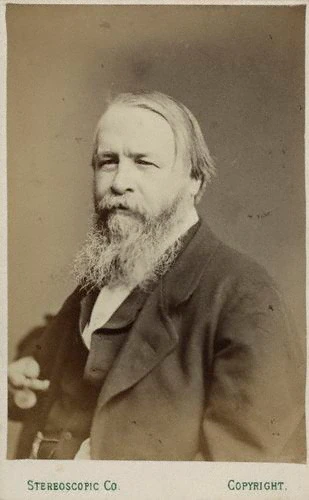
Alexander Beresford Hope
| Name | Alexander Beresford Hope |
| Title | British politician and author (1820-1887) |
| Gender | Male |
| Birthday | 1820-01-25 |
| nationality | United Kingdom of Great Britain and Ireland |
| Source | https://www.wikidata.org/wiki/Q1739864 |
| pptrace | View Family Tree |
| LastUpdate | 2025-11-26T23:30:36.775Z |
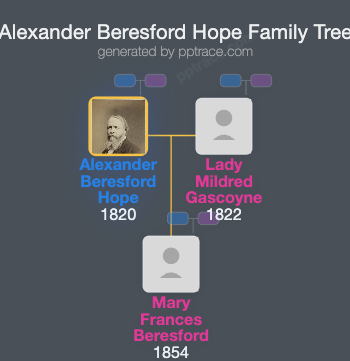
Family Tree
Tap  to expand more relatives
Introduction
Sir Alexander James Beresford Hope, PC, was born on 25 January 1820 and died on 20 October 1887. He was a British author and a Conservative politician who was known as Alexander Hope until 1854, and also went by the names A. J. B. Hope and A. J. B. Beresford Hope from 1854 onward.
Early Life: Beresford Hope was the third and youngest son of Thomas Hope, a writer and patron of the arts, and his wife, the Honorable Louisa Beresford. Louisa was the daughter of William Beresford, 1st Baron Decies, who was the younger son of George Beresford, 1st Marquess of Waterford. The Hope family was of Scottish descent but had resided in the Netherlands for many years, where they engaged in mercantile and banking activities. They returned to Britain following the occupation of the Netherlands by French troops in 1795. Beresford Hope was educated at Harrow School and Trinity College, Cambridge. His father died in 1831, and his mother later married her first cousin, General William Beresford, 1st Viscount Beresford. In 1854, Beresford Hope inherited estates from his stepfather, including Bedgebury Park in Kent and Beresford Hall in Staffordshire; he also adopted the surname Beresford by Royal Licence. His brother was Henry Thomas Hope.
Parliamentary Career: He served as a Member of Parliament for Maidstone from 1841 to 1852 and again from 1857 to 1859. He unsuccessfully contested seats at Cambridge University in 1859 and Stoke-upon-Trent in 1862; however, he was elected as MP for Stoke-upon-Trent in 1865 and served as one of the two representatives for Cambridge University from 1868 until his death. From 1865, he sat as an independent Conservative. He was a vocal opponent of Benjamin Disraeli's Reform Act of 1867, referring to Disraeli as "the Asian mystery," a comment reflecting Disraeli's Jewish origins. Disraeli responded by alluding to Beresford Hope's Dutch heritage, mentioning "Batavian graces." Beresford Hope was appointed to the Privy Council in 1880 but did not hold ministerial office.
Philanthropy and Writing: Beresford Hope was known for his strong support of the Church of England. His advocacy included opposition to the Deceased Wife's Sister Bill. In 1839, while at Trinity College, he co-founded the Cambridge Camden Society, later known as the Ecclesiological Society, alongside John Mason Neale and Benjamin Webb. He re-established the society in 1879 as the St Paul's Ecclesiological Society. He was a wealthy individual who purchased and sought to restore ecclesiastical buildings; notably, in 1844, he acquired St Augustine's Abbey in Canterbury, intending to convert it into a college for missionary clergy. He supervised the commissioning of All Saints Church in Margaret Street, London, designed by William Butterfield, on behalf of the Ecclesiological Society. Around 1850, he inherited estates in Alstonefield and Sheen in Staffordshire, aiming to transform Sheen into "the Athens of the Moorlands," rebuilding the local church to Butterfield's design and establishing a school and lending library. His plans for Sheen included various cultural and ecclesiastical projects, some of which remained unrealized. Beresford Hope authored works on archaeological, architectural, ecclesiastical, and artistic subjects, including "Essays" (1844), "English Cathedrals in the XIX. Century" (1861), and "Worship in the Church of England" (1874). He served as President of the Royal Institute of British Architects from 1865 to 1867 and was a trustee of the British Museum. In 1855, he co-founded the Saturday Review. He was elected a Fellow of the Royal Society in 1880. Additionally, he laid the foundation stone of Christ Church in St Leonards-on-Sea in 1873 and supported the funding of the Woodard Schools, a network of church-affiliated schools founded by Canon Nathaniel Woodard.
Family: In 1842, Beresford Hope married Lady Mildred Arabella Charlotte Henrietta Gascoyne-Cecil, daughter of James Gascoyne-Cecil, 2nd Marquess of Salisbury, and sister to Robert Gascoyne-Cecil, 3rd Marquess of Salisbury. The couple had three sons and seven daughters. Lady Mildred was a prominent figure in London society and died in March 1881. Beresford Hope died six years later at the age of 67 at Bedgebury Park, Goudhurst, Kent, and was buried at Christ Church, Kilndown, Kent. His daughter Bridget married Alban Gibbs, 2nd Baron Aldenham.
Works: His writings include "Essays" (1844), "English Cathedrals in the XIX. Century" (1861), "The Social and Political Bearings of the American Disruption" (1863), "Cathedrals in Their Missionary Aspects" (1872), "Hints Towards Peace in Ceremonial Matters" (1874), "Worship in the Church of England" (1874), "Strictly Tied-up" (1880), "The Brandreth" (1882), and "Worship and Order" (1883).