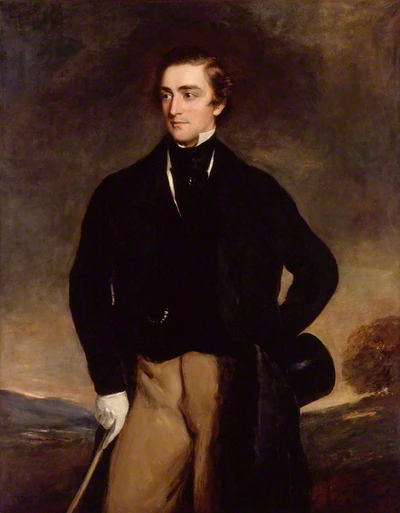
Sidney Herbert, 1st Baron Herbert Of Lea
| Name | Sidney Herbert, 1st Baron Herbert Of Lea |
| Title | British politician (1810-1861) |
| Gender | Male |
| Birthday | 1810-09-16 |
| nationality | United Kingdom of Great Britain and Ireland |
| Source | https://www.wikidata.org/wiki/Q337595 |
| pptrace | View Family Tree |
| LastUpdate | 2025-11-26T23:27:05.508Z |
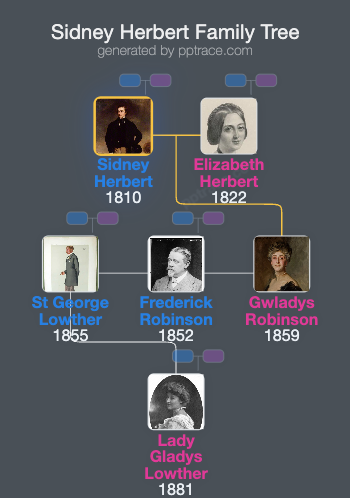
Family Tree
Tap  to expand more relatives
Introduction
Sidney Herbert, 1st Baron Herbert of Lea, PC, was born on 16 September 1810 and died on 2 August 1861. He was a British statesman renowned for his association with Florence Nightingale and his role in military and health reforms in the United Kingdom.
Herbert was the younger son of George Herbert, 11th Earl of Pembroke. His mother was Countess Catherine Woronzow, a Russian noblewoman and daughter of Semyon Vorontsov, the Russian ambassador to Great Britain. The family is commemorated by Woronzow Road in St John's Wood, London. Sidney Herbert received education at Harrow School and Oriel College, Oxford, where he distinguished himself as a speaker at the Oxford Union.
In 1832, Herbert entered the House of Commons as a Conservative Member of Parliament representing a division of Wiltshire. During the tenure of Prime Minister Robert Peel, Herbert held minor government offices and was appointed Secretary at War in 1845. He remained loyal to Peel, aligning with the Peelites or Liberal Conservatives. From 1852 to 1854, he served again as Secretary at War in the coalition government of Lord Aberdeen, during which he was responsible for the War Office amid the Crimean War.
Herbert briefly served in 1855 under the first Lord Palmerston, but resigned following the government's decision to fund an inquiry into the Crimean War's conduct. He later returned to office in 1859 as Secretary at War when the post was combined with that of Secretary of State for War. Herbert was a member of the Canterbury Association from 20 March 1848.
He managed the Pembroke family estates, centered at Wilton House in Wiltshire, during most of his adult life. His elder half-brother, Robert Herbert, 12th Earl of Pembroke, had lived in exile in Paris following a failed marriage in 1814.
Herbert collaborated closely with Florence Nightingale. He involved her in the effort to lead a team of nurses to Scutari during the Crimean War and subsequently championed reforms in Army health and the War Office. His work and advocacy caused health issues, leading to a breakdown in his health, which contributed to his resignation from government office in July 1861, shortly after being created a baron in the peerage of the United Kingdom.
Regarding his personal life, Herbert is believed to have had an affair with Caroline Norton, a noted society figure and author, in the early 1840s. Norton was unable to secure a divorce from her abusive husband, and their relationship ended in 1846. In that year, Herbert married Elizabeth à Court-Repington, the daughter of Lieutenant-General Charles Ashe à Court-Repington and niece of William à Court, 1st Baron Heytesbury. Elizabeth was a philanthropist, author, and translator, and maintained friendships with figures such as Benjamin Disraeli and two cardinals.
Sidney and Elizabeth Herbert resided at 49 Belgrave Square, London, and had seven children: Mary Catherine Herbert (later married Friedrich von Hügel), George Robert Charles Herbert (who succeeded as the 13th Earl of Pembroke), Elizabeth Maud Herbert (married Sir Charles Hubert Parry), Sidney Herbert (who succeeded his brother as the 14th Earl of Pembroke), William Reginald Herbert (who died at age 16), Michael Henry Herbert (a diplomat and British Ambassador to the US), and Constance Gwladys Herbert (married twice, including to the Earl of Lonsdale and later to the Earl de Grey).
Sidney Herbert died of Bright's disease in 1861. He was buried at Wilton, where a neo-Romanesque church rebuilt by his father houses a marble effigy of him alongside his wife Elizabeth. His memorials include statues formerly placed in front of the War Office in Pall Mall, London, and in Victoria Park, Salisbury, Wiltshire, as well as a memorial on Inchkeith island. Several geographic locations, including Herbert Sound in Antarctica and Pembroke, Ontario in Canada, are named in his honor. Mount Herbert on Banks Peninsula in New Zealand and the town of Wānaka (renamed Pembroke) also bear his name.