William Steuart
| Name | William Steuart |
| Title | British Army general |
| Gender | Male |
| Birthday | 1643-00-00 |
| nationality | Great Britain |
| Source | https://www.wikidata.org/wiki/Q8018797 |
| pptrace | View Family Tree |
| LastUpdate | 2025-11-26T12:26:23.939Z |
Family Tree
Tap  to expand more relatives
Introduction
William Steuart (also spelled Stewart) was born in 1643 and died on June 4, 1726. He was a Scottish-born military officer and politician who held several significant positions during his lifetime, including Commander-in-Chief of Queen Anne's Forces in Ireland, Member of Parliament for County Waterford, and a Privy Counsellor.
Family Background and Early Life:
Steuart was the second son of Colonel William Stewart, who died in 1691. His father served as an adjutant to James Graham, 1st Marquess of Montrose, during the Battle of Philiphaugh. His mother, Barbara, was the granddaughter of James Stewart, Earl of Arran, who was the Lord Chancellor of Scotland. His paternal grandfather was William Stewart of Burray, residing at Mains, Wigtownshire, and was the elder brother of Alexander Stewart, 1st Earl of Galloway. William Steuart was a first cousin to John Sinclair, 8th Earl of Caithness, and a nephew of Lieutenant-Colonel Sir Archibald Stewart, the first Baronet of Burray.
His father was granted lands in Ireland by King Charles II in lieu of arrears of pay for service as a Cavalier officer during the English Civil War. Steuart grew up on these lands in Ireland.
Military Career:
Steuart joined the English Army, initially serving as a captain with the 1st Foot Guards. He was promoted by William III of Orange to lieutenant-colonel of the 16th Foot and later became colonel of the 9th Regiment of Foot following the Glorious Revolution. Before his command, the regiment participated in an unsuccessful attempt to relieve the besieged city of Derry under Colonel John Cunningham, who was dismissed for failure. Steuart's regiment was part of General Percy Kirke's second relief force for Derry.
During the Williamite War in Ireland, he served in various campaigns against the Jacobite Irish Army. He was badly wounded in the right hand during the First Siege of Limerick in 1690, which resulted in permanent disability. He was wounded again at Limerick and Athlone. His promotions included brigadier-general in 1694, major-general in 1696, and lieutenant-general by 1703.
Notable Incidents:
On December 24, 1700, Steuart engaged in a duel with Colonel Bellew near Hounslow. Steuart, with his left hand, shot Bellew through the hat at close range, after which Bellew threw away his pistol, indicating he did not wish to kill Steuart.
Later Career:
In 1711, in the absence of the Duke of Ormonde, Queen Anne appointed Steuart as Commander-in-Chief of her forces in Ireland. That same year, he was promoted to full general and made a Privy Counsellor. George I later removed him from his colonelcy of the 9th Foot, suspecting him of sympathizing with the Jacobite claimant, the Chevalier.
Residences and Political Office:
Steuart resided at Hanover Square, London, and served as Member of Parliament for County Waterford from 1703 to 1715. He owned substantial landholdings in Ireland, which were inherited by his nephews and nieces after his death.
Death and Legacy:
William Steuart died on June 4, 1726, and was buried in Westminster Abbey, in the vault of the Duke of Buckingham, alongside his first wife. In his will, he left £5,000 to establish a school for poor boys in St. George's parish, London. Additionally, he donated the land for the construction of St George's, Hanover Square, laying its first stone in 1721. The house and its contents in Hanover Square were sold at auction in 1730.
Marriages:
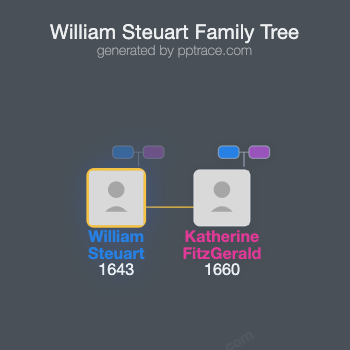
Steuart was married twice. His first wife was The Rt. Hon. and Lady Katherine FitzGerald, Viscountess Grandison, widow of Brigadier-General Hon. Edward FitzGerald-Villiers, and daughter of Sir John Fitzgerald of Dromana House, County Waterford. She died in December 1725. A month later, he married Eliza, daughter of Sir Rowland Alston and Temperance Crew. Neither marriage produced children.
His nephews included Colonel John Steuart of Dublin, Major Charles Stewart, James Steuart (Admiral of the Fleet), and Brigadier-General William Steuart of Ballylane. His brothers included Captain James Steuart, who inherited his land holdings, and Brigadier-General William Steuart, who died in 1736 and has a monument in Bath Abbey.