Lord Charles Cavendish
| Name | Lord Charles Cavendish |
| Title | British politician; (1704-1783) |
| Gender | Male |
| Birthday | 1704-03-17 |
| nationality | Great Britain |
| Source | https://www.wikidata.org/wiki/Q2958710 |
| pptrace | View Family Tree |
| LastUpdate | 2025-11-26T12:21:49.619Z |
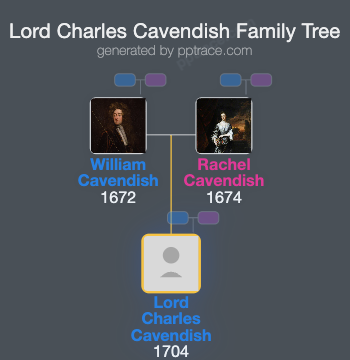
Family Tree
Tap  to expand more relatives
Introduction
Lord Charles Cavendish FRS (17 March 1704 – 28 April 1783) was a British nobleman, politician, and scientist. He was the youngest son of William Cavendish, 2nd Duke of Devonshire, and Rachel Russell.
He married Lady Anne de Grey on 9 January 1727. Lady Anne de Grey was the daughter of Henry Grey, 1st Duke of Kent, and Jemima Grey, his first wife. Lady Anne de Grey died on 20 September 1733. Charles Cavendish and Lady Anne de Grey had two children: Henry Cavendish (1731–1810) and Frederick Cavendish (1733–1812). Henry Cavendish became known for his work in physics and chemistry and is considered one of the most accomplished scientists of his era.
In his political career, Lord Charles Cavendish entered the House of Commons in 1725 representing Heytesbury. He served as a Member of Parliament until 1741, at which point he transferred the management of the family estate in Derbyshire to his nephew, William Cavendish, Marquess of Hartington.
As a scientist, Cavendish was involved in various scientific endeavors. In 1757, the Royal Society awarded him the Copley Medal for his work in developing thermometers capable of recording maximum and minimum temperatures. He also engaged in early electrical research, notably experimenting with the Leyden jar, an electrical storage device that was introduced to England in 1746. His interest in electricity was continued by his son Henry Cavendish, who gained prominence for his own experiments in electrical phenomena. Henry Cavendish is also known for the torsion-balance measurement of the Earth's mass.
One of Lord Charles Cavendish's notable experiments involved attempts to replicate the plasma glow observed in Francis Hauksbee’s experiments. In particular, an experiment during the 1750s involved the use of a semi-vacuum in a friction-generator's glass globe. A recent thesis on plasma arcs references an account by Joseph Priestley concerning Benjamin Wilson's replication of Lord Charles Cavendish's experiment in 1759. Wilson observed a "singular appearance of light" on the surface of mercury (quicksilver) within the evacuated apparatus, which may have been related to cathode spots or plasma phenomena in the experiments.
External references include familysearch.org and scholarly works on plasma science. Media related to Lord Charles Cavendish is available through Wikimedia Commons.