William Pole-Tylney-Long-Wellesley, 4th Earl Of Mornington
| Name | William Pole-Tylney-Long-Wellesley, 4th Earl Of Mornington |
| Title | Anglo-Irish nobleman |
| Gender | Male |
| Birthday | 1788-06-22 |
| nationality | United Kingdom of Great Britain and Ireland |
| Source | https://www.wikidata.org/wiki/Q8016977 |
| pptrace | View Family Tree |
| LastUpdate | 2025-11-26T23:27:35.041Z |
Family Tree
Tap  to expand more relatives
Introduction
William Pole-Tylney-Long-Wellesley, 4th Earl of Mornington, was born on 22 June 1788 in London. He was baptized at St George's, Hanover Square, on 19 July of the same year. His family lineage is rooted in Anglo-Irish aristocracy, with notable ancestors including Henry Colley (or Cowley) of Castle Carbery, King's County, Ireland, who died in 1719. The Colley family emigrated from Rutland, England, during the reign of King Henry VIII, establishing themselves as soldiers and administrators in Ireland. Henry Colley's sister, Elizabeth, married Garret (or Gerald) Wesley I of Dangan, Meath. Their descendant Richard Colley (later Richard Wesley) inherited the Wesley estates in 1728 upon the death of his cousin and adopted the Wesley name, later becoming 1st Baron Mornington in 1746. He married Ann Hill, producing five sons, including Garret Wesley, 1st Earl of Mornington, and William Wesley, who became 1st Marquess Wellesley and served as Governor General of India.
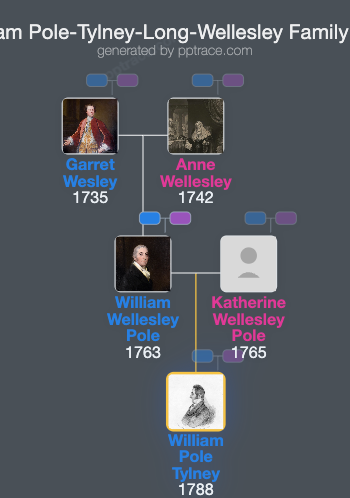
William's paternal grandfather was William Wesley, who inherited the Pole estates from his uncle, William Pole of Ballyfin, in 1778, under the condition that the family adopt the Pole surname. As a result, William Wesley-Pole was born in 1763, establishing the Wellesley family line that would include notable figures like Arthur, Duke of Wellington.
William Pole-Tylney-Long-Wellesley's early life involved a surname change to Wellesley in the early 1790s. On 14 March 1812, he married Catherine Tylney-Long, known as "The Wiltshire Heiress" and reputedly the wealthiest commoner in England. Shortly before their marriage, he assumed the additional surname Tylney-Long by royal license. During this time, he entered politics as a Tory Member of Parliament, representing St Ives from 1812 until 1818, and later Wiltshire, aligning with his wife's influential family.
He held the position of Gentleman Usher to King George IV, appointed on 8 August 1822, a role which provided immunity from debt arrest. His expenses and lifestyle, characterized by dissipation and extravagance, led to mounting debts. In 1822, he began a relationship with Helena Paterson Bligh, the wife of Captain Thomas Bligh of the Coldstream Guards. Helena later became his second wife in 1828 after the death of his first wife in 1825; their marriage was short-lived and tumultuous.
Following his marriage to Helena, Long-Wellesley attempted to manage or exploit his first wife's estate, including the demolition and partition of Wanstead House to settle his debts. He re-entered Parliament briefly in 1830 as a member for St Ives and subsequently for Essex from 1831 to 1832. During this period, he sought custody of his children, who were in the care of his first wife's sisters. His efforts to regain custody led to legal battles; he was imprisoned for contempt of court in July 1831 and invoked parliamentary privilege to avoid further liability, which was ultimately unsuccessful.
In his later years, he lived a dissipated lifestyle and resided in Brussels for some time to evade creditors. From 1842, he was styled Viscount Wellesley, and in 1845, he succeeded his father as the 4th Earl of Mornington. The remainder of his life was marked by financial difficulties, residing on a modest pension of £10 weekly provided by his cousin, Arthur Wellesley, 2nd Duke of Wellington.
William Pole-Tylney-Long-Wellesley died from heart disease on 1 July 1857 in lodgings at Thayer Street, Manchester Square, London. His funeral was held in Kensal Green Cemetery, where his coffin is located in Catacomb B. His life was associated with notable familial prominence and judicial difficulties, with his obituary in the Morning Chronicle noting his life as marked by dissipation and gambling.
References for his biography include the Dictionary of National Biography. Further reading encompasses works such as Tim Couzens' "Hand of Fate" (2001), Cheryl Nicol's "Inheriting the Earth" (2016), Geraldine Roberts' "The Angel & The Cad" (2015), and a dedicated blog to his life and scandals.