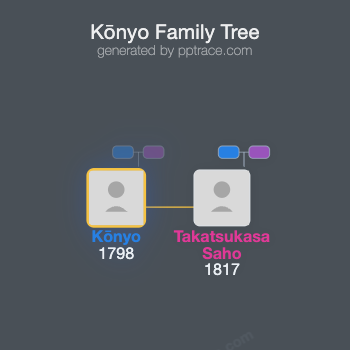
Kōnyo
| Name | Kōnyo |
| Title | (1798-1871) |
| Gender | Male |
| Birthday | 1798-07-14 |
| nationality | Japan |
| Source | https://www.wikidata.org/wiki/Q6605750 |
| pptrace | View Family Tree |
| LastUpdate | 2025-11-17T09:48:09.464Z |
Family Tree
Tap  to expand more relatives
Introduction
Kōnyo (born around 1801, the first year of Kyōwa era) until August 19, 1871, was a monk of the Jōdo Shinshū Hongwanji-ha during the late Edo period. He served as the 20th head priest (Sōke) of the Hongwanji, the head temple of the Nishi Hongwanji branch. His posthumous name was Mitsutsuna, and his temple name was Shinpō-in. He also held the title of Daigōjōshō (Great Ritual Master).
Life and Family Background
Kōnyo was born in 1798 (Kansei 10) as the second son of Bunjun, the abbot of Kenshō-ji located in Kawachi Province (present-day Osaka Prefecture). His biological father was the third son of Hongan-ji’s 18th head, Nōnyo, and thus Bunjun's nephew. Initially, he served as the abbot of Kenshō-ji, but in 1819 (Bunkyū 2), he became the adopted son of the 19th head, Nōnyo. The following year, in 1823 (Bunsei 9), he inherited the position of 20th Sōke. His family had one son and five daughters; among the sons, the fifth son, Kōson (later the 21st Sōke, Myōnyo), is the most well known.
Adoption and Succession
Kōnyo ultimately adopted and succeeded his adopted son, Kōmyō, who became the 21st Sōke. Among the children he raised, there was also a person named Tokujyo. By 1868 (Meiji 1), the three head basins of the priestly halls had been organized. After his death on August 19, 1871 (Meiji 4), Kōson inherited the position as the 21st Sōke.
Political Activities and Religious Influence
Kōnyo was actively involved in the sonnō jōi (revere the Emperor, expel foreigners) movement during the late Edo period. During the turmoil following the arrival of Western ships (Black Ships), he was known as a monk who promoted pro-imperial and anti-foreign sentiments. He appointed the sonnō monk Gesshō, who was from Suō Province, to a senior position and further deepened his allegiance to the imperial court.
In 1863 (Bunkyū 3), he donated 10,000 ryō to the imperial court and issued a document known as the "Go-in Kunenshō" (Imperial Will and Religious Doctrine), which outlined the teachings of the sect. This document emphasized "the imperial law (the emperor's authority) as the core, with benevolence and righteousness as priorities," beliefs which later came to symbolize an alignment with State Shinto.
Additionally, Kōnyo was involved in efforts such as restoring the Tennō Mausoleum at Kameyama, and during the Kinmon Incident (Hamamatsu Gate Incident) in the same year, he sheltered and helped escape dozens of Chōshū Domain samurai who supported the pro-imperial cause, cooperating with the shogunate and the Chōshū Domain. These actions caused the Hongwanji’s pro-imperial stance to attract suspicion from the shogunate, leading Aizu Domain to order the Shinsengumi to station within the temple grounds.
Notes and Related Items
Details regarding Kōnyo—such as source references or information connected with the Shinsengumi and other related events—are based on historical records and research literature.
[Note]
This summary focuses on Kōnyo’s life, family structure, and his political and religious activities. Personal matters or emotional descriptions are omitted.