Austen Chamberlain
| Name | Austen Chamberlain |
| Title | British politician (1863-1937) |
| Gender | Male |
| Birthday | 1863-10-16 |
| nationality | United Kingdom |
| Source | https://www.wikidata.org/wiki/Q188999 |
| pptrace | View Family Tree |
| LastUpdate | 2025-11-26T23:32:19.142Z |
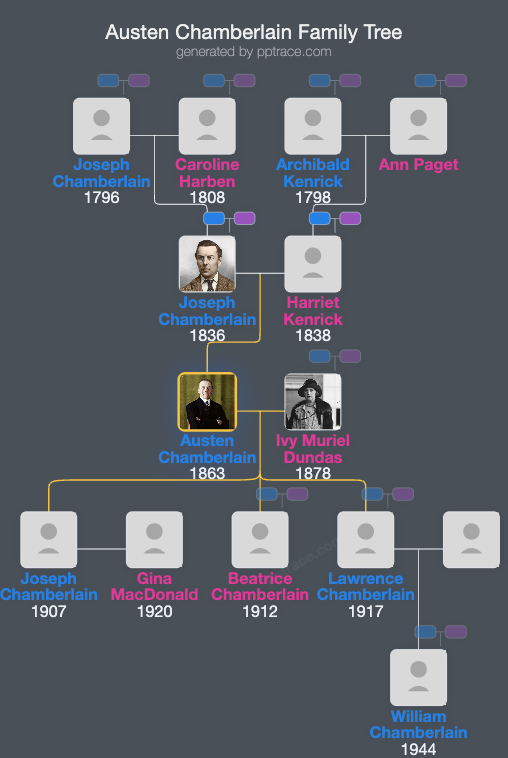
Family Tree
Tap  to expand more relatives
Introduction
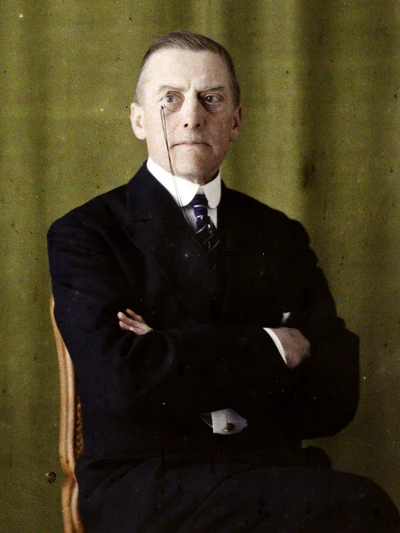
Sir Joseph Austen Chamberlain (16 October 1863 – 16 March 1937) was a British politician, the son of Joseph Chamberlain and the older half-brother of Neville Chamberlain, who served as Prime Minister. He was born in Birmingham and was the second child of Joseph Chamberlain and Harriet Kenrick. Following his mother's death during his birth, his father remarried Florence, with whom he had additional children, including Neville Chamberlain.
Austen Chamberlain was educated at Rugby School and Trinity College, Cambridge. During his university years, he was vice-president of the Cambridge Union and delivered his first political address in 1884. He studied abroad in France at the Paris Institute of Political Studies and in Germany at the University of Berlin. He gained familiarity with European political culture, including meetings with Georges Clemenceau, Alexandre Ribot, and Otto von Bismarck.
He returned to England in 1888 and was elected to Parliament in 1892 as a member of the Liberal Unionist Party for East Worcestershire. His maiden speech was delivered in 1893 and was highly regarded. Austen served in multiple government positions, including Civil Lord of the Admiralty (1895–1900), Financial Secretary to the Treasury (1900–1902), and Postmaster General (1902–1903). In 1903, he became Chancellor of the Exchequer, a position he held until 1905. Following the resignation of his father from the government in 1903, Austen supported his father's tariff reform policies and became a prominent advocate for protectionism after his father's stroke in 1906.
In December 1905, the Unionist government led by Arthur Balfour fell into opposition, and Austen Chamberlain was among the few who maintained parliamentary presence. After the death of his father, Austen took a leading role in tariff reform within the Unionist Party. In late 1911, he was a candidate for the leadership of the Conservative Party but withdrew in favor of Bonar Law to preserve party unity.
During the First World War, Austen Chamberlain returned to government as Secretary of State for India in May 1915 in the coalition government of H. H. Asquith. He resigned from this post later that year due to the failure of the Kut Campaign. He re-entered government as Chancellor of the Exchequer under David Lloyd George, serving from 1919 to 1921. Subsequently, he was the Conservative Party leader in the House of Commons from 1921 to 1922. He resigned after the Carlton Club meeting, which decided to end the coalition with Lloyd George.
From 1924 to 1929, Austen Chamberlain served as Foreign Secretary under Prime Minister Stanley Baldwin. During this tenure, he negotiated the Locarno Treaties of 1925, aimed at preventing war between France and Germany, for which he was awarded the Nobel Peace Prize in 1925. His later roles included First Lord of the Admiralty in 1931, and he remained active in Parliament until his death. In the 1930s, he was among the MPs supporting Winston Churchill's calls for rearmament against German threats.
Austen Chamberlain died on 16 March 1937.