Edward Strachey
| Name | Edward Strachey |
| Title | English man of letters (1812-1901) |
| Gender | Male |
| Birthday | 1812-01-01 |
| nationality | United Kingdom of Great Britain and Ireland |
| Source | https://www.wikidata.org/wiki/Q15712121 |
| pptrace | View Family Tree |
| LastUpdate | 2025-11-28T20:13:18.762Z |
Family Tree
Tap  to expand more relatives
Introduction
Sir Edward Strachey, 3rd Baronet (1812–1901), was an English author and intellectual. He was born on 12 August 1812 at Sutton Court, Chew Magna, Somerset. He was the eldest son of Edward Strachey (1774–1832), who served in the Bengal service of the East India Company. His paternal grandfather was Sir Henry Strachey, 1st Baronet, and his mother was Julia Woodburn, the third daughter of Major-general William Kirkpatrick.
Sir Edward had five brothers: Sir Henry Strachey (1816–1912), who served in the Bengal army; Sir Richard Strachey; William Strachey (1819–1904), associated with the colonial office; Sir John Strachey; and George Strachey, who was a minister at the court of Saxony.
Initially, Sir Edward was prepared for service in the East India Company and was educated at Haileybury. However, he contracted inflammation of the knee-joint when he was about to depart for India, which resulted in him requiring the use of crutches for over twenty years.
In 1836, inspired by the publication "Subscription no Bondage" by F. D. Maurice, Sir Edward sought an introduction through his mother's friend, John Sterling. He requested permission to study with Maurice at Guy's Hospital for university entrance, but his physical condition prevented him from pursuing this plan. Instead, he spent the latter half of 1836 with Maurice at Guy's Hospital, where Maurice became his spiritual adviser.
In 1858, upon the death of his uncle, Sir Henry Strachey, 2nd Baronet, Sir Edward succeeded to the baronetcy and to the Somerset estates. As a landowner, he was actively involved in local governance and public service. He served as a magistrate and deputy-lieutenant, was High Sheriff of Somerset in 1864, and was a poor-law guardian and member of the first Somerset County Council.
Politically, he affiliated with the Liberal Party and expressed admiration for William Ewart Gladstone. Religious views aligned with those of Maurice’s discipleship: he was an Anglican but opposed to High Church doctrines and engaged in biblical criticism.
Sir Edward Strachey died at Sutton Court on 24 September 1901 and was interred in Chew Magna churchyard.
Throughout his life, Sir Edward published several works, including *A Commentary on the Marriage Service* (1843), *Shakespeare's Hamlet: an Attempt to find a Key to a great Moral Problem* (1848), *Hebrew Politics in the Time of Sargon and Sennacherib* (1853; later revised as *Jewish History and Politics*, 1874), *Miracles and Science* (1854), and *Politics Ancient and Modern*, co-authored with F. D. Maurice in *Tracts for Priests* (1861).
He also authored *Talk at a Country House* (1895), which was originally published in the Atlantic Monthly. His editorial work includes editions of Malory's *Morte d'Arthur* (1868, 1891), and he contributed to Richard Garnett’s edition of Thomas Love Peacock’s works, as well as wrote an introduction to Edward Lear’s *Nonsense Songs* (1895).
In 1870, Sir Edward authored a series of articles in the *Daily News*, discussing the proposed Irish Land bill, with material supplied by his acquaintance, Chichester Fortescue. He occasionally translated Persian poetry and wrote articles for periodicals such as *The Spectator* and *Blackwood's Magazine*.
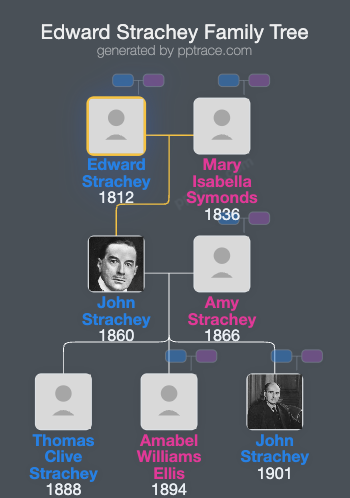
Sir Edward was married twice. His first marriage occurred on 27 August 1844 to Elizabeth Wilkinson, daughter of Reverend W. Wilkinson; she died without children on 11 April 1855. His second marriage was on 3 November 1857 to Mary Isabella Symonds, daughter of John Addington Symonds. Mary died on 5 October 1883, leaving three sons and a daughter. Their children included Edward Strachey, 1st Baron Strachie (1858–1936), John St. Loe Strachey (1860–1927), and Henry Strachey (1863–1940). Their daughter, Frances, married William Henry Cantrell Shaw of Normanton House, Derby, in 1902.