James St. John Jefferyes
| Name | James St. John Jefferyes |
| Title | (1734-1796) |
| Gender | Male |
| Birthday | 1734-01-01 |
| nationality | — |
| Source | https://www.wikidata.org/wiki/Q75261185 |
| pptrace | View Family Tree |
| LastUpdate | 2025-11-26T12:27:01.961Z |
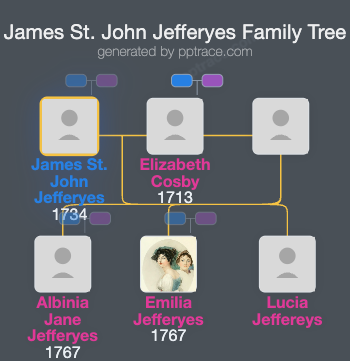
Family Tree
Tap  to expand more relatives
Introduction
James St John Jeffereyes (also recorded as St John Jeffreys) was born in 1734 and died on 14 September 1780. He was an Anglo-Irish individual involved in military, landownership, and political activities during the 18th century.
Jeffereyes was the son of James Jeffreys, a diplomat, and Anne Brodrick. His paternal grandfather was Sir James Jeffreys, and he was also related to St John Brodrick. He began his higher education at Trinity College Dublin on 12 February 1752; however, he did not complete his degree and instead pursued a career in the British Army.
By the year 1766, Jeffereyes had reached the rank of major in the 24th Regiment of Foot. He held the position of Lieutenant-Governor of Cork from 1768 to 1769. His political career included serving as a Member of Parliament in the Irish House of Commons. He represented Midleton from 1758 until 1776, after which he served as the MP for Randalstown from 1776 until his death in 1780. During his time in Parliament, he was known to oppose Richard Boyle, 2nd Earl of Shannon, a prominent local magnate. In 1778, he supported the popery bill, which sought to grant Irish Roman Catholics greater property rights; this was in contrast to Shannon's opposition to the bill.
As a landowner, Jeffereyes is noted for his activities as a reforming landlord on his Blarney Castle estate. During the 1760s and 1770s, he invested over £8,000 in loans to manufacturers and in constructing industrial premises on his estate to promote economic development. His improvements included housing for workers and establishing water-powered facilities for local industries. He offered favorable leases to residents and fostered the growth of textile manufacturing by inviting printers from Dublin to set up operations in his village. By 1776, his estate housed thirteen factories, including a linen tape factory, a tuck mill, and a leather works.
Jeffereyes married Arabella Fitzgibbon, who was the sister of John FitzGibbon, 1st Earl of Clare. The couple had one son, George Jeffreyes, and four daughters. One of his daughters, Mary Anne, was married to George Nugent, 7th Earl of Westmeath; their marriage ended in 1796 amid a scandalous divorce.
This account draws on available historical records relating to his military, political, and landowning pursuits, as well as his familial connections.