Kantarō Suzuki
| Name | Kantarō Suzuki |
| Title | 29th Prime Minister of Japan (1868-1948) |
| Gender | Male |
| Birthday | 1868-01-18 |
| nationality | Japan |
| Source | https://www.wikidata.org/wiki/Q335198 |
| pptrace | View Family Tree |
| LastUpdate | 2025-11-17T10:09:13.089Z |
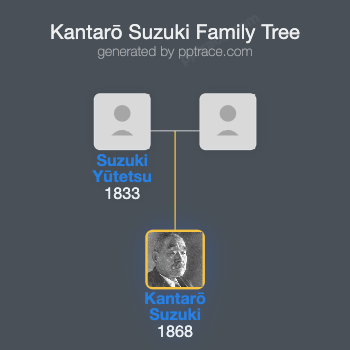
Family Tree
Tap  to expand more relatives
Introduction
Baron Kantarō Suzuki (鈴木 貫太郎) was born on 18 January 1868 in Izumi Province, which corresponds to present-day Sakai, Osaka Prefecture. He was the first son of Suzuki Yoshinori, who served as the daikan (local governor) of Sekiyado Domain. Suzuki was raised in Sekiyado, located in Shimōsa Province, now Noda City in Chiba Prefecture.
Suzuki enrolled in the Imperial Japanese Naval Academy in 1884, entering the 14th class. He graduated in 1887, ranking 13th out of 45 cadets. His early naval service included assignments aboard corvettes Tsukuba and Tenryū, as well as the cruiser Takachiho. Upon receiving his commission as an ensign, he served on the corvette Amagi, cruiser Takao, corvette Jingei, the ironclad Kongō, and the gunboat Maya.
He was promoted to lieutenant on 21 December 1892 and served as chief navigator on several vessels, including Kaimon, Hiei, and Kongō. During the First Sino-Japanese War in 1895, Suzuki commanded a torpedo boat and participated in a night torpedo assault at the Battle of Weihaiwei. Afterward, he graduated from the Naval Staff College in 1898, gaining a reputation as a torpedo warfare expert.
Suzuki was promoted to lieutenant commander on 28 June 1898 and served in various staff roles, including as naval attaché to Germany from 1901 to 1903. He was promoted to commander on 26 September 1903. During the Russo-Japanese War, Suzuki commanded Destroyer Division 2 in 1904, contributing to the Battle of Port Arthur by assisting in rescuing survivors. He also served as executive officer aboard the cruiser Kasuga during the Battle of the Yellow Sea and commanded Destroyer Division 4 under the 2nd Fleet at the Battle of Tsushima, where he helped sink the Russian battleship Navarin.
Promoted to captain on 28 September 1907, Suzuki commanded several ships including the destroyer Akashi, cruiser Soya, battleship Shikishima, and cruiser Tsukuba between 1908 and 1912. He was promoted to rear admiral on 23 May 1913 and commanded the Maizuru Naval District. He served as Vice Minister of the Navy from 1914 to 1917 during World War I.
In June 1917, Suzuki was promoted to vice admiral and participated in the deployment of cruisers Asama and Iwate to San Francisco in 1918, along with 1,000 cadets, under U.S. Navy Rear Admiral William Fullam. He subsequently served as Commandant of the Imperial Japanese Naval Academy and commanded the 2nd and 3rd Fleets, as well as the Kure Naval District. Suzuki reached the rank of full admiral on 3 August 1923 and became Commander-in-Chief of the Combined Fleet in 1924.
Between 1925 and 1929, Suzuki served as Chief of the Imperial Japanese Navy General Staff. He retired from active service but continued to hold influential positions, including Privy Councillor and Grand Chamberlain from 1929 to 1936. In 1936, he narrowly escaped assassination during the February 26 Incident; an assailant's bullet remained lodged in his body until his cremation, only revealed posthumously.
Suzuki held the peerage of Baron from 20 November 1936. Throughout his career, he received numerous honors, including the Grand Cordon of the Order of the Rising Sun, the Order of the Sacred Treasure, and the Order of the Golden Kite.
During World War II, Suzuki opposed Japan's war against the United States. He was appointed as Prime Minister on 7 April 1945 following the resignation of Kuniaki Koiso, holding office until 17 August 1945. As Prime Minister, he served as Minister for Foreign Affairs and for Greater East Asia, and was involved in final negotiations leading to Japan's surrender. He attended a significant conference where Emperor Hirohito decided to accept unconditional surrender. Following Japan's surrender, Suzuki resigned, and Prince Higashikuni became Prime Minister. He then served as Chairman of the Privy Council from December 1945 until June 1946. Suzuki died of cancer on 17 April 1948 in Noda, Chiba Prefecture. His cremated remains are interred in his hometown.