Lord Dudley Stuart
| Name | Lord Dudley Stuart |
| Title | British politician |
| Gender | Male |
| Birthday | 1803-01-11 |
| nationality | United Kingdom of Great Britain and Ireland |
| Source | https://www.wikidata.org/wiki/Q6679196 |
| pptrace | View Family Tree |
| LastUpdate | 2025-11-26T23:22:57.882Z |
Family Tree
Tap  to expand more relatives
Introduction
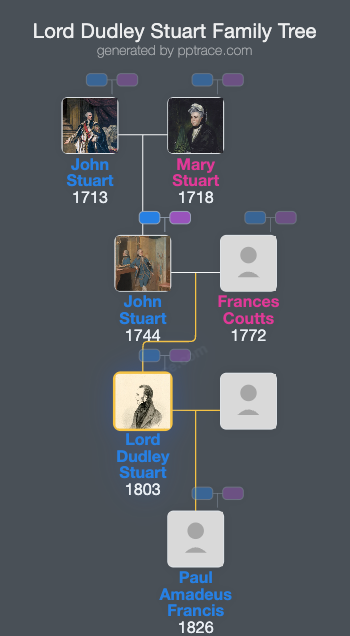
Lord Dudley Coutts Stuart was born on 11 January 1803 in London and died on 17 November 1854 in Stockholm. He was a British politician and the youngest son of John Stuart, 1st Marquess of Bute, and his second wife, Frances Coutts. Frances Coutts was the daughter of the banker Thomas Coutts.
In 1820, Stuart was admitted to Christ Church, Oxford. On 20 July 1824, he married Princess Christine Bonaparte (1798–1847), who was the daughter of Lucien Bonaparte by his first wife, Christine Boyer. Princess Christine Bonaparte was also the sister of Princess Gabrielli. Stuart and Christine Bonaparte had one son, Paul Amadeus Francis Coutts Stuart, who died unmarried in 1889.
Stuart was a member of the Whittington Club and served as vice-president and later president of the Literary Association of the Friends of Poland. Politically, he was associated with the Whig party and later identified with the Liberal party. He was an advocate for Polish independence and expressed general sympathy for the causes of Eastern European peoples against Russian influence. Among his diplomatic activities related to Polish affairs, he received Lajos Kossuth in England following Kossuth's exile from Hungary.
An anecdote involving Stuart was recounted by Richard Cobden in 1857. According to this account, Stuart traveled to Southampton to meet Kossuth upon his arrival in England after imprisonment in Turkey. Stuart’s enthusiasm led him to visit Lord Palmerston at Broadlands and to request that Kossuth visit Palmerston. However, Kossuth declined the invitation, not wishing to meet Palmerston. Stuart then asked Cobden to influence Kossuth to change his mind, but Cobden explained that Kossuth was already acquainted with Palmerston and preferred not to meet him.
In 1853, Stuart publicly critiqued the Metropolitan Police, advocating for a reduction in its strength.
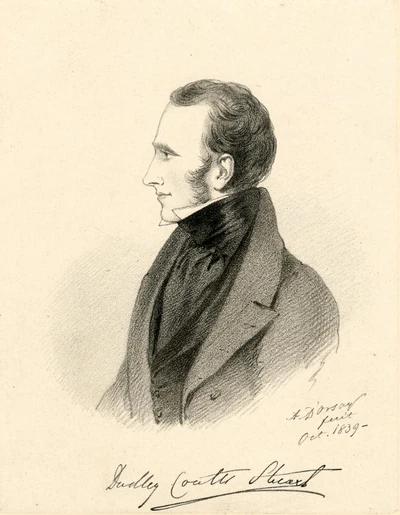
References to Stuart’s parliamentary contributions are documented in Hansard from 1803 to 2005. Additional information and imagery, including a 1848 print of Stuart by Sabina Karnicka, are available at the Museum of Warsaw.