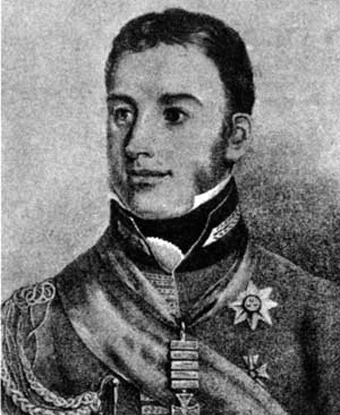
Edward Pakenham
| Name | Edward Pakenham |
| Title | British general and politician (1778-1815) |
| Gender | Male |
| Birthday | 1778-03-19 |
| nationality | United Kingdom of Great Britain and Ireland |
| Source | https://www.wikidata.org/wiki/Q1293005 |
| pptrace | View Family Tree |
| LastUpdate | 2025-11-26T23:27:41.941Z |
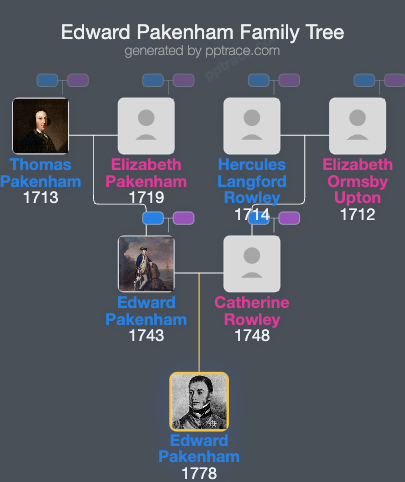
Family Tree
Tap  to expand more relatives
Introduction
Major-General Sir Edward Michael Pakenham (19 March 1778 – 8 January 1815) was a British Army officer and politician. He was the son of Edward Pakenham, 2nd Baron Longford, and Catherine Rowley. Pakenham was born at Pakenham Hall, located in County Westmeath, Ireland, which is present-day Tullynally Castle. His education was at The Royal School, Armagh. His family purchased his commission as a lieutenant in the 92nd Regiment of Foot when he was sixteen years old.
Between 1799 and 1800, Pakenham served as a representative for Longford Borough in the Irish House of Commons. His military service began during the 1798 Rebellion in Ireland, where he fought with the 23rd Light Dragoons against the French. His early postings included service in Nova Scotia, Barbados, and Saint Croix; in 1803, he led an attack on Saint Lucia and was wounded. He participated in the Battle of Copenhagen in 1807 during the Danish campaign and fought in Martinique against the French Empire, receiving further wounds.
In 1806, his sister Catherine married Arthur Wellesley, who later became the Duke of Wellington. Pakenham joined Wellington in the Peninsular War as adjutant-general, commanding a regiment in the Battle of Bussaco in 1810, and fighting at Fuentes de Oñoro in 1811 to defend the fortress of Almeida. In 1812, he commanded the Third Division at Salamanca and was recognized for his contributions during the campaign. He received the Army Gold Cross with clasps for participating in multiple battles, including Martinique, Bussaco, Fuentes de Oñoro, Salamanca, the Pyrenees, Nivelle, Nive, Orthez, and Toulouse.
During the War of 1812, Pakenham was promoted to major general and took command of British forces in North America after the death of General Robert Ross at the Battle of North Point near Baltimore in September 1814. His primary objective was to capture New Orleans, as part of the Louisiana Campaign initiated by Vice Admiral Cochrane, who believed controlling New Orleans would weaken American resolve and influence the legality of the Louisiana Purchase. By winter 1814, an expeditionary force of approximately 8,000 troops under Pakenham arrived on the Gulf Coast.
Although a ceasefire known as the Treaty of Ghent was signed on 24 December 1814, ratification was pending, so the war persisted until the news reached the combatants in February 1815. The campaign included a reconnaissance-in-force on 28 December, designed to assess defenses along Line Jackson. Pakenham decided to withdraw after observing the left flank collapse during this operation.
In early January 1815, Pakenham’s forces arrived at New Orleans and commenced an artillery bombardment on the American defenses. The Americans responded with an artillery exchange that lasted three hours. Pakenham developed a detailed plan that divided his troops into four brigades for an attack across different sections of the American line. However, the initial assault was compromised when Colonel Thomas Mullins' 44th Foot failed to secure the necessary fascines and ladders due to a misidentification during the night. This prevented the British from scaling the American earthworks effectively.
On the morning of 8 January, Pakenham led the assault personally. During the attack, he was wounded multiple times: first, he was struck in the left knee by grapeshot, then in the right arm. After mounting a horse to rally his troops, he was fatally wounded by a second volley of grapeshot to the spine and was carried off the battlefield on a stretcher. He was 36 years old at the time of his death. His reported last words directed Major Duncan MacDougall to inform General John Lambert to assume command and send forward reserves.
The British attack on the American defenses resulted in a defeat for the British forces, with heavy casualties. Wellington expressed regret over Pakenham’s death, acknowledging his service and noting the circumstances of the campaign.