Parsley Peel
| Name | Parsley Peel |
| Title | British businessman (1723–1795) |
| Gender | Male |
| Birthday | 1723-01-01 |
| nationality | — |
| Source | https://www.wikidata.org/wiki/Q16859468 |
| pptrace | View Family Tree |
| LastUpdate | 2024-09-12T18:16:20Z |
Family Tree
Tap  to expand more relatives
Introduction
Robert "Parsley" Peel (1723 – 12 September 1795) was a British merchant and calico printer. He was born in 1723 at Peele Fold in Oswaldtwistle, Lancashire, to William Peel and Jane Anne Walmsley. His family traditionally engaged in yeoman farming; however, his grandfather, also named Robert Peel, shifted the family business to woollen cloth manufacturing.
Peel's father, William Peel, attempted to restore the family to agriculture after inheriting the family woollen cloth business. Following his education at Blackburn Grammar School, William Peel initially joined his father's wool manufacturing enterprise. He inherited woodblocks previously used by his grandfather for wool printing and began experimenting with them.
In 1750, with financial backing from William Yates—a local public house landlord—William Peel collaborated with his brother-in-law, Jonathan Haworth, who had trained as a calico printer in London. Together, they established Haworth, Peel and Yates, comprising a factory in Blackburn and a warehouse in Manchester. During this period, Robert Peel had dropped the final 'e' from his surname, reasoning that it was unnecessary as it did not affect pronunciation.
Peel gained a reputation for innovating within the textile industry, being among the first to employ carding cylinders. He conducted experiments at his residence, which family tradition attributes to a young daughter named Anne bringing him a sprig of parsley and suggesting it for a fabric pattern. Peel etched the parsley design onto a pewter plate for printing; this method involved finishing the print with an iron by a household member. Alternative accounts suggest the experiments occurred either at Peel's farm or his house in Fish Lane, with involvement from a neighbor, Mrs. Milton, who finished the cloth. The precise technical innovation remains uncertain but likely involved the use of acetate of lead as a dye-fixer or metal engraving methods. The pattern, named "Nancy's pattern" after Peel's daughter, became highly popular. As a result, Robert Peel earned the nickname "Parsley Peel." His company became one of the pioneering calico printers in Lancashire.
Peel also collaborated with weaver James Hargreaves on new textile technologies. In 1762, they established a carding machine but did not adopt it immediately. When Hargreaves invented the spinning jenny in 1764, Peel was eager to implement this technology. They set up a factory at Stanhill where Hargreaves worked. In 1768, Peel's spinning jennies faced destruction during riots, which also damaged some of Peel's inventions. Following this incident, Peel relocated his manufacturing operations to Burton-upon-Trent, where he built three mills, including one served by Peel's Cut, a canal he constructed.
In 1779, Peel's mill in Altham was targeted during riots specifically against machinery, including carding machines and spinning jennies. Peel regarded this destruction as an opportunity to adopt Richard Arkwright's water frame (carding engine), which eventually became central to his operations. By 1795, Peel & Co., his family’s manufacturing firm, had expanded to encompass 23 mills across northwest England, making it the largest in the cotton industry at the time.
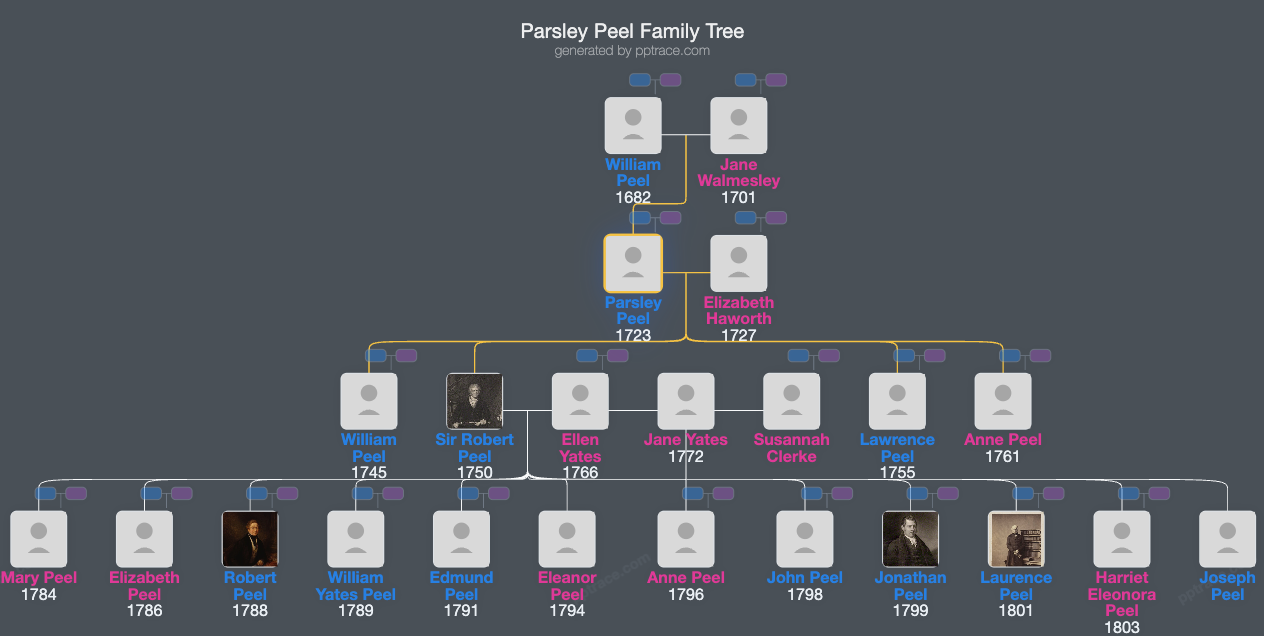
Peel was married to Elizabeth Haworth on 28 August 1744. They had eight children, notably Sir Robert Peel, 1st Baronet, who continued the family business. His grandson, Sir Robert Peel, 2nd Baronet, became a prominent British Prime Minister and is recognized for shaping the modern police service.
Physically described as a tall, robust man with reddish hair, Peel was considered cautious and shrewd. He aimed for social mobility for his children, although he did not expect to rise himself. Notable figures such as John Wesley commented on his ascension from modest beginnings to considerable wealth through industry. In 1794, Peel was granted a coat of arms featuring a shuttle held by a lion, with a bee symbolizing industriousness, and adopted the family motto "Industria."
Later in life, Peel relied increasingly on a cane. He spent his final days in Ardwick Green near his daughter’s residence. He died on 12 September 1795 and was buried at St. John's Church in Manchester. His wife survived him by six months. His estate was divided equally among his eight children, valued at approximately £13,000 at the time, equivalent to about £1.1 million in 2013 currency.