Mabel Digby
| Name | Mabel Digby |
| Title | Anglo-Irish noblewoman |
| Gender | Female |
| Birthday | — |
| nationality | — |
| Source | https://www.wikidata.org/wiki/Q6721430 |
| pptrace | View Family Tree |
| LastUpdate | 2025-11-26T13:08:14.792Z |
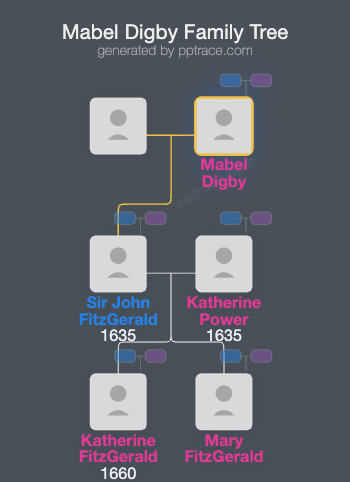
Family Tree
Tap  to expand more relatives
Introduction
Mabel Digby, Lady of Dromana and Decies, was an Anglo-Irish noblewoman whose birth and death dates are not documented. She was the eldest daughter of Sir Robert Digby and Lettice FitzGerald, the 1st Baroness Offaly. Her family was prominent among the Anglo-Irish aristocracy, with her father Sir Robert Digby and her mother Lettice FitzGerald holding notable titles and positions. Mabel was born in Coleshill, Warwickshire, England, sometime after 1598, and was one of ten children in her family. Her siblings included Robert Digby, 1st Baron Digby, and Essex Digby, who served as Bishop of Dromore.
Mabel Digby entered into marriage with Sir Gerald FitzGerald, Lord of Dromana and Decies, though the exact date of their union is unknown. Sir Gerald was the son of Sir John Og FitzGerald and Elinor Butler. Descriptions of Mabel characterize her as being "suitably English and Protestant," and accounts note that she had a significant influence over her husband. Together, they resided primarily at Dromana Castle in County Waterford. The marriage produced three children: Sir John FitzGerald, who succeeded in the Dromana estate and died on 1 March 1664; a daughter who married Sir Richard Franklyn, a Parliamentarian major in Cromwell’s army; and another daughter whose name is not recorded. Sir John FitzGerald married twice, first to Katherine Le Poer, with whom he had an only daughter, Katherine FitzGerald, Viscountess Grandison, and second to Helen McCarthy.
Following the death of her first husband on 6 August 1643, Mabel married Donagh O'Brien of Arragh. Details of her second marriage remain sparse.
During the Irish rebellion of 1641, which began in Ulster on 23 October and spread to County Waterford by December, Mabel Digby displayed open sympathy towards the Irish rebels. Despite her husband's support for the English Crown, Mabel’s actions reflect her alignment with the Irish resistance. In 1642, she hosted and visibly supported the rebels at Dromana Castle by serving food and drink, including beef, mutton, bread, and beer. In September of that year, she reportedly handed over Dromana Castle to the rebels. However, shortly thereafter, the castle was besieged by English forces and was captured.
The fate of Mabel Digby after these events is not recorded; her date of death remains unknown. Her grandson, Katherine, inherited the Dromana estate after the death of her only son in 1664. The FitzGerald family managed to retain their estates through the tumultuous period of the Cromwellian settlements, largely due to their Protestant faith and the influence of her daughter’s marriage to Richard Franklyn, who served as a major in Oliver Cromwell's army and was sympathetic to the Parliamentarian cause.