Anthony Armistead
| Name | Anthony Armistead |
| Title | Virginia colonial person |
| Gender | Male |
| Birthday | 1645-01-01 |
| nationality | United States of America |
| Source | https://www.wikidata.org/wiki/Q4772013 |
| pptrace | View Family Tree |
| LastUpdate | 2025-11-16T10:08:58.279Z |
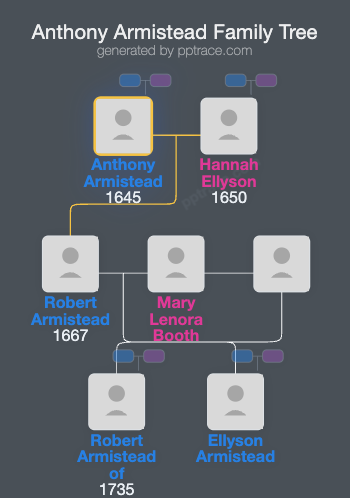
Family Tree
Tap  to expand more relatives
Introduction
Captain Anthony Armistead (circa 1645 – before 1705) was a colonial figure in Virginia, known for his roles as a planter, militia officer, politician, and Justice of the Peace within the Colony and Dominion of Virginia under British rule. His activities included participation in judicial proceedings following Bacon's Rebellion in 1676, multiple terms as a member of the House of Burgesses representing Elizabeth City County, and contributions to the political and economic development of his family in Tidewater Virginia.
Early and Family Life
Anthony Armistead was the youngest of three sons born to William Armistead and his wife Anne, both of whom emigrated from Yorkshire, England to Elizabeth City County, Virginia, in the 1730s. He was named after his English grandfather. William Armistead demonstrated strategic skill in acquiring land and influence through marriage alliances and land acquisitions. Anthony's elder brother, John Armistead, achieved prominence by serving on the Virginia Governor's Council.
Anthony Armistead married Hannah Ellyson, daughter of Dr. Robert Ellyson of James City County. Dr. Ellyson was a burgess and a confidante of Governor Sir William Berkeley. The family produced several notable children, including:
- Lieutenant Colonel Anthony Armistead Jr., who also served in the House of Burgesses.
- Captain Robert Armistead.
- Major William Armistead, married to Hannah Hines and others.
- Judith Armistead, who married John West III.
- Hannah Armistead, who married William Shelton.
Career and Public Service
By the mid-1670s, Anthony Armistead had established himself as a member of the Elizabeth City County Court, which administered county governance and judicial functions. He also held the rank of captain in the county militia. During Bacon's Rebellion of 1676, he supported Governor William Berkeley and participated in a court-martial that condemned a rebel to death by hanging.
In the political arena, Armistead was first elected as a representative from Elizabeth City County to the Virginia House of Burgesses during the legislative session of 1680-1682. His initial committee assignment was to Public Claims. He was reelected in 1693, during which time he introduced his first legislative bill concerning the regulation of tanners; however, this bill did not pass. After a period of absence from the assembly, he served continuously from 1696 to 1700, mostly on the Committee of Propositions and Grievances, which was responsible for addressing issues within the colony. In 1700, he was appointed to a committee tasked with revising Virginia's legal code, a revision that was enacted posthumously in 1705. Despite his political involvement, records indicate he was reprimanded for lapses in attendance, suggesting sporadic participation in legislative sessions.
Death and Legacy
Anthony Armistead died in Williamsburg during the legislative session that commenced on April 17, 1705. The House of Burgesses requested the governor to issue a warrant for a special election to elect a successor from Elizabeth City County on May 2, 1705. His legacy extended through his children, at least two of whom served as burgesses, along with a son-in-law who also held legislative office, indicating the prominence of the Armistead family in Virginia's political sphere during the colonial period.