Empress Wanrong
| Name | Empress Wanrong |
| Title | wife of Puyi, Empress of China (1906-1946) |
| Gender | Female |
| Birthday | 1906-11-13 |
| nationality | Qing dynasty |
| Source | https://www.wikidata.org/wiki/Q464563 |
| pptrace | View Family Tree |
| LastUpdate | 2025-10-25T11:24:08.382Z |
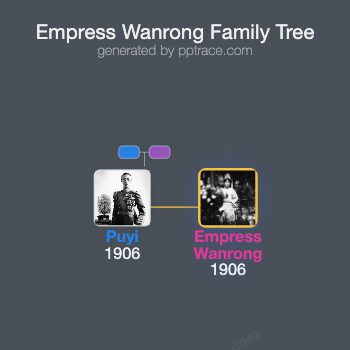
Family Tree
Tap  to expand more relatives
YouTube
Introduction
Wanrong (Chinese: 婉容), born on 13 November 1906, was a member of the Gobulo clan of the Manchu Plain White Banner. She was of Daur ancestry and was born in Beijing near Di'anmen in the Dongcheng District. Her father was Rongyuan, who served in the Qing imperial administration until the 1911 Revolution, and her biological mother was Aisin-Gioro Hengxin, who died when Wanrong was two years old. After her mother's death, Wanrong was raised by her stepmother, Aisin-Gioro Hengxiang. She had a brother named Runliang and a half-brother named Runqi. The family lived in Mao Er hutong in Beijing.
Wanrong received an education comparable to her brothers, attending an American missionary school in Tianjin. Her father believed in gender equality in education, which was uncommon at the time. Her early life was spent in the context of a China transitioning from imperial rule to a republic, following the overthrow of the Qing dynasty in 1912.
In 1922, Wanrong married Puyi, the last emperor of China. The marriage was arranged during the period when Puyi was residing in the Forbidden City as a deposed emperor. Puyi, then 16 years old, initially intended to marry Wenxiu, a 12-year-old girl, but due to opposition from the dowager consort Jin, Wanrong was selected as his wife. She moved to Beijing from her home to prepare for the marriage, which involved traditional palace ceremonies, including stepping over fire, a saddle, and an apple, in accordance with Manchu traditions.
Wanrong became empress consort in 1922 and resided in the Forbidden City. She had her own kitchen, and her daily routines included reading, playing the piano, writing poetry, practicing painting, and engaging with Western culture, including the study of English. She was also known to detach herself from palace protocol by engaging in Western customs like eating with a knife and fork.
Her marriage to Puyi was reportedly unhappy, and she perceived Wenxiu, Puyi's other consort, as a rival. Wanrong maintained personal relationships and kept a diary expressing her feelings of loneliness and discontent. She was also a heavy smoker, eventually addicted to opium, initially prescribed for medical reasons but later used recreationally.
Following the 1924 coup led by Feng Yuxiang, Wanrong and Puyi were exiled from the Forbidden City. They moved to the Prince Chun Mansion in Beijing and later to Tianjin in 1925, residing in the Zhang Garden and later the Jing Garden within the Japanese concession. In Tianjin, Wanrong’s lifestyle included social outings, theater, shopping, and horseback riding. She kept a diary detailing her personal frustrations, health issues, and her perceived neglect by Puyi, especially after Wenxiu's departure.
In late 1931, Puyi became involved with the Japanese-controlled puppet state of Manchukuo. Wanrong was brought to meet Puyi in Manchuria, and they moved to Dalian and subsequently to Xinjing (Changchun). In 1934, Puyi was proclaimed emperor of Manchukuo, and Wanrong was installed as empress. She participated in state ceremonies and was introduced to drawing, music, and tennis during this period.
Wanrong's relationship with Puyi deteriorated further during her time in Manchukuo. She engaged in secret affairs with aides due to her loneliness, and she developed a severe opium addiction, consuming large quantities regularly. She also suffered from mental health issues, including hallucinations.
She gave birth to an illegitimate daughter, who was reportedly killed at birth, although accounts vary. Wanrong's health declined due to her addiction, and her behavior became increasingly unstable. She was confined to her quarters and subjected to shackling at times to prevent her movement. Her appearance deteriorated, with discolored teeth, emaciation, and hair loss.
In August 1945, during the Soviet invasion of Manchuria, Wanrong and others attempted to flee, but she was captured by Chinese Communist forces. She was later held in prison in Yanji, Jilin. During her imprisonment, she experienced hallucinations, suffered from malnutrition and opium withdrawal, and was reportedly displayed as a spectacle by prison guards. Wanrong died on 20 June 1946 at the age of 39 in Yanji, from the effects of malnutrition and withdrawal. Her remains were never officially recovered; her place of burial remains unknown, although her brother conducted a ritual burial at the Western Qing tombs on 23 October 2006.
Wanrong was posthumously titled Empress Xiaokemin. She was portrayed in media, notably by Joan Chen in Bernardo Bertolucci's 1987 film "The Last Emperor." Her life story includes honors such as the Grand Order of the Orchid Blossom and the Order of the Precious Crown awarded by Manchukuo and Japan, respectively.