Ronald Reagan
| Name | Ronald Reagan |
| Title | president of the United States from 1981 to 1989 and actor |
| Gender | Male |
| Birthday | 1911-02-06 |
| nationality | United States of America |
| Source | https://www.wikidata.org/wiki/Q9960 |
| pptrace | View Family Tree |
| LastUpdate | 2025-11-17T06:45:50.296Z |
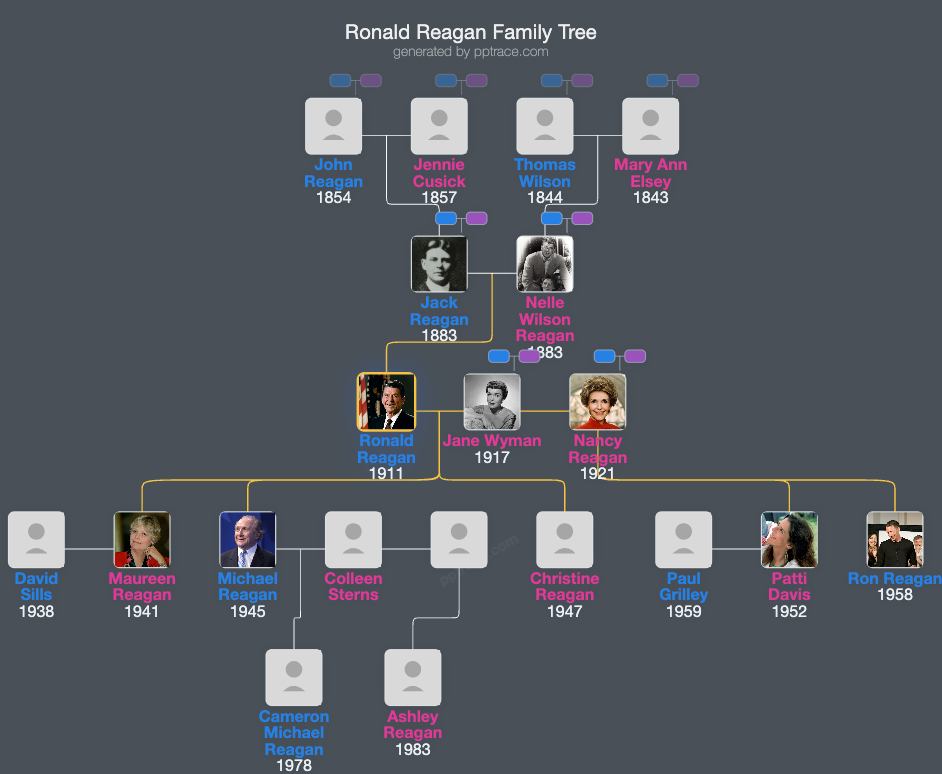
Family Tree
Tap  to expand more relatives
Introduction
Ronald Wilson Reagan was born on February 6, 1911, in an apartment in Tampico, Illinois. His parents were Nelle Clyde Wilson and Jack Reagan. Nelle was involved in the Disciples of Christ and was active in prayer meetings; she influenced Reagan's Christian faith. Jack Reagan was primarily focused on earning money to support the family, but struggled with alcoholism. Reagan had an older brother named Neil. The family lived in various locations, including Chicago, Galesburg, Monmouth, and eventually settled in Dixon, Illinois, in 1920.
Reagan attended Dixon High School, where he developed interests in drama and football. His first job was as a lifeguard at Lowell Park on the Rock River. In 1928, he enrolled at Eureka College, a liberal arts institution affiliated with the Disciples of Christ. While at Eureka, he was a mediocre student but active in cheerleading, sports, drama, and campus politics. He served as student body president and participated in a student strike that led to the resignation of the college president. He was initiated into Tau Kappa Epsilon fraternity, serving as chapter president, and played as a guard for the Eureka Red Devils football team in 1930 and 1931. During his college years, Reagan was noted for inviting Black teammates to his home, reflecting his family's progressive stance on racial issues at that time.
After graduating from Eureka College with a Bachelor of Arts degree in economics and sociology in 1932, Reagan worked as a sports broadcaster in Davenport, Iowa, covering Big Ten Conference football games. He later worked for WHO radio in Des Moines as a broadcaster for the Chicago Cubs. In this role, he was known for creating play-by-play descriptions and often expressed opposition to racism.
In 1936, Reagan traveled with the Chicago Cubs to spring training in California and took a screen test, which led to a seven-year contract with Warner Bros. He moved to Hollywood in 1937, making his film debut in "Love Is on the Air." Over the next several years, he appeared in approximately thirty films, primarily B movies. Notable early roles included George Gipp in "Knute Rockne, All American" (1940), which later became associated with his nickname "the Gipper," and the role of a leg amputee in "Kings Row" (1942). His popularity peaked during this period, with Gallup polls placing him among the top 100 stars.
During World War II, Reagan's acting career was interrupted. He enlisted in the United States Army Reserve in April 1937, serving initially as a private in the 322nd Cavalry Regiment and later as a second lieutenant in the Officers Reserve Corps. With the worsening relations between the U.S. and Japan, he was called to active duty in 1942 and assigned to the United States Army Air Forces as a public relations officer. He received over 400 training films during his service and was discharged as a captain on December 9, 1945.
Reagan also served as president of the Screen Actors Guild twice, first from 1947 to 1952 and again from 1959 to 1960. In the 1950s, he hosted "General Electric Theater" and worked as a motivational speaker for General Electric.
In the political arena, Reagan's 1964 speech "A Time for Choosing" marked his emergence as a leading conservative figure. He was elected governor of California in 1966, where he increased taxes, turned a budget deficit into a surplus, and managed university protests with strict methods.
In 1976, Reagan was the Republican candidate for president but lost in the primaries to Gerald Ford. He secured the Republican nomination in 1980 and defeated incumbent President Jimmy Carter in the general election. He served two terms as President of the United States from 1981 to 1989. His policies included economic deregulation ("Reaganomics"), tax cuts, increased military spending, and a hardline stance against the Soviet Union. His presidency saw significant foreign policy initiatives, including escalating the arms race, engaging in negotiations with Mikhail Gorbachev, and the signing of the Intermediate-Range Nuclear Forces Treaty.
Reagan survived an assassination attempt during his presidency. His second term included foreign military interventions, such as the 1986 bombing of Libya and the illegal arms sale to Iran to fund Nicaraguan Contra rebels. His administration contributed to the end of the Cold War.
He left office in 1989, with the U.S. economy experiencing low inflation, reduced unemployment, and the longest peacetime economic expansion at that time. Despite domestic spending cuts, the national debt had nearly tripled due to tax cuts and military expenditures. After presidency, Reagan intended to remain active publicly but was diagnosed with Alzheimer's disease in 1994. His health declined gradually until his death in 2004.