Yi Un
| Name | Yi Un |
| Title | former Crown Prince of Korea |
| Gender | Male |
| Birthday | 1897-10-20 |
| nationality | Q28233 |
| Source | https://www.wikidata.org/wiki/Q484866 |
| pptrace | View Family Tree |
| LastUpdate | 2025-11-17T10:09:25.169Z |
Introduction
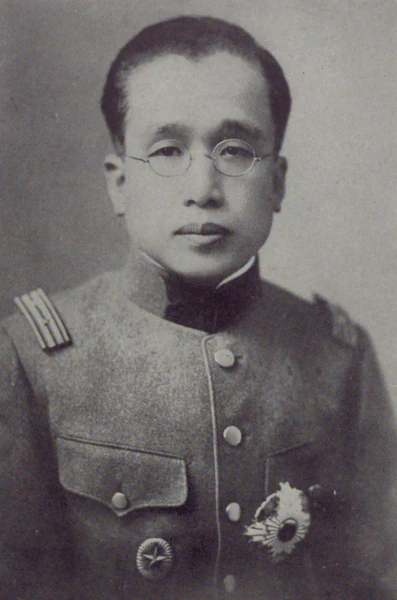
Yi Un (Korean: 이은; born 20 October 1897, died 1 May 1970) was a member of the Korean royal family and held several notable titles throughout his lifetime. He was the 28th Head of the Korean Imperial House and the last Imperial Crown Prince of the Korean Empire. His early life was centered in Seoul, where he was born at Deoksugung Palace. He was the seventh son of Gojong, the Gwangmu Emperor, and his mother was Princess Consort Eom Seon-yeong, a palace attendant who was posthumously titled Princess Sunheon. Yi Un was also the younger half-brother of Emperor Sunjong and Prince Imperial Ui.
In 1900, he was granted the title Prince Imperial Yeong (영친왕). Following Korea's annexation by Japan in 1910, the imperial family’s status was effectively dissolved, with Emperor Sunjong forced to abdicate. In 1907, Yi Un became the heir apparent to Sunjong. In April 1920, he married Princess Masako of Nashimoto, the eldest daughter of Prince Nashimoto Morimasa, in Tokyo.
On 10 June 1926, after the death of Emperor Sunjong, Yi Un inherited the late emperor's titles and was known as King Yi of Changdeokgung. He attained the rank of Lieutenant General in the Imperial Japanese Army, serving in various capacity and commands, including leading Japanese forces in China and serving on the Supreme War Council. His military career included graduation from the Imperial Japanese Army Academy in 1917, promotions through the ranks, and service on the staff of the Imperial Japanese Army General Staff and the Chosen Army.
His military activities expanded across various regions, including northern China and Manchukuo, during the Second Sino-Japanese War and World War II. In August 1938, he was promoted to major general and later became a lieutenant general in December 1942. He commanded units such as the IJA 51st Division and served on the Supreme War Council in April 1945.
Following Japan's surrender in World War II, Yi Un was stripped of his royal status under the American occupation in 1947, and his Japanese titles were revoked by the post-war Japanese constitution. He was declared stateless after Korea achieved independence, as Korea's government refused him permission to return. He acquired Japanese citizenship in May 1947 and traveled to the United States.
While in the United States, Yi Un suffered a stroke in March 1959 and subsequently returned to Japan in May of that year. Despite multiple attempts by Korean authorities to allow his return, permission was denied until November 1963, when President Park Chung Hee permitted him and Crown Princess Bangja to go back to Korea. By that time, his health was in decline due to cerebral thrombosis. He lived at Nakseon Hall within Changdeok Palace and passed away there on 1 May 1970. His remains are interred at Hongreung in Namyangju, near Seoul.
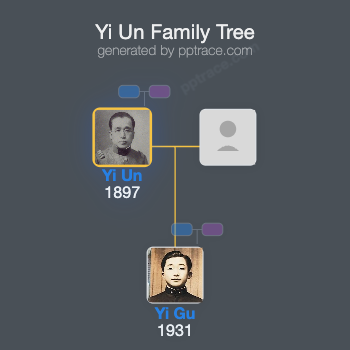
Yi Un had two children: Yi Jin (born 1921, died in infancy in 1922) and Yi Gu (born 1931, died in 2005). Yi Gu succeeded as the 29th Head of the Korean Imperial Household and married Julia Mullock, an American citizen, with whom he adopted a daughter.
His honors include the Grand Cordon of the Order of the Golden Ruler of Korea (1900), the Grand Cordon of the Order of the Rising Sun with Paulownia Flowers (Japan, 1907), the Grand Cross of the Order of the Dannebrog (Denmark, 1927), the Commander Grand Cross of the Order of Vasa (Sweden, 1927), and the Grand Cross of the Order of the White Lion (Czechoslovakia, 1927).
Posthumously, Yi Un is known as Yi Un, Crown Prince Euimin of Korea. His spirit tablet was placed in Jongmyo shrine in 1973. His former residence, Kitashirakawa Palace in Tokyo, was transformed into the Akasaka Prince Hotel after World War II, and more recently, it became part of Tokyo Garden Terrace Kioicho.
Family Tree
Tap  to expand more relatives