Gao Bin
| Name | Gao Bin |
| Title | Qing dynasty politician, died 1755 |
| Gender | Male |
| Birthday | 1683-00-00 |
| nationality | Qing dynasty |
| Source | https://www.wikidata.org/wiki/Q7772911 |
| pptrace | View Family Tree |
| LastUpdate | 2025-10-27T02:31:44.913Z |
Family Tree
Tap  to expand more relatives
Introduction
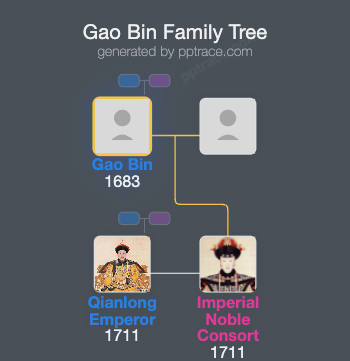
Gao Bin (1683–1755), courtesy name Youwen, sobriquet Dongxuan, was born in Liaoyang. His ancestors belonged to the Inner Court Bannerman (Neiwu Fu Xiang Huangqi Bangyi), later transferred to Manchu Bannermen of the Xiang Huang banner, with family records noting the change to the Gaojia clan. Gao Bin was a statesman of the Qing Dynasty, serving as Minister of Personnel, Grand Governor of Waterways, and Grand Academician of Wen Yuan Ge; he was posthumously awarded the posthumous title Wending. His eldest daughter was Imperial Noble Consort Hui-xian, his only son was Gao Heng, and his nephew was Gao Jin.
He initially resided in Liaoyang. As an adult, he studied with his mother. At age 10, he lost both parents and thereafter lived with his mother while continuing his studies. In the first year of the Yongzheng Emperor’s reign (1723), he was promoted from an Inner Court official to a Second Rank Attaché and Assistant Leader; in April, he was promoted to Supervisory Board Member and Guardian of the Military; in the fourth year of Yongzheng (1726), he served as Superintendent of Suzhou Weaving and managed Shushuguan customs revenue. He also governed Rehe and held administrative posts in Guangdong, Zhejiang, Jiangsu, and Henan as Prefect of the Board of Revenue. In September of the ninth year of Yongzheng (1731), he was appointed Vice Governor of Hedong. In the tenth year of Yongzheng (1732), he was transferred to serve as Imperial Envoy of the Lianghuai Salt District and Acting Director of Jiangning Weaving; in the eleventh year, he managed the affairs of Jiangnan Vice-Governor, and served as Acting Governor of Waterways of Jiangnan. In 1735, he was again appointed to oversee salt administration in Lianghuai and was appointed Right Vice Minister of War to serve as Grand Governor of Waterways of Jiangnan. In 1737, he returned to Beijing to pay court, proposing the excavation of the Dangshan Maocheng Pufu to divert the Yellow River’s backflow into the Grand Canal, which was approved by the court. From 1740 to 1741, he served as Grand Governor of Waterways of Jiangnan and then as Governor of Zhili, overseeing the waterwheel revenues, promoted to Right Vice Minister of War and Deputy Minister of Supervisory Office, managing the Yongding River and initiating major water conservancy projects around the capital. In May of the tenth year of Qianlong (1745), he succeeded Neshan to serve as Minister of Personnel, and in December, he became a senior Grand Academician and was appointed Minister of War, gaining the title of Taizi Taibao and Inner Minister. In December of the twelfth year of Qianlong (1747), he was promoted to Minister of Political Affairs, succeeding Laibao as Minister of Personnel, and in March, he was appointed Wen Yuan Ge Grand Academician and Minister of War, again given the title of Taizi Taibao and promoted to Imperial Grand Minister. In 1748, he resumed the role of Grand Governor of Jiangnan Waterways. In 1750, during a southern tour, he temporarily managed the seal-related affairs of Jiangnan Waterways. At age 70 in 1752, he was granted an imperial poem. In 1753, after the breach of the Grand Canal, resulting in flooding in Baoying and Gaoyou, Gao Bin was dismissed from his position but remained in office. From the tenth to the twentieth year of Qianlong, he concurrently served as Minister of Inner Court Affairs, senior Grand Academician, lecturing at the Court of Judicial Review, and Deputy Commander at the 玉牒馆 (Imperial Records Office). In 1755, he passed away and was posthumously promoted to Imperial Guard Inner Grand Minister, with the posthumous title Wending. In the twenty-second year of Qianlong, he participated in the southern inspection tour, where he issued edicts honoring the Waterway officials at the Qingjiangpu Temple of the South River, and was enshrined at the Emperor’s Xianliang Temple in Beijing. His tomb is located in the southeastern corner of the Eastern Qing Tombs. A stele inscribed by Emperor Qianlong in his honor—“Meritorious service to pacify disturbances”—remains at Qingjiangpu in Huai’an.
Regarding his writings, in the eighth year of Yongzheng (1730), he compiled the “Chuxue Qiaoyao” with annotations for his descendants’ study; he was ordered to author the “Zhi-li Wu Dao Chenggui” in five volumes; and he helped compile and collate the “Yinzi Zhengyi Houbian,” a posthumous supplement to the imperial law and regulation collection. Other works include “Gu Zai Cao Ting Wenji” (Four volumes) and “Gu Zai Cao Ting Ji,” as well as numerous poems and essays preserved in collections edited by Shen Deqian, Yuan Mei, and others. Gao Bin’s family included his eldest daughter, Imperial Noble Consort Hui-xian; his only son Gao Heng; and nephews such as Gao Jin. The family also produced several other Grand Governors of the Inner Court.