William Proby, Lord Proby
| Name | William Proby, Lord Proby |
| Title | Royal Navy officer and politician (1779-1804) |
| Gender | Male |
| Birthday | 1779-06-19 |
| nationality | United Kingdom of Great Britain and Ireland |
| Source | https://www.wikidata.org/wiki/Q8017103 |
| pptrace | View Family Tree |
| LastUpdate | 2025-11-26T12:24:28.839Z |
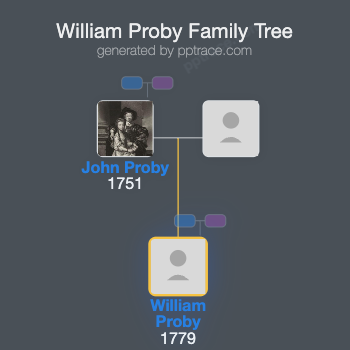
Family Tree
Tap  to expand more relatives
Introduction
William Allen Proby, known as Lord Proby, was born on 19 June 1779. He was the eldest son of John Proby, who was later created the 1st Earl of Carysfort, and his first wife Elizabeth Osbourne. His family background was British, and he was involved in both naval and political careers during his lifetime.
Proby received his education at Rugby School, located in Warwickshire, England, beginning in 1788. His early education set the foundation for his subsequent service in the Royal Navy.
He was commissioned into the Royal Navy at a young age, likely benefiting from familial influence to achieve rapid promotion through the ranks. In December 1797, while serving on the Lisbon station, Proby was temporarily put in command of the HMS Emerald. By 1798, at the age of 19, he had attained the rank of post-captain. During his naval career, he also commanded the fireship Tarleton and the sloop Peterel.
Proby's command of the frigate Danae faced a significant incident in March 1800. On 14 March 1800, a mutiny occurred aboard Danae off Le Conquet near Brest. Forty crew members seized control of the ship, citing discontent with the presence of French and American sailors, as well as possible disciplinary issues. Proby managed to secure the loyal crew below decks and surrendered the ship to a French brig-corvette, Colombe, with the remark, "To the French nation, but not to mutineers." He and the loyal crew members were later exchanged on parole and received favorable treatment by French authorities.
In April 1802, Proby took command of the HMS Amelia. The following month, he led missions to Cork, Waterford, and Dublin to disembark 150 discharged sailors. During the summer, he engaged in anti-smuggling operations between Berry Head and Mount's Bay. By late August, HMS Amelia sailed toward Den Helder, carrying Dutch troops discharged from British service. Throughout 1803, the vessel was based in Portsmouth, with patrols near Jersey and the Downs, and involved in the blockade of Dutch ports.
While in service at the Leeward Islands, Bermuda, and Surinam, Proby continued his naval duties. He contracted yellow fever during his time in Surinam and died from the illness on 6 August 1804 at the age of 25. His death occurred while he was in command of the frigate. He was buried in a vault at St Michael's Cathedral in Bridgetown, Barbados; a tablet there commemorates his death.
In addition to his naval career, William Proby was a Member of Parliament. He represented Buckingham as a Whig from 1802 until his death in 1804. His younger brother, John Proby, succeeded him as the MP for Buckingham after his death.
Regarding his titles, Proby was styled as Lord Proby from 1789, when his father was elevated in the Peerage of Ireland to become Earl of Carysfort. William Proby remained unmarried throughout his life. After his father's death in April 1828, his younger brother John Proby succeeded to the earldom of Carysfort.