Kamei Koremi
| Name | Kamei Koremi |
| Title | Feudal lord and domain governor of Tsuwa Province during late Edo and early Meiji periods. |
| Gender | Male |
| Birthday | 1825-11-14 |
| nationality | — |
| Source | https://www.wikidata.org/wiki/Q11370778 |
| pptrace | View Family Tree |
| LastUpdate | 2025-11-27T11:15:42.414Z |
Family Tree
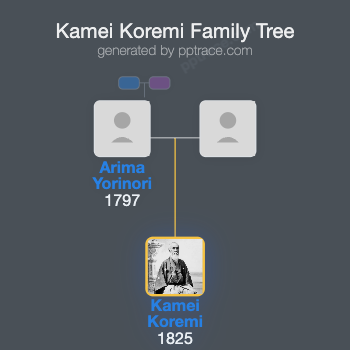
Tap  to expand more relatives
Introduction
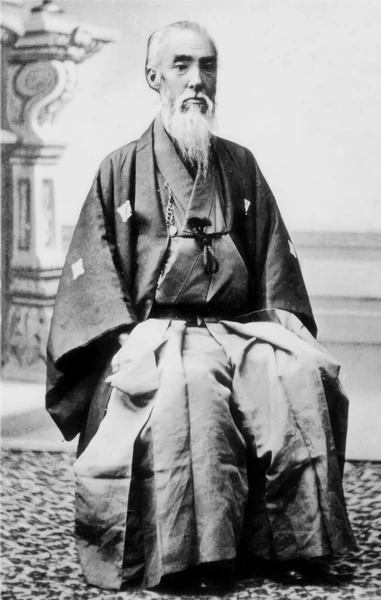
Kamei Koremi (October 5, 1825 – March 23, 1885) was a feudal lord (daimyo) of Tsuwa no Province during the late Edo period and the early Meiji era. He served as the 12th head of the Kamei family of Tsuwa no and was also the 11th daimyo of the domain.
Birth and Family Background
He was born in Edo as the sixth son of Arima Yoritoku, the 9th daimyo of Chikugo Kurume Domain.
Adoption and Succession as Daimyo
In 1839 (Tenpō 10), he was adopted by Kamei Izakata, the 10th daimyo of Tsuwa no Domain. On June 21 of the same year, following Izakata’s retirement, he inherited the family headship.
Titles and Appointments
In February of 1840 (Tenpō 11), he was promoted to Junior Fifth Rank, Lower Grade, with the courtesy title of Oki-no-kami (Governor of Oki Province).
Domain Governance and Promotion of Scholarship
In 1842 (Tenpō 13), he retired the senior retainers Tago Tamba and gained full control of domain politics. He appointed Okakuma Omi to power and actively promoted learning. Funds obtained from selling the shoya residence in Fukagawa, Edo (worth 10,000 ryō), were invested in educational initiatives, contributing to the development of scholarship in the domain.
Promotion and Political Policies
In 1860 (Man'en 1), he was elevated to Junior Fourth Rank, Lower Grade.
Late Edo Period Turmoil and Response
Due to neighboring Choshu Domain, he navigated the conflicts between pro-shogunate and pro-revolution factions. During the Second Chōshū Expedition in 1866 (Keiō 2), he adopted a hesitant stance. After the shogunate army retreated, he handed over Hasegawa Kyuuzaburou to the Chōshū domain in efforts to restore peace.
Meiji Restoration and Castle Demolition
Following the Meiji Restoration, he demonstrated loyalty to the new government. With the abolition of the han system in 1871, he ordered the dismantling of Sambu Matsuryō Castle, his residence. The artifacts stored in the shrine’s former treasure house within the castle were transferred for religious purposes.
Administrative and Religious Administration
Before the abolition of the han system in 1871, he led the demolition of his residence as part of the abolition process.
Participation in New Government and Administrative Roles
In 1868 (Meiji 1), he was appointed as a member of the new government, overseeing religious and imperial affairs. He served as a judge of the Department of Shrine Affairs, a councilor (Gicchō), and vice-governor of Shinto shrines.
Restoration of Domain Titles and Promotions
In June 1869 (Meiji 2), he was appointed as the governor of Tsuwa no Domain following the reversion of domain lands and titles (hansei). He was promoted to Junior Fourth Rank, Upper Grade. He received further promotions to Senior Fourth Rank in 1870 and Senior Third Rank in 1871.
Retirement and Later Years
In 1876 (Meiji 9), he ceded his family headship to his adopted son, Kamei Tokuaki, and retired from public life.
Death and Honors
He was awarded the Third Class Order of the Rising Sun and the Order of the Sacred Treasure, Gold and Silver Star, in 1881 (Meiji 14). He died on March 23, 1885, at his residence in Koishikawa, Tokyo, at the age of 61.
Related materials and topics include the Meirokusha (Meirosha) society.