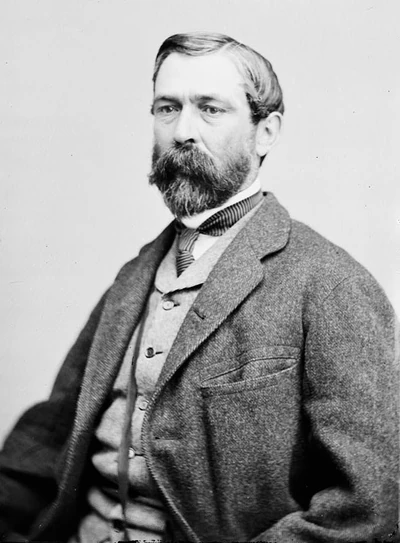
Richard Taylor
| Name | Richard Taylor |
| Title | Confederate general in the American Civil War (1826-1879) |
| Gender | Male |
| Birthday | 1826-01-27 |
| nationality | United States of America |
| Source | https://www.wikidata.org/wiki/Q1967771 |
| pptrace | View Family Tree |
| LastUpdate | 2025-11-17T06:39:17.964Z |
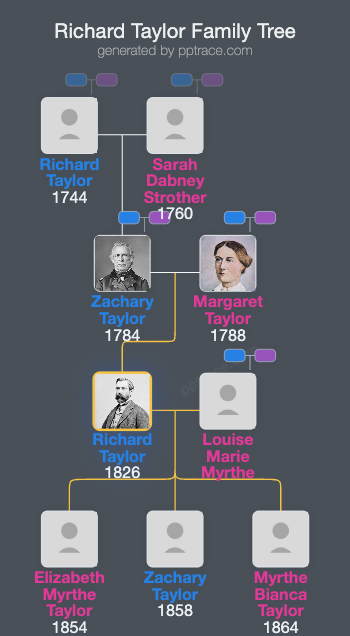
Family Tree
Tap  to expand more relatives
Introduction
Richard "Dick" Taylor was born on January 27, 1826, at Springfield, a family plantation near Louisville, Kentucky. His father was Zachary Taylor, who served as a lieutenant colonel in the United States Army at the time of Richard’s birth and later became the 12th president of the United States. His mother was Margaret Mackall (Smith) Taylor. Richard Taylor was the only son among six children; he had five older sisters, two of whom died in childhood before his birth, and three—Ann Mackall Taylor, Sarah Knox Taylor, and Mary Elizabeth Taylor—who survived to adulthood.
The Taylor family spent much of Richard’s early years on the American frontier, where his father commanded frontier forts. Richard received private education in Kentucky and Massachusetts before attending college. He initially studied at Harvard College in Cambridge, Massachusetts, but completed his education at Yale University in New Haven, Connecticut, graduating in 1845. During his time at Yale, Taylor was a member of Skull and Bones, a social club, and dedicated much of his reading to classical and military history books.
In July 1846, during the Mexican–American War, Taylor visited his father in Matamoros, Mexico, where he reportedly volunteered as his father's aide-de-camp. However, health issues, specifically rheumatoid arthritis, compelled him to leave active service. Instead, he managed the family cotton plantation in Jefferson County, Mississippi. In 1850, Taylor persuaded his father—who was then serving as the President of the United States—to purchase Fashion, a large sugar cane plantation in St. Charles Parish, Louisiana. Following his father’s sudden death in July 1850, Richard Taylor inherited the plantation.
On February 10, 1851, Taylor married Louise Marie Myrthe Bringier of Louisiana. She was the daughter of Aglae Bringier, a wealthy French Creole, and her husband. Over the next several years, Taylor expanded his plantation acreage, improved its sugar processing facilities, and increased the enslaved labor force to around 200 people, amassing significant wealth.
In 1855, Taylor entered local politics and was elected to the Louisiana State Senate, serving until 1861. His political affiliations shifted from the Whig Party to the American (Know Nothing) Party, and finally to the Democratic Party. He participated as a delegate in the first Democratic Convention of 1860 in Charleston, South Carolina, where he attempted to mediate between the fractured factions of the Democratic Party, although his efforts ultimately failed.
Following the outbreak of the American Civil War in 1861, Taylor was first involved with the Confederacy as a civilian aide-de-camp to General Braxton Bragg in Pensacola, Florida. Although opposed to secession, Taylor accepted the role, citing his military knowledge was valuable for training Confederate forces. Subsequently, he was commissioned as a colonel of the 9th Louisiana Infantry Regiment, a unit composed largely of volunteers who supported Taylor due to his connection with Jefferson Davis, the Confederate President and Davis’s late wife was Taylor’s sister, Sarah Knox Taylor.
Taylor arrived in Richmond, Virginia, in July 1861 with his regiment and participated in the First Battle of Manassas. He was promoted to brigadier general on October 21, 1861, commanding a Louisiana brigade in the Shenandoah Valley under Stonewall Jackson during the Valley campaign. During this campaign, Taylor’s brigade consisted of Louisiana regiments including the "Louisiana Tigers," known for their combativeness and resilience. He led attacks at battles such as Front Royal, Winchester, and Port Republic. Health issues, specifically rheumatoid arthritis, periodically incapacitated him, preventing active command during some battles, including Gaines Mill.
On July 28, 1862, Taylor was promoted to major general, becoming the youngest to hold this rank in the Confederacy. His promotion was supported by Confederate leadership due to his demonstrated leadership and Jackson’s recommendation. His subsequent assignments involved commanding the District of West Louisiana, with responsibilities to recruit, organize, and defend the area against Union advances. During 1863, Taylor engaged U.S. forces in battles such as Fort Bisland and Irish Bend, engaging in efforts to control Louisiana’s Bayou Teche region and contest Union efforts around Port Hudson.
Throughout his military career, Taylor operated within the strategic context of defending Confederate territories in Louisiana and supporting broader Confederate operations across the Trans-Mississippi Department. He continued his military efforts until his death on April 12, 1879.