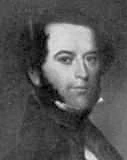
David Stuart
| Name | David Stuart |
| Title | American politician (1753-1814) |
| Gender | Male |
| Birthday | 1753-08-03 |
| nationality | United States of America |
| Source | https://www.wikidata.org/wiki/Q1176763 |
| pptrace | View Family Tree |
| LastUpdate | 2025-11-17T06:36:46.779Z |
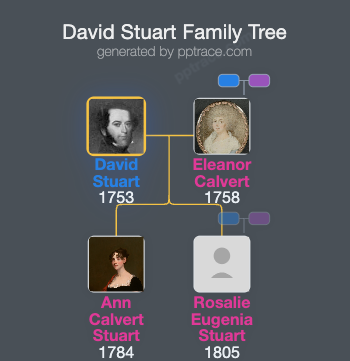
Family Tree
Tap  to expand more relatives
Introduction
David Stuart (August 3, 1753 – October 1814) was an American physician and politician associated with Virginia. He served as a member of the Virginia House of Delegates from 1785 to 1789 and was appointed as one of three commissioners by President George Washington in 1791 to oversee the design and construction of the federal capital, now Washington, D.C.
Early Life and Family Background:
Stuart was the eldest son of Reverend William Stuart (1723–1798) and Sarah Foote (c. 1732–c. 1795). The family resided on the Cedar Grove plantation along the Potomac River. Reverend William Stuart was rector of St. Paul's Parish in King George County, Virginia, from 1749 to 1796. He studied theology in London, was ordained by Bishop Edmund Gibson, and was known for his eloquence and integrity. The Stuart family included William’s seven daughters and five sons, with David being the eldest.
The Stuart family descended from Rev. David Stuart, who is believed to have been a descendant of the Scottish royal house and supported the Jacobite pretender, James Francis Stuart. Rev. David Stuart emigrated to Virginia in 1715 and married Jane Gibbons. His father, Rev. William Stuart, served as rector of Aquia Parish in Stafford County, Virginia, from 1722 until his death in 1749.
Education and Medical Training:
David Stuart received a private education suitable to his social class and graduated from the College of William and Mary in Williamsburg. He then traveled to Europe to complete his medical studies, studying at the University of Edinburgh and finishing his education in Paris, France.
Career and Public Service:
After returning to Virginia in 1778, Stuart established a medical practice in Alexandria and farmed mainly outside of the city in Fairfax County. His first plantation was Abingdon, located on the Potomac River, which was within the area later ceded to the federal government in 1791 for the creation of Washington, D.C. The site is now within Arlington County, Virginia.
In 1783, Stuart and James Wright purchased a lot in Alexandria. The same year, Stuart married Eleanor Calvert Custis, the widow of John Parke Custis, and stepmother to Martha and George Washington's stepchildren. Stuart utilized enslaved labor on his farms; records from the 1787 tax census show he owned 13 adult and nine child slaves in Fairfax County.
Stuart was elected three times to the Virginia House of Delegates representing Fairfax County and served as an elector in the 1788–89 presidential election, casting votes for George Washington. He also participated in Virginia’s ratification convention for the U.S. Constitution in 1788, supporting ratification alongside other Federalists like Charles Simms, James Madison, and John Marshall. Notably, he was aligned with the Federalist movement and played a role in the political debates surrounding the Constitution.
In 1791, President George Washington appointed Stuart as a commissioner to oversee the surveying and planning of the new capital city. Stuart served on this commission until 1794, contributing to the naming of the city as the "City of Washington" and attending the ceremony at Jones Point for the placement of the first boundary stone.
Family and Marriage:
On November 20, 1783, Stuart married Eleanor Calvert Custis, a descendant of Cecilius Calvert, Lord Baltimore. Eleanor was initially married to John Parke Custis, with whom she had four children, including George Washington Parke Custis and Eleanor (Nelly) Custis. Stuart became their legal guardian after the death of John Parke Custis in 1781. The couple resided at various estates in Fairfax County, including Hope Park and Ossian Hall.
As a guardian, Stuart managed the estate of John Parke Custis, including property and enslaved persons intended for the inheritance of Custis’s children. He also served as a gentleman justice of Fairfax County, with a lifelong appointment, and played a significant role in relocating the Fairfax County courthouse.
Involvement in Slavery and Legacy:
Stuart’s ownership of enslaved individuals is documented, including the ownership of enslaved people recorded in the 1787 tax census. Correspondence with George Washington discusses issues related to slavery and the gradual abolition movement within Virginia.
Death:
David Stuart died in October 1814. His family connections included being the brother-in-law of William Mason, married to his sister Ann. His estate management and political activities reflect his involvement in early American state and federal affairs.