Masuzō Nomura
| Name | Masuzō Nomura |
| Title | (1875-1959) |
| Gender | Male |
| Birthday | 1875-03-05 |
| nationality | Japan |
| Source | https://www.wikidata.org/wiki/Q51914889 |
| pptrace | View Family Tree |
| LastUpdate | 2025-11-17T09:46:56.443Z |
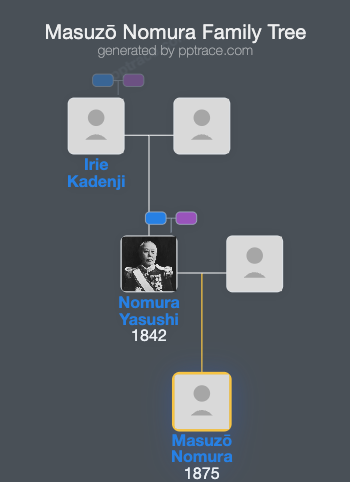
Family Tree
Tap  to expand more relatives
Introduction
Masuzo Nomura (March 5, 1875 – December 25, 1959) was a Japanese educator, politician, and nobleman, serving as a Viscount member of the House of Peers. He was active during the Meiji through Showa periods.
Life and Career
Masuzo Nomura was born on March 5, 1875, as the eldest son of Yasuda Nomura, who worked for the Ministry of Foreign Affairs. Following his father's death, he inherited the title of Viscount on February 19, 1909 (Meiji 42).
Education
He graduated from the Faculty of Agriculture at Tokyo Imperial University and later studied abroad in the German Empire in 1910 (Meiji 43).
Professional Experience
In 1905 (Meiji 38), he became a teacher at Wakayama Prefectural Komogawa Middle School, later serving as a teacher at Aichi Prefectural Fifth Middle School and Kanagawa Prefectural Fourth Middle School. Other positions included Vice Chairman of the Textbook Review Committee, President of the Imperial Fisheries Association, President of the South Seas Fisheries Association, Councilor of the Central Cooperative Bank, Councilor of the Japanese Eubio Society, Chairman of the Imperial Education Society, Director of the Great Japan Eubio Society, Director of Tokyo University of Agriculture, and member of committees such as the National Language Deliberation Council, Education Deliberation Council, Literary and Educational Council, Price Deliberation Council, and Agricultural and Forestry Planning Committee.
Political Activities
On July 10, 1911 (Meiji 44), he was elected as a Viscount member of the House of Peers, affiliating with research groups. He served as a House of Peers member for a total of five terms until his resignation on April 13, 1946 (Showa 21).
Honors
He was awarded the Order of the Third Class on May 1, 1937 (Showa 12).
Major Works
His notable publications include:
- "Gakushuin Facilities Report" (1925)
- "Reflecting on the Imperial Capital" (1927, Japan Society for the Promotion of Science)
- "Tokyo Sightseeing" (1928, Japan Society for the Promotion of Science)
- "The Thirteen Roads of Chirin" (1931, Bunsyodo Printing)
- "Water Light" (1934, Imperial Fisheries Association)
- "Mountain Shadows: South Seas, Taiwan, Korea" (1934, Seibundo Publishing)
- "Three Cities Pilgrimage to Ise" (1934, Imperial Education Society)
- "Wandering Clouds" (1937, South Seas Fisheries Association)
- "North China from Manchuria" (1941, Imperial Fisheries Association)
Family and Relatives
Masuzo Nomura's wife was Sumie, who was the sister-in-law of Shigeru Naraohara. She was the eldest daughter of Navy Rear Admiral Ichibei Mouri. His children include his eldest son, Oyū, and his third son, Masamasa (a Navy Lieutenant Commander).
Sources and References
References include "Personnel Directory," 14th Edition, Volume 2 (Sanyo Publishing, 1943); "Directory of the House of Peers (Part C)" (Revised December, Showa 21, House of Peers Secretariat, 1947); "History of the Parliamentary System: 100 Years of the National Diet—List of House of Councillors and House of Representatives Members" (Ministry of Finance Printing Bureau, 1990); and "Heisei New Correction of the Kugeirike Arisome" Volume 2 (Kasumi Memorial Hall, 1996).