William Ormsby-Gore, 4th Baron Harlech
| Name | William Ormsby-Gore, 4th Baron Harlech |
| Title | British politician and banker (1885-1964) |
| Gender | Male |
| Birthday | 1885-04-11 |
| nationality | United Kingdom |
| Source | https://www.wikidata.org/wiki/Q2908365 |
| pptrace | View Family Tree |
| LastUpdate | 2025-11-26T23:30:41.445Z |
Family Tree
Tap  to expand more relatives
Introduction
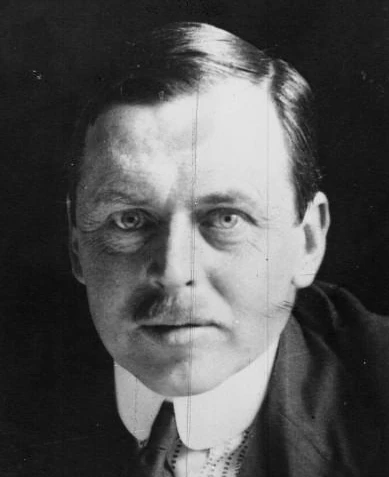
William George Arthur Ormsby-Gore, 4th Baron Harlech (11 April 1885 – 14 February 1964), was a British Conservative politician and banker.
**Early Life and Education**
Born at Eaton Square, London, Harlech was the son of George Ormsby-Gore, 3rd Baron Harlech, and Lady Margaret Gordon, daughter of Charles Gordon, 10th Marquess of Huntly. He attended Eton College and New College, Oxford.
**Military Service and World War I**
Harlech joined the Territorial Army, receiving a commission as a second lieutenant in the Shropshire Yeomanry in 1907. He was promoted to lieutenant in 1911. At the outbreak of World War I, he was mobilized with his regiment and traveled to Egypt, where he was promoted to captain in 1915 and served on the general staff. In 1916, he joined the Arab Bureau as an intelligence officer, attached to Sir Henry A. McMahon, the British High Commissioner.
During his service, Harlech opposed the secret Sykes-Picot Treaty, publicly criticizing the division of Ottoman lands among allies and advocating for Arab and Jewish self-determination. He contested the idea that Africans were incapable of self-governance, attributing prejudices rather than abilities as the primary obstacle. After the war, he urged Britain to implement the League of Nations mandates framework.
In 1917, he was recalled to England, serving as Parliamentary Private Secretary to Lord Milner, assistant secretary in the War Cabinet, and liaison with Sir Mark Sykes. He maintained a personal friendship with Zionist leader Chaim Weizmann, who stayed at Harlech’s London residence during cabinet deliberations on the Balfour Declaration. From March to August 1918, Harlech served as the British military liaison officer with the Zionist mission in the Holy Land. Following the war, he was part of the British delegation at the 1919 Paris Peace Conference. He continued serving in the yeomanry until 1921 and was appointed an honorary colonel of the 10th Battalion of the Royal Welch Fusiliers in 1939.
**Political Career**
Harlech was elected Member of Parliament for Denbigh Boroughs in the January 1910 general election, winning by eight votes. He served as MP until 1918, when he was elected for Stafford. In 1938, he succeeded his father as the 4th Baron Harlech and entered the House of Lords.
From 1921 to 1922, he was the British representative to the League of Nations' Permanent Mandates Commission, contributing to its expansion and processes for grievances in mandates. He served as Under-Secretary of State for the Colonies from 1922 to 1929, with a brief interruption during the Labour government in 1924. In the 1927 New Year Honours, he was sworn into the Privy Council.
Harlech held various government posts, including Postmaster-General in 1931, First Commissioner of Works from 1931 to 1936, and Colonial Secretary from 1936 until 1938. He resigned as Colonial Secretary eight days after becoming a peer due to his opposition to the partitioning of Palestine amid Arab protests. He was appointed Knight Grand Cross of the Order of St Michael and St George (GCMG) in 1938. During this period, he was also a critic of Nazi Germany.
**World War II and Later Public Service**
During the Second World War, Harlech served as Civil Defence Commissioner for North-East England. From 1941 to 1944, he was High Commissioner to South Africa.
**Cultural and Public Interests**
Harlech maintained an extensive library at his estate, Brogyntyn near Oswestry, and along with his father, deposited valuable manuscripts at the National Library of Wales. He authored several works, including *Florentine Sculptors of the Fifteenth Century* (1930), *Guide to the Mantegna Cartoons at Hampton Court* (1935), and three volumes in the *Guides to the Ancient Monuments of England* series.
He served on the board of Midland Bank, owned by his family, and was chairman of the Bank of West Africa. He was Lord Lieutenant of Merionethshire from 1938 to 1957 and was appointed Knight Companion of the Order of the Garter (KG) in 1948.
Harlech was involved with art institutions, serving as trustee of the National Gallery and Tate Gallery, as well as a chairman of advisory committees for the Victoria and Albert Museum and other bodies. He was President of the National Library of Wales from 1950 to 1958, Pro-Chancellor of the University of Wales, and held the title of Constable of Harlech and Caernarfon castles.
**Personal Life**
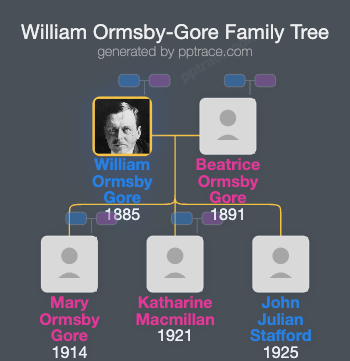
In 1913, Harlech married Lady Beatrice Edith Mildred Gascoyne-Cecil, daughter of the 4th Marquess of Salisbury. They had six children: Mary Hermione, Owen Gerard Cecil (died young), William David (later 5th Baron Harlech), Katherine Margaret Alice, Captain John Julian Stafford, and Elizabeth Jane.
Harlech died in February 1964 at the age of 78. His eldest surviving son, William David Ormsby-Gore, succeeded him as the 5th Baron Harlech and served as British Ambassador to the United States in the 1960s. Lady Harlech died in 1980.