Zaitao
| Name | Zaitao |
| Title | Qing Dynasty prince (1887-1970) |
| Gender | Male |
| Birthday | 1887-06-23 |
| nationality | People's Republic of China |
| Source | https://www.wikidata.org/wiki/Q8064893 |
| pptrace | View Family Tree |
| LastUpdate | 2025-10-27T03:39:57.258Z |
Family Tree
Tap  to expand more relatives
Introduction
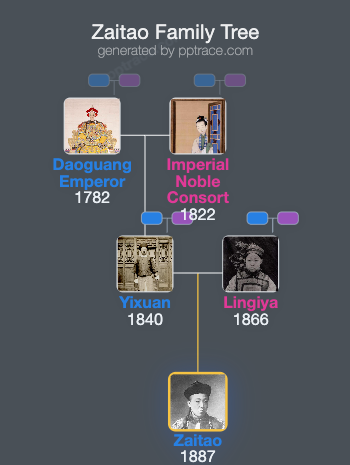
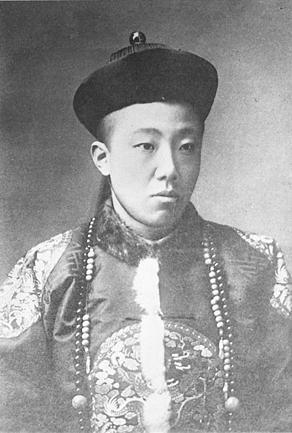
Zaitao (23 June 1887 – 2 September 1970), courtesy name Shuyuan, art name Yeyun, was a Manchu prince of the Qing dynasty. He was a member of the Aisin Gioro clan, born as the seventh son of Yixuan, Prince Chun, who was a prominent Qing nobleman. His family belonged to the Plain Red Banner of the Eight Banners system, an administrative and military structure central to Manchu society.
In 1890, during the reign of the Guangxu Emperor, Zaitao was granted the title of a second class zhenguo jiangjun, a noble rank within the Qing hereditary system. He received a promotion in 1894 to buru bafen fuguo gong. In 1898, he was transferred from the lineage of Yimo (who had no son to succeed him) to the lineage of Yihe, Prince Zhong of the Second Rank, as Yihe's adopted son. That same year, he was promoted to acting beizi, a hereditary noble title. By 1902, Zaitao attained the rank of beile.
In December 1908, Zaitao was elevated to an acting junwang, or second-rank prince, although he continued to hold the nominal title of beile. That year, he was appointed alongside Tieliang as a zongsi jicha, a type of inspector-official. In 1909, under Emperor Xuantong (Puyi), he was put in charge of the Military Consultancy (軍諮處). His international military observations included a visit to eight countries—Japan, the United States, Britain, France, Germany, Italy, Austria, and Russia—in 1910 to study their military developments. In May of that year, he served as an envoy to Britain to attend the funeral of King Edward VII.
With the fall of the Qing dynasty in 1912, Zaitao participated in efforts to preserve imperial traditions. He, along with Zaixun and other members of the imperial family, founded the Royalist Party (宗社黨), which aimed to protect the ancestral temple and royal heritage. During the brief restoration of Puyi in 1917 by the warlord Zhang Xun, Zaitao was appointed as the Commanding Officer of the Imperial Guards.
In later years, Zaitao's political involvement continued. In 1931, he was recruited by the Nationalist Government of the Republic of China to participate in the National Crisis Conference. Following the establishment of the People’s Republic of China in 1949, he served as a member of the National People's Congress and the Chinese People's Political Consultative Conference.
Zaitao had an interest in horses; he studied cavalry warfare at the Saumur Cavalry School in France. After 1949, he became a consultant on horses in the artillery formation of the People's Liberation Army. During the Korean War, he was involved in selecting horses for the People's Volunteer Army in Inner Mongolia.
He also engaged in Beijing opera, trained in martial arts for both long and short-range performances, and specialized in playing monkey roles. His instructors included Yang Xiaolou and Zhang Qilin, and operatic actor Li Wanchun studied under him for three years.
Zaitao was married to Wanzhen (1885–1949), from the Jiang clan, with whom he fathered several children, including his first son born in 1905, and multiple daughters and sons. He also had several concubines from different clans, who bore him additional children.
He died in Beijing in 1970 at the age of 83.