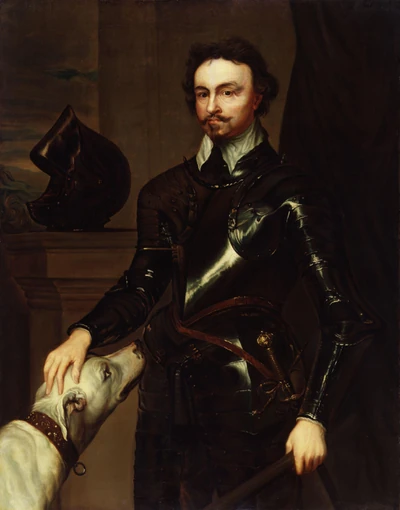
Thomas Wentworth
| Name | Thomas Wentworth |
| Title | 1st Earl of Strafford, English earl and politician (1593–1641) |
| Gender | Male |
| Birthday | 1593-04-13 |
| nationality | Kingdom of England |
| Source | https://www.wikidata.org/wiki/Q336091 |
| pptrace | View Family Tree |
| LastUpdate | 2025-11-26T23:24:02.462Z |
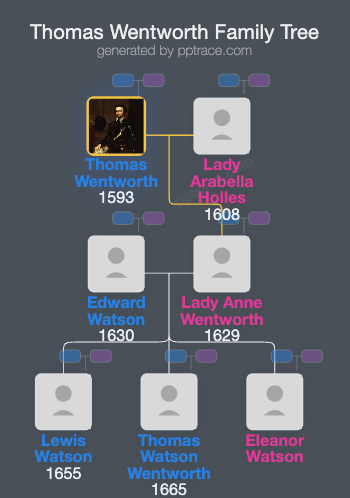
Family Tree
Tap  to expand more relatives
Introduction
Thomas Wentworth, 1st Earl of Strafford (13 April 1593 – 12 May 1641), was an English statesman involved in the political developments leading up to the English Civil War. He held several titles during his career, including Sir Thomas Wentworth, 2nd Baronet (between 1614 and 1628), Baron Wentworth (created in 1628), Viscount Wentworth (from late 1628 or early 1629), and ultimately Earl of Strafford (January 1640).
**Early Life and Education**
Wentworth was born in London. He was the son of Sir William Wentworth, 1st Baronet, of Wentworth Woodhouse near Rotherham, Yorkshire, and Anne Atkins, daughter of Sir Robert Atkins of Stowell, Gloucestershire. His education included studies at St John's College, Cambridge, and legal training at the Inner Temple beginning in 1607. He was knighted in 1611.
**Marriage and Family**
Wentworth was first married to Margaret Clifford, daughter of Francis Clifford, Earl of Cumberland. Following her death in 1622, he married Arabella Holles in 1625. Arabella was the daughter of John Holles, 1st Earl of Clare. His third marriage was to Elizabeth Rhodes in 1632, shortly after his tenure as Lord Deputy of Ireland.
**Parliamentary Career**
Wentworth entered Parliament representing Yorkshire in 1614 during the "Addled Parliament." He participated actively in debates during the 1621 Parliament, supporting claims of the House of Commons amid tensions with King James I. He was elected again for Yorkshire in 1625 and served as High Sheriff of Yorkshire after the dissolution of Parliament that year. In 1624, he represented Pontefract in the Happy Parliament. Throughout these years, he maintained an ambiguous stance: supporting the monarchy's authority while also advocating for certain parliamentary rights.
**Support for the Petition of Right**
In 1628, Wentworth was a prominent supporter of the Petition of Right, which aimed to limit the powers of the king in matters of taxation and imprisonment. After Charles I accepted the Petition, Wentworth shifted to championing royal authority, asserting that kingly power was essential for government stability. This shift caused him to be viewed as a turncoat by some contemporaries.
**Conflict with Parliament and Rise to Power**
In the Parliament of 1628, Wentworth opposed parliamentary efforts to take control of executive powers and was involved in factional conflicts leading to his creation as Baron Wentworth. Following the assassination of Buckingham in 1628, he was elevated to Viscount Wentworth and appointed president of the Council of the North. He expressed intentions to unify royal prerogative and the interests of the subjects, emphasizing the importance of the monarch's authority.
During the period of Personal Rule (1629–1640), Wentworth was a leading member of the "Thorough Party," advocating for strong royal control. He opposed parliamentary assertions of independence and participated actively in policies that centralized authority.
**Lord Deputy of Ireland**
In November 1629, Wentworth became a privy councillor and was appointed Lord Deputy of Ireland in January 1632, arriving in Dublin in July 1633. His tenure was marked by administrative reforms, including dismissing inefficient officials and securing cooperation from Irish parliamentary bodies. He married Elizabeth Rhodes in 1632, following the death of his second wife Arabella.
In Ireland, Wentworth demonstrated effective governance, maintaining control over parliaments and obtaining necessary legislative grants. His governance style was characterized by authoritative intervention and administrative restructuring.
**Death**
Strafford was executed on 12 May 1641 after being attainted by Parliament, which condemned him to death amid the escalating conflict between Crown and Parliament. King's reluctant signing of the death warrant resulted in his execution.
**Legacy**
Throughout his career, Wentworth was granted multiple peerages reflecting his rising status, culminating in the Earl of Strafford title. His career was deeply intertwined with the constitutional conflicts of early 17th-century England and Ireland.