Chapman Grant
| Name | Chapman Grant |
| Title | American zoologist, historian and publisher (1887-1983) |
| Gender | Male |
| Birthday | 1887-03-27 |
| nationality | United States of America |
| Source | https://www.wikidata.org/wiki/Q1062746 |
| pptrace | View Family Tree |
| LastUpdate | 2025-11-16T10:15:06.393Z |
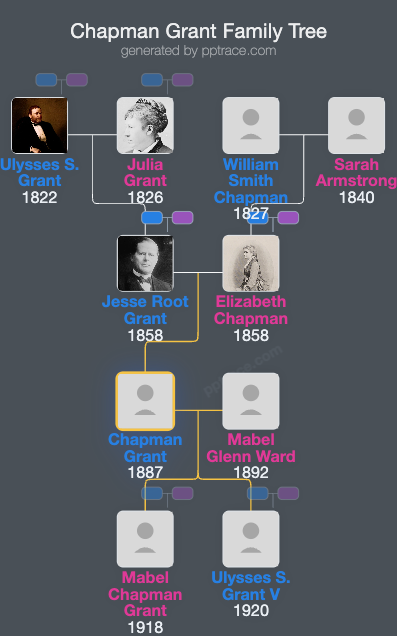
Family Tree
Tap  to expand more relatives
Introduction
Chapman Grant (March 27, 1887 – January 5, 1983) was an American herpetologist, historian, and publisher. He was a grandson of Ulysses S. Grant, the 18th President of the United States, and was the last surviving grandson of President Grant. Grant was born in Salem Center, New York, the son of Jesse Root Grant II, who was the youngest son of Ulysses S. Grant. In 1892, he relocated to San Diego, California, with his family.
As a child, Grant was interested in science and spent time at the California Academy of Sciences. He attended Williams College, from which he graduated in 1910. In September 1913, he became an assistant curator of entomology at the Children's Museum of the Brooklyn Institute of Arts and Sciences. Two months later, in November 1913, Grant entered military service on the Mexican border, receiving a commission as a second lieutenant in the 14th U.S. Cavalry.
He married Mabel Glenn Ward in 1917, and they had two children, one of whom, Ulysses S. Grant V, survived him. Throughout his military career, Grant continued his scientific endeavors, publishing scientific papers and serving as curator at the Arkansas Valley Museum and Historical Society. He retired from the army with the rank of major.
During the 1930s and 1950s, Grant conducted several expeditions on behalf of the San Diego Natural History Museum and the Illinois Museum of Natural History, focusing on Caribbean herpetofauna. His research led to the description of fifteen new taxa, including species such as the blue iguana, the cotton ginner gecko, Gaige's dwarf gecko, Klauber's dwarf gecko, Nichols' dwarf gecko, Roosevelt's dwarf gecko, Townsend's dwarf gecko, Cook's anole, the Culebra Island giant anole, Cochran's croaking gecko, the web-footed coqui, Cook's robber frog, and the whistling coqui. Two West Indian snake species, Chilabothrus granti and Typhlops granti, are named in his honor.
In 1932, Grant founded the scientific journal Herpetologica, a quarterly publication of the Herpetologists' League, which he co-founded in 1936. Additionally, he was the publisher of Scientists Forum, another scientific magazine. His contributions to ecology and herpetology were recognized in 1982 when the Major Chapman Grant Hall of Ecology was named within the San Diego Natural History Museum, located in Balboa Park.
Chapman Grant passed away in 1983 at the age of 95 in a nursing home in Escondido, California. He was survived by his son, Ulysses S. Grant V (1920–2011).
Selected Works:
- 1935: "Secondary sexual differences and notes on the mud turtle Kinosternon subrubrum in northern Indiana," American Midland Naturalist, vol. 16, pp. 798–800.
- 1935: "Natrix sipedon sipedon in central Indiana, its individual and sexual variation," American Midland Naturalist, vol. 16, pp. 921–931.
- 1937: "Herpetological notes from central Kansas," American Midland Naturalist, vol. 18, pp. 370–372.
- 1940 (with W. Gardner Lynn): "The Herpetology of Jamaica," Bulletin of the Institute of Jamaica Science, Series 1, pp. 1–148.
- 1960: "Differentiation of the two southwestern tortoises (genus Gopherus), with notes on their habits," Transactions of the San Diego Society of Natural History, vol. 12, pp. 441–448.
See also:
- Tanager Expedition
References and further reading are available, including his obituary published in the Los Angeles Times on January 17, 1983. His contributions to herpetology and natural history are also documented through the Web site of the Herpetologists' League.