Tokugawa Iesada
| Name | Tokugawa Iesada |
| Title | Edo shogun (1824-1858) |
| Gender | Male |
| Birthday | 1824-05-06 |
| nationality | Japan |
| Source | https://www.wikidata.org/wiki/Q336383 |
| pptrace | View Family Tree |
| LastUpdate | 2025-11-17T10:08:06.729Z |
Family Tree
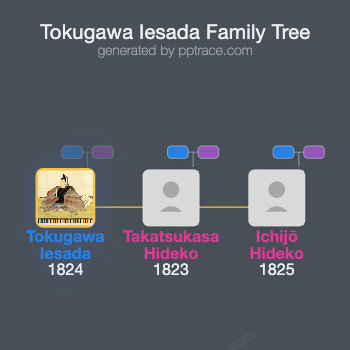
Tap  to expand more relatives
Introduction
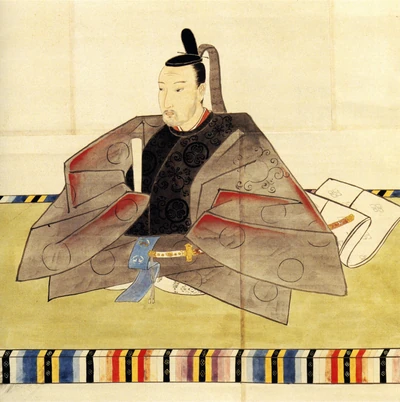
Tokugawa Iesada (徳川 家定; May 6, 1824 – August 14, 1858) was the 13th shōgun of the Tokugawa shogunate of Japan. His term as shōgun lasted from 1853 until his death in 1858. He succeeded Tokugawa Ieyoshi and was succeeded by Tokugawa Iemochi. His reign coincided with the onset of the Bakumatsu period, a time of significant political and social change in Japan.
Born in Edo Castle, Iesada's birth name was Masanosuke (政之助). He was the fourth son of Tokugawa Ieyoshi, the twelfth shōgun, and his concubine Honjuin. Due to the high mortality rates among Ieyoshi's children, Iesada was designated heir at an early age. His interactions with others were restricted as a preventive measure against illness, possibly due to health issues; some historians suggest he may have suffered from cerebral palsy. His early childhood was affected by smallpox, which left scars on his face.
Following the death of Tokugawa Ienari in 1841, Iesada’s fitness as heir was questioned, leading to initial considerations of Tokugawa Yoshinobu as a successor. However, under the influence of rōjū Abe Masahiro, Iesada retained his position as heir.
In 1853, Iesada became shōgun following the death of his father. His health was already fragile at this time, and he was largely inactive in political affairs; daily negotiations with foreign powers were handled by Abe Masahiro. Notably, the Convention of Kanagawa was signed on March 31, 1854, establishing formal relations with the United States. Following Abe Masahiro's resignation, Hotta Masayoshi assumed leadership of the rōjū.
During his tenure, Japan experienced several major natural disasters. The Great Nankaidō earthquakes and tsunamis from November 4-7, 1854, resulted in approximately 80,000 deaths. These were followed by the Tōkai earthquake on December 23, 1854, which affected the Tōkai region and caused damage along the coast from Bōsō Peninsula to Tosa Province, including Shimoda on the Izu Peninsula. The earthquakes and resulting tsunamis were interpreted by some as signs of divine displeasure, especially given the port of Shimoda was set to host a U.S. consulate. The Nankai earthquake occurred on December 24, 1854, killing over 10,000 people. In 1855, the Edo earthquake, one of the powerful Ansei great earthquakes, caused fires and casualties in Edo.
In December 1856, Iesada married Princess Atsu, the adopted daughter of Shimazu Nariakira and Konoe Tadahiro. She was also known as Midaidokoro Atsuko. Their marriage did not produce any children.
On October 21, 1857, Iesada received American Consul Townsend Harris at Edo Castle. Under the advice of Hotta Masayoshi, Iesada signed the Harris Treaty in 1858, along with other unequal treaties that ended Japan’s policy of sakoku and opened the country to foreign influence. These treaties included the Anglo-Japanese Friendship Treaty and the Anglo-Japanese Treaty of Amity and Commerce.
During his reign, Emperor Kōmei opposed many of these foreign policies, which contributed to the Sonnō Jōi movement advocating reverence for the emperor and expulsion of foreigners. Subsequently, Ii Naosuke was appointed tairō on April 23, 1858. From 1858, a widespread cholera outbreak occurred, causing an estimated 100,000 to 200,000 deaths in Edo alone. Iesada died childless in 1858, possibly due to cholera. His final resting place is at the Tokugawa clan temple of Kan’ei-ji in Ueno. His Buddhist name was Onkyō-in.
Within the bakufu, factions clashed over succession, with Tokugawa Nariaki of Mito and Satsuma supporting Tokugawa Yoshinobu, while others, including the Ōoku and officials like Ii Naosuke, supported Tokugawa Iemochi. These disagreements led to the Ansei Purge.
Iesada was married three times: first to Princess Takatsukasa Atsuko; after her death from smallpox in 1848, to Princess Ichijō Hideko; and later to Princess Atsu. All marriages were childless. He was later adopted as a son by his cousin, Tokugawa Yoshitomi, who became Tokugawa Iemochi.
His reign spanned the Kaei (1848–1854) and Ansei (1854–1860) eras of the Japanese calendar.