Charles Harrison
| Name | Charles Harrison |
| Title | general during the American Revolutionary War |
| Gender | Male |
| Birthday | 1740-00-00 |
| nationality | United States of America |
| Source | https://www.wikidata.org/wiki/Q5078808 |
| pptrace | View Family Tree |
| LastUpdate | 2025-11-16T10:07:31.821Z |
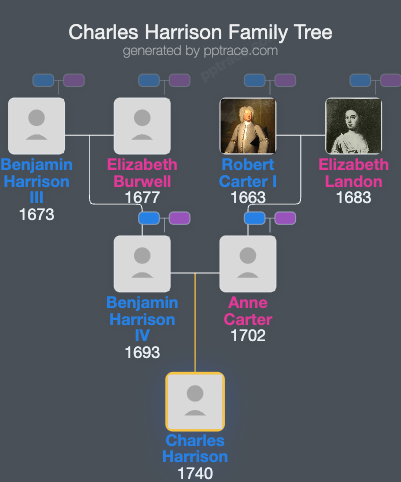
Family Tree
Tap  to expand more relatives
Introduction
Charles Harrison (1740 – December 12, 1793) was a Brigadier General in the Continental Army during the American Revolutionary War. He was born in Charles City, Virginia Colony, around 1740, to Benjamin Harrison IV and Anne Carter. Harrison was a member of the Harrison family of Virginia, which included his brother Benjamin Harrison V, a signer of the Declaration of Independence, and his nephew William Henry Harrison, who served as the ninth President of the United States.
In December 1775, the Virginia Convention authorized the formation of a state artillery company. Charles Harrison was appointed as one of the lieutenants in this company on February 13, 1776, alongside other officers including James Innis and Edward Carrington. The company was accepted by the Second Continental Congress on March 19, 1776. Subsequently, a second artillery company, led by French volunteer Dohickey Arundel, was formed but was later disbanded after Arundel’s death. The Virginia Continental Artillery Company coexisted with the Virginia State Artillery Company, authorized on January 11, 1776.
On November 26, 1776, Congress authorized Harrison's Continental Artillery Regiment to comprise ten companies, including the existing units. The regiment assembled in Williamsburg, Virginia, in the spring and summer of 1777 and was assigned to the Southern Department. Harrison was appointed as the regiment’s colonel, with Edward Carrington as lieutenant colonel. The regiment joined the main Continental Army at Valley Forge, Pennsylvania, in March 1778.
Harrison’s regiment participated in the Battle of Monmouth on June 28, 1778, under Henry Knox’s artillery brigade. During this engagement, British forces under Sir Henry Clinton attempted to break the American line, but Harrison’s artillery contributed to the defense. By fall 1778, the regiment’s manpower had diminished significantly, with only 27 men remaining.
On August 10, 1779, Harrison’s regiment was renamed the 1st Continental Artillery Regiment. A review of officer seniority led to the consolidation of artillery regiments, with Harrison’s becoming the 1st Continental Artillery Regiment, differentiating from others such as the 2nd, 3rd, and 4th regiments. Three Maryland artillery companies joined Harrison's regiment on a provisional basis in 1778 and officially merged in May 1780, becoming the 11th and 12th Companies.
During the Southern campaign, Harrison was involved in key battles, including the Battle of Camden on August 16, 1780, where he commanded 100 artillerymen with six cannons. His role at Camden was under the command of General Horatio Gates, following a dispute over seniority with Carrington, who was also operating in the southern theater.
Harrison later commanded Nathanael Greene's artillery at the Battle of Hobkirk’s Hill on April 25, 1781. He led 40 Virginia gunners with three six-pound cannons during this engagement. The action involved a strategic retreat and subsequent re-positioning of artillery under threat from British forces. Harrison’s guns were ultimately saved with assistance from American dragoons.
The 1st Regiment was reorganized into ten companies on January 1, 1780, and was furloughed in the summer of 1783. The regiment was officially disbanded on November 15, 1783. Charles Harrison resigned his command on January 1, 1783, and was awarded the brevet rank of brigadier general on September 30, 1783, as recognition for his service.
Harrison married Mary Claiborne, daughter of Charles Claiborne. The couple had six children, including Charles II, Mary Herbert, Benjamin Henry, Anne Carter, Elizabeth Randolph, and Augustine. Harrison died on December 12, 1793.
His familial connections include his brother Benjamin Harrison V, a signer of the Declaration of Independence, and his nephew William Henry Harrison, an American president.