Takenouchi Koretada
| Name | Takenouchi Koretada |
| Title | 5 Dec 1858 - certain 26 Dec 1907 |
| Gender | Male |
| Birthday | 1858-12-05 |
| nationality | — |
| Source | https://www.wikidata.org/wiki/Q47470213 |
| pptrace | View Family Tree |
| LastUpdate | 2025-11-29T01:01:47.909Z |
Family Tree
Tap  to expand more relatives
Introduction
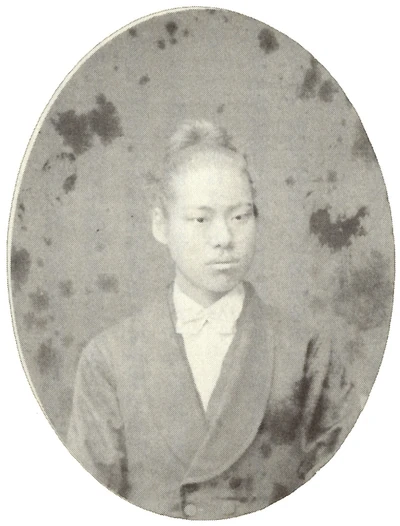
Takeyuchi Koretada (born December 5, 1858 (November 1, Ansei 5) – December 26, 1907 (Meiji 40)) was a Meiji-era scholar of Kokugaku, politician, and member of the kazoku aristocracy. His courtesy name was Gindai. His father was Jinaru Takeyuchi, a Umatō (equerry) from Kyoto, Yamashiro Province, and he was the eldest son. Due to family circumstances, he inherited the title of viscount on September 28, 1888.
He was born in Kyoto, Yamashiro Province, and resided in Omiya Village, Atago District, Kyoto (now Kita Ward, Kyoto City). He studied under Shigeishimaru Watanabe and was involved in guiding juniors as the secretary of the family academy “Dōseikan.”
On July 10, 1890, he was elected as a viscount in the House of Peers and served in that position until his death. Other public duties include serving as an officer for the Great Funeral Ritual in 1914.
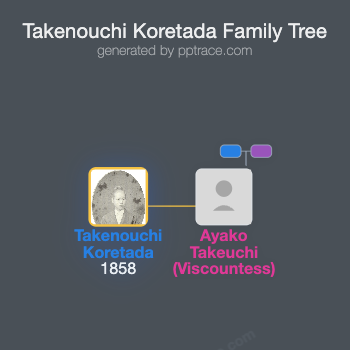
In terms of family relationships, his wife was Ayako Takeyuchi, the fifth princess by birth of Prince Asahiko Kuni-no-miya. His children included his eldest son, Takeyuchi Koreji (Viscount), his second son, Takeyuchi Kiyōnobu (Viscount), and his eldest daughter, Chiyoko Hasegawa (wife of Hisashirō Hasegawa). His brothers were Takeyuchi Shigeo and Takeyuchi Takanari (adopted son of Taketo Tōdō). His father-in-law was Kuniei Imaizumi. His sisters included Shikō Sanada (wife of Yukimin Sanada), Tsuruko Shimazu (wife of Tadaaki Shimazu), and Utagusa Hondō (wife of Oya Hondō).
His remains are interred at Aoyama Reien, plot 1-R-12-27.
In terms of works, he reviewed Watanabe Shigeishimaru’s “Gakukai Shinro” (The Educational Sea’s Navigational Guide), published in 1883 by Dōseikan.
Major references include “Jinji Kōshinroku” (1903), “Meiji Kōjō-chō” (1971), “Nihon Jinmei Daijiten Dai 4 Kan” (1979), “Gikai Seido Hyakunen-shi – Kizoku-in / Sangiin Giin Meikan” (1990), “Heisei Shinshū Kōzoku Kakei Taisei” (1996), and “Kyoto-shi Seishi Rekishi Jinbutsu Daijiten” (1997).