Prince Louis Ferdinand Of Prussia
| Name | Prince Louis Ferdinand Of Prussia |
| Title | prince of Prussia and composer |
| Gender | Male |
| Birthday | 1772-11-18 |
| nationality | Kingdom of Prussia |
| Source | https://www.wikidata.org/wiki/Q555336 |
| pptrace | View Family Tree |
| LastUpdate | 2025-11-12T01:15:51.929Z |
Family Tree
Tap  to expand more relatives
Introduction
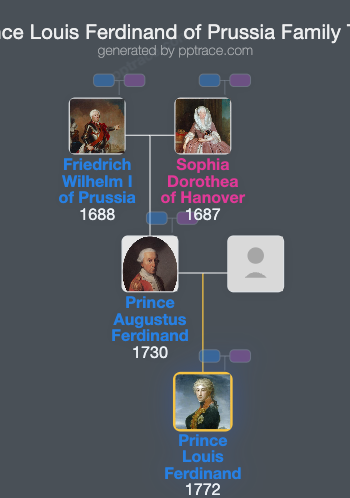
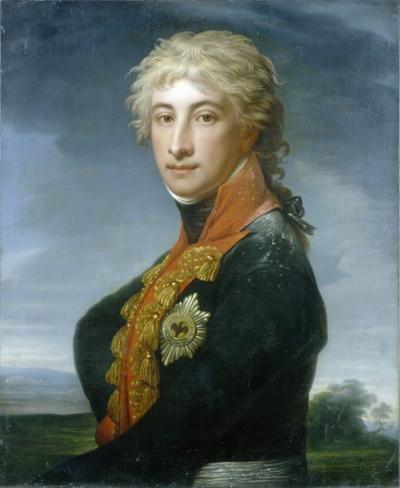
Prince Frederick Louis Christian "Ferdinand" of Prussia (German: Friedrich Ludwig Christian; 18 November 1772 – 10 October 1806) was a member of the Prussian royal family, a soldier, composer, and pianist. He was born at Friedrichsfelde Palace near Berlin and was a son of Prince August Ferdinand of Prussia and Elisabeth Louise of Brandenburg-Schwedt. His paternal uncle was King Frederick the Great. He was baptized Friedrich Ludwig Christian and was commonly known as Louis, with the nickname Ferdinand used to distinguish him from his cousin, Prince Friedrich Ludwig Karl of Prussia (1773–1796).
He participated in the French Revolutionary Wars, notably fighting in the War of the First Coalition from 1792 to 1794, near Longwy and Verdun. He took part in the cannonade at Valmy and sustained injuries during the Siege of Mainz. After being promoted to major general, he served in the Battle of Kaiserslautern in November 1793. On 23 February 1795, he was appointed as the chief of the “von Baden” infantry regiment. Towards the end of May 1796, he served as a brigadier within a corps covering the demarcation line in Westphalia. He was promoted to lieutenant general on 2 June 1799, with a patent from 20 May of that year.
In 1806, Louis Ferdinand supported the resumption of hostilities against Napoleon and the French Empire, which contributed to the outbreak of the War of the Fourth Coalition. He was killed at the Battle of Saalfeld during the early stages of this conflict. He commanded approximately 8,300 men when engaged against Marshal Jean Lannes' V Corps, which had about 12,800 soldiers. The engagement involved a confrontation in the Thuringian Forest, with the Prussians positioned behind the Saale River, complicating retreat. As the Prussian forces began to rout, Louis Ferdinand charged the French cavalry and was killed in combat by French quartermaster Jean-Baptiste Guindey after refusing to surrender and wounded a French non-commissioned officer. His death was noted as significant within the Prussian military and court.
Aside from his military career, Louis Ferdinand was an accomplished musician and composer. Johann Friedrich Reichardt, Kapellmeister to Frederick II and Frederick William II, considered him a talented pianist. His early compositions were performed by Prince Henry’s orchestra, and he participated actively in Berlin salons, playing improvisations on the piano. His circle of acquaintances included notable figures such as Friedrich Schlegel, Wackenroder, and Tieck, who were involved with early German Romanticism.
Ludwig van Beethoven dedicated his Third Piano Concerto to Louis Ferdinand, recognizing his proficiency at the instrument. Anton Reicha composed the variation cycle "L’art de varier" for him. His musical output comprises 13 published compositions with opus numbers, predominantly chamber works, and two rondos for piano and orchestra (Op. 9 and 13). His surviving works are characterized by expressive and individualistic qualities, considered somewhat progressive for their time and associated with early Romanticism. Franz Liszt later wrote a piece titled "Élégie sur des motifs du Prince Louis Ferdinand de Prusse," S. 168, for piano.
His known compositions include piano quintets, trios, quartets, fugues, rondos, and a large octet, with opus numbers ranging from 1 to 13, composed between 1803 and 1823. Despite his limited oeuvre, his music holds a place in the early Romantic musical movement.
Louis Ferdinand was a member of the Prussian royal family, with his family background tracing to notable ancestors and relatives, including an illegitimate child of Henriette Fromme, Ludwig von Wildenbruch.