John F. Kennedy
| Name | John F. Kennedy |
| Title | President of the United States from 1961 to 1963 |
| Gender | Male |
| Birthday | 1917-05-29 |
| nationality | United States of America |
| Source | https://www.wikidata.org/wiki/Q9696 |
| pptrace | View Family Tree |
| LastUpdate | 2025-11-17T06:44:37.214Z |
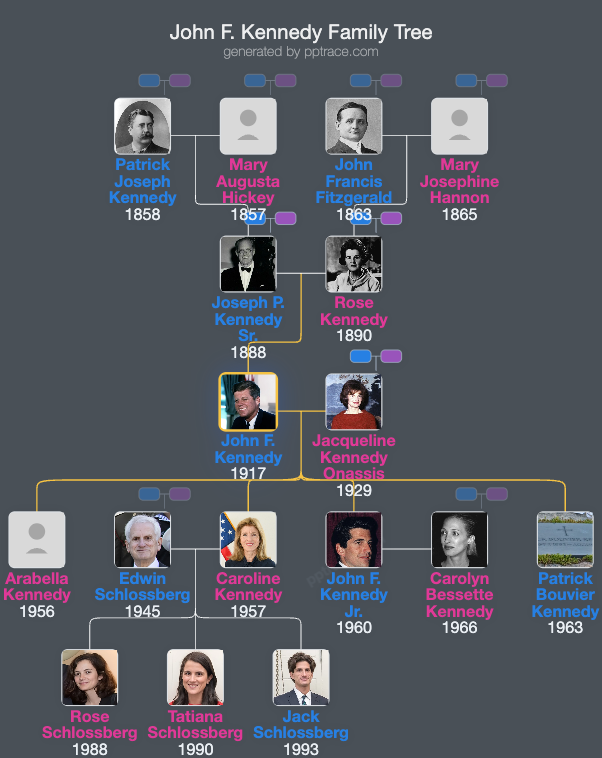
Family Tree
Tap  to expand more relatives
Introduction
John Fitzgerald Kennedy was born on May 29, 1917, in Brookline, Massachusetts, a suburb of Boston. His parents were Joseph P. Kennedy Sr., a businessman and politician, and Rose Kennedy (née Fitzgerald), a philanthropist and socialite. Kennedy's paternal grandfather was P. J. Kennedy, a ward boss in East Boston and a state legislator, while his maternal grandfather was John F. Fitzgerald, a U.S. congressman and two-term mayor of Boston. All four of his grandparents were children of Irish immigrants.
Kennedy had one older brother, Joseph Jr., and seven younger siblings: Rosemary, Kathleen, Eunice, Patricia, Robert, Jean, and Ted. The Kennedy family accumulated significant wealth through Joseph P. Kennedy Sr.'s business ventures, establishing trust funds for his children. The family moved from Boston to the Riverdale neighborhood of New York City in 1927 due to a polio outbreak in Massachusetts and Joe Sr.'s business interests.
Kennedy's early education included attending Canterbury School in New Milford, Connecticut, where he began in 1930 and had an appendectomy in 1931. He subsequently enrolled at Choate, a preparatory boarding school in Wallingford, Connecticut, graduating in June 1935. During his time at Choate, Kennedy was involved in various extracurricular activities and was noted for rebellious behavior. His early aspirations included studying at the London School of Economics under Harold Laski, but health issues prevented this, leading him to briefly attend Princeton University before transferring to Harvard College in 1936.
At Harvard, Kennedy focused on his studies and extracurricular pursuits, such as writing for The Harvard Crimson and participating in athletics. He suffered from back problems resulting from a football injury. During his undergraduate years, he traveled to Europe with his brother and worked at the American embassy in London in 1938. His travels included visits to Germany, the Soviet Union, and the Middle East, providing him exposure to international affairs.
Kennedy completed his bachelor's degree cum laude at Harvard in 1940 with a concentration in government and international affairs. His senior thesis, titled "Appeasement in Munich," was published as the book Why England Slept and addressed the lead-up to World War II. He developed an interest in political philosophy and supported U.S. intervention in the war, diverging from his father's isolationist stance.
Following graduation, Kennedy enrolled at Stanford Graduate School of Business in the fall of 1940 and audited classes, though his plans were later interrupted by the outbreak of World War II. During the war, he served as a lieutenant in the U.S. Naval Reserve, commanding PT boats in the Pacific theater. His unit notably survived the sinking of PT-109, an incident that elevated his public profile.
Kennedy entered politics in 1946 when he was elected to the U.S. House of Representatives representing a Boston district, serving from 1947 to 1953. He was subsequently elected to the U.S. Senate in 1952, serving as the junior senator from Massachusetts from 1953 until 1960. During his Senate term, he authored the book Profiles in Courage, which won a Pulitzer Prize.
Kennedy ran for president in the 1960 election, winning the Democratic nomination and narrowly defeating Republican candidate Richard Nixon. His presidency began on January 20, 1961. His time in office included increased Cold War tensions, such as the Bay of Pigs invasion in 1961 and the Cuban Missile Crisis in 1962. He authorized the deployment of additional advisors to South Vietnam and initiated the Strategic Hamlet Program. He signed the first nuclear arms treaty in 1963, and his administration established the Peace Corps, the Alliance for Progress with Latin America, and continued the Apollo program aimed at landing a man on the Moon by the end of the decade.
Kennedy's domestic policies included support for the civil rights movement, although with limited success in passing his comprehensive New Frontier agenda. His foreign policy was marked by efforts to counter communism and Soviet influence worldwide.
On November 22, 1963, Kennedy was assassinated in Dallas, Texas. Vice President Lyndon B. Johnson succeeded him as president. Lee Harvey Oswald was arrested for the assassination but was killed two days later by Jack Ruby. Investigations by the FBI and the Warren Commission concluded that Oswald acted alone; however, conspiracy theories continue to circulate.
Following Kennedy's death, Congress enacted many of his policy initiatives, including the Civil Rights Act of 1964 and the Revenue Act of 1964. Kennedy's presidency and personal life have remained subjects of historical analysis and public interest.