Edward Ord
| Name | Edward Ord |
| Title | Major General, Union Army general |
| Gender | Male |
| Birthday | 1818-10-18 |
| nationality | United States of America |
| Source | https://www.wikidata.org/wiki/Q712376 |
| pptrace | View Family Tree |
| LastUpdate | 2025-11-12T01:17:12.224Z |
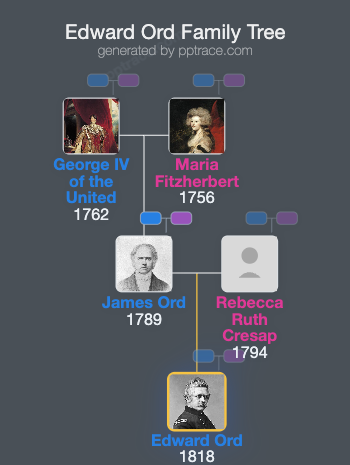
Family Tree
Tap  to expand more relatives
Introduction
Edward Otho Cresap Ord (October 18, 1818 – July 22, 1883) was an American military engineer and United States Army officer. He served in various conflicts, including the Seminole War, the Indian Wars, and the American Civil War. Ord played a significant role during the Civil War, notably in the final days leading to the surrender of Confederate General Robert E. Lee. Additionally, he designed Fort Sam Houston. Ord died in Havana, Cuba, of yellow fever.
**Early life and education**
Born in Cumberland, Maryland, Ord was the son of James and Rebecca Ord. Family tradition suggested that James Ord was the illegitimate son of King George IV of the United Kingdom and Maria Fitzherbert; however, historian James Munson concluded that Mrs. Fitzherbert had no children by the Prince of Wales, whereas Saul David notes it is generally accepted that at least one child resulted from that relationship, with James Ord being a possible candidate.
Ord was recognized as a mathematical genius and was appointed to the United States Military Academy by President Andrew Jackson. His roommate at West Point was William Tecumseh Sherman. He graduated in 1839 and was commissioned as a second lieutenant in the 3rd U.S. Artillery.
**Military career and early assignments**
Ord participated in the Second Seminole War in Florida and was promoted to first lieutenant. In 1847, he traveled with Henry Halleck and William Tecumseh Sherman aboard the USS Lexington around Cape Horn to Monterey, California, then a newly acquired U.S. territory. He led the completion of Fort Mervine, renamed Fort Halleck, which was later called Ord Barracks and eventually renamed in 1904 to honor the original Presidio of Monterey.
During the California Gold Rush, Ord and Sherman assisted in the survey of Sacramento, California, contributing to the layout of the future city. He also conducted surveys of Los Angeles in 1849, producing maps that provide valuable historical records. He was paid $3,000 for this work and was offered land in the downtown district, which he declined in favor of monetary compensation.
Ord was promoted to captain in 1850 and was transferred in 1852 to work with the U.S. Coast Survey, focusing on the geodetic survey of Southern California's coast and Channel Islands, aiding navigation safety during the Gold Rush. He completed surveys near San Pedro that contributed to the development of the Port of Los Angeles. Ord later returned to the Army in 1855 and served in the Pacific Northwest, at Benicia Barracks, and Fort Monroe, Virginia.
In 1859, while attending artillery school at Fort Monroe, Ord was summoned to address concerns related to John Brown's raid on Harpers Ferry. He arrived after the situation was under control but observed the aftermath and wrote to his wife about the events.
**Family**
Ord married Mary Mercer Thompson on October 14, 1854. They had thirteen children, including Jules Garesche Ord, who was killed in action after leading the charge at San Juan Hill during the Spanish-American War, and Edward Otho Cresap Ord II, a Major in the U.S. Army and a painter, inventor, and poet. His grandson, James Garesche Ord, commanded the 28th Infantry Division during World War II.
**Civil War service**
At the Civil War’s outbreak in 1861, Ord was serving as a captain and post commander at Fort Vancouver. He marched to San Francisco and regional offices before engaging in combat roles in the Eastern and Western Theaters. He was promoted to major general of volunteers in 1862 and commanded the 2nd Division of the Army of the Tennessee. Previously, he was involved in operations against Confederate forces, including the Battle of Hatchie’s Bridge, where he was seriously wounded.
Ord assumed command of the XIII Corps during the Siege of Vicksburg after McClernand's relief. He also commanded forces in West Virginia and Maryland in 1864, and in July of that year, took command of the XVIII Corps during the early stages of the Siege of Petersburg. He was wounded during the attack on Fort Harrison in late 1864, returning to action in January 1865.
In March 1865, during a prisoner exchange, Ord discussed peace negotiations with Confederate General James Longstreet, suggesting a meeting between Lee and Grant. This idea was communicated up the chain of command but was ultimately declined.
During the Appomattox Campaign, Ord led the Army of the James and was among the Union forces that accepted Lee’s surrender at Appomattox Court House on April 9, 1865. He purchased the marble table from the surrender room as a souvenir. Following Lincoln’s assassination, Ord investigated the conspiracy to determine if it extended beyond Washington, D.C., and his findings indicated that the Confederate government was not involved.
**Post-war career**
Ord was assigned to command the Army of Occupation in Richmond during Reconstruction, then led various military departments including the Department of Arkansas, the Fourth Military District, the Department of California, and the Department of the Platte. He supervised the construction of Fort Sam Houston while stationed in Texas and participated in a notable buffalo hunting expedition with prominent figures such as Philip Sheridan, George Custer, and Buffalo Bill Cody.
He was appointed military governor of the Fourth Military District in 1876, overseeing Mississippi and Arkansas. Ord retired from the Army in 1881 with the rank of brevet major general.
**Later years and death**
After retirement, Ord was employed as a civil engineer for the Mexican Southern Railroad, a project initiated by Ulysses S. Grant. He relocated to Mexico but contracted yellow fever while traveling from Vera Cruz to New York. He was taken ashore in Havana, Cuba, where he died on July 22, 1883.
**Legacy**
Numerous geographic locations and monuments commemorate Ord. The Fort Ord National Monument in California bears his name. The communities of Ord, Nebraska, and mountains in Texas and Arizona are named after him. Statues and busts of Ord are displayed in various historical sites, including Vicksburg National Military Park and Grant’s Tomb. Streets in Los Angeles, San Francisco, and Washington, D.C., also bear his name.