George Stuart
| Name | George Stuart |
| Title | British admiral |
| Gender | Male |
| Birthday | 1780-03-01 |
| nationality | — |
| Source | https://www.wikidata.org/wiki/Q18624487 |
| pptrace | View Family Tree |
| LastUpdate | 2025-11-26T12:23:08.575Z |
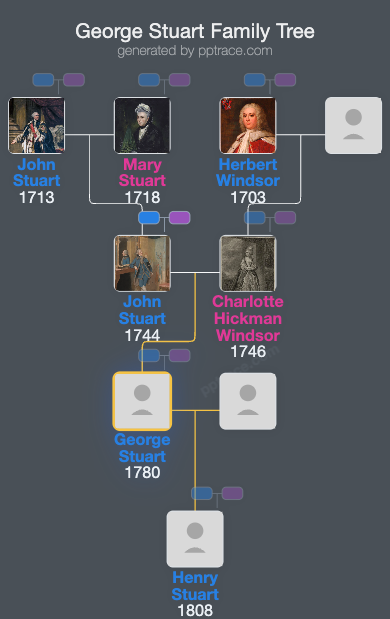
Family Tree
Tap  to expand more relatives
Introduction
Lord George Stuart, CB (1 March 1780 – 19 February 1841) was an officer in the Royal Navy who achieved the rank of Rear-Admiral of the Blue. He died at Balls Park, Hertfordshire.
**Family Background and Early Life**
He belonged to a branch of the Stuart family descended from King Robert II of Scotland. He was the seventh son of John Stuart, 1st Marquess of Bute, and his wife Charlotte Jane. When his father was elevated to the marquessate in 1796, he acquired the courtesy title of Lord Stuart. His siblings included Charles Stuart, who died aboard HMS Leda in 1796, and Captain William Stuart of the Royal Navy.
**Education and Naval Career**
Stuart attended Eton College before entering the Royal Navy in November 1793 as a midshipman. In 1795, he participated in the second voyage of HMS Providence under Captain William Robert Broughton, which was an expedition to locate George Vancouver and explore the Pacific coast of North America, as well as Japan and Macau. The ship was wrecked on a coral reef at Miyako-jima, and Stuart, along with 29 other seamen, returned to Britain in 1799 aboard an East Indiaman.
He was promoted to lieutenant in 1800 and became a commander in 1802. On 3 March 1804, he was appointed captain and took command of the 44-gun frigate HMS Sheerness in the Indian Ocean. However, he was not aboard when Sheerness sank during a storm off Trincomalee on 7 January 1805. On 8 April 1806, while commanding the frigate HMS Duncan, he captured the French privateer Île de France in the North Sea. In 1807, he took command of the 32-gun frigate HMS l'Aimable, with which he captured another French privateer.
**Military Engagements**
In the summer of 1808, Stuart's l'Aimable escorted General Wellesley's army from Cork to Portugal. On 3 February 1809, he captured the French frigate Iris after a 28-hour pursuit in the North Sea. That year, he commanded a light squadron at the mouth of the Elbe River and on 7 July, a landing party under his command destroyed French coastal batteries and occupied the nearby city for a short period. Later, on 29 July, the French occupied Geestendorf on the Weser River. Stuart led a cross-country march to attack and retake the town, succeeding in this operation. The French forces, under Duke Friedrich-Wilhelm of Braunschweig-Oel, later escaped when the fortress at Geestendorf was destroyed.
In November 1810, Stuart commanded the frigate HMS Horatio, and in December 1813, he occupied Zierikzee in the Netherlands, expelling French forces from the island of Schouwen. During the War of 1812, he commanded the newly commissioned 58-gun ship HMS Newcastle.
**Later Honors and Retirement**
In 1815, Stuart was appointed a Companion of the Order of the Bath and served as Naval Aide-de-camp to King William IV. He was promoted to Rear-Admiral of the Blue in 1837.
**Family**
He married Jane Stewart, daughter of Major General James Stewart, on 7 October 1800. Jane Stewart died in 1862. The marriage produced several children, including:
- Emily Frances Stuart (died 1886), who married Charles Abbott, son of Charles Abbott, 1st Baron Tenterden
- Elizabeth Jane Stuart (1803–1877), who married John Townshend, 4th Marquess Townshend
- Henry Stuart (1808–1880), who married Cecilia Hammersley, daughter of Charles Hammersley