Mrs. Patrick Campbell
| Name | Mrs. Patrick Campbell |
| Title | British stage actress (1865–1940) |
| Gender | Female |
| Birthday | 1865-02-09 |
| nationality | United Kingdom |
| Source | https://www.wikidata.org/wiki/Q461990 |
| pptrace | View Family Tree |
| LastUpdate | 2025-11-26T23:32:56.568Z |
Family Tree
Tap  to expand more relatives
Introduction
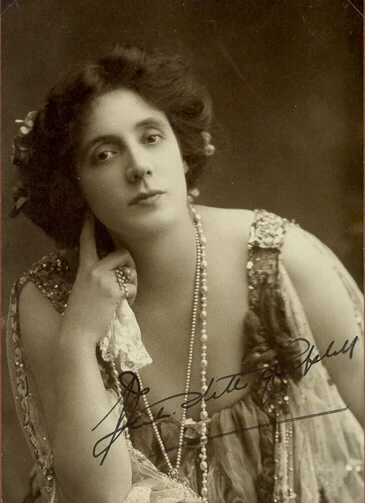
Beatrice Rose Stella Tanner (born 9 February 1865, died 9 April 1940), known by her stage name Mrs Patrick Campbell or Mrs Pat, was an English stage actress. She was primarily recognized for her performances in plays by William Shakespeare, George Bernard Shaw, and J.M. Barrie. Notably, she originated the role of Eliza Doolittle in Shaw's *Pygmalion* on the West End in 1914. Her career also included tours in the United States and appearances in films.
**Early Life**
Beatrice Tanner was born in Kensington, London. Her father, John Tanner (1829–1895), was a descendant of Thomas Tanner, Bishop of St Asaph, and was a consul and merchant associated with the British East India Company. Her mother, Maria Luigia Giovanna Romanini (1836–1908), was the daughter of Count Angelo Romanini, an Italian political exile from Brescia who had joined the Carbonari. The Romanini family traveled through Eastern Europe under a firman from the Sultan of Turkey before settling in England. John Tanner's fortunes fluctuated, partly due to losses sustained during the Indian Mutiny. Beatrice studied briefly at the Guildhall School of Music.
**Stage Career**
Campbell made her professional debut in 1888 at the Alexandra Theatre in Liverpool, two years after her marriage to Patrick Campbell. By 1890, she appeared at London's Adelphi Theatre, and her popularity increased with performances in Sir Arthur Wing Pinero’s *The Second Mrs Tanqueray* (1893) at St. James's Theatre. She also starred in *The Masqueraders* (1894), *John-a-Dreams* (1894), and *The Notorious Mrs. Ebbsmith* (1895). Her notable performances included roles in *Fédora* (1895), *Little Eyolf* (1896), and several Shakespearean roles—Juliet, Ophelia, and Lady Macbeth—performed in collaboration with Forbes-Robertson at the Lyceum Theatre in London's West End during the years 1895 to 1898.
As her reputation grew, Campbell helped to advance the careers of actors such as Gerald Du Maurier and George Arliss. In 1900, she became her own manager and made her Broadway debut in *Heimat* by Hermann Sudermann, achieving significant success. She continued performing on Broadway and U.S. tours until 1933, with notable roles in productions like *Hedda Gabler* (1907), *Electra* (1908), *The Thunderbolt* (1908), and *Bella Donna* (1911).
In 1914, she played Eliza Doolittle in the original West End production of Shaw’s *Pygmalion*, a role expressly written for her. She brought this performance to New York and toured with it in 1915. She reprised her role in a 1920 London revival. Other major performances included Hedda Gabler in 1922 and Mrs. Alving in Ibsen's *Ghosts* (1928), with John Gielgud as her son Oswald.
Her final significant stage role was Mrs. MacDonald in the Broadway production of Ivor Novello's *A Party*, which garnered positive reviews. Later in her career, she appeared in films such as *One More River* (1934), *Riptide* (1934), and *Crime and Punishment* (1935). Her career decisions in her later years were sometimes criticized for limiting her opportunities.
**Relationship with George Bernard Shaw**
Campbell became acquainted with George Bernard Shaw in the late 1890s. Shaw praised her performances but also criticized others. They first met in 1897; Shaw had attempted to persuade her to play Judith Anderson in *The Devil's Disciple*. In 1912, during negotiations to stage *Pygmalion* in London, Shaw developed an infatuation with Campbell, leading to a passionate mutual fascination and a correspondence that became legendary. Campbell ended the affair, but they maintained a friendship. Shaw never cast her in roles he had originally envisioned for her and, in later years, declined to allow publication of their letters in unedited form for reasons related to his personal and public image. Most of these letters were only published posthumously in 1952.
**Personal Life**
In 1884, Campbell eloped with Patrick Campbell, the son of a banker, while pregnant with their first child, Alan "Beo" Urquhart Campbell. Their marriage coincided with Campbell's pregnancy, and their son was born in 1886. Patrick's health deteriorated, leading to long absences abroad, including South Africa during the Boer War, where he was killed in 1900. The couple's second child, Stella Campbell, was born in 1886. Stella and Beo both pursued acting careers, with Stella later choosing marriage over the stage.
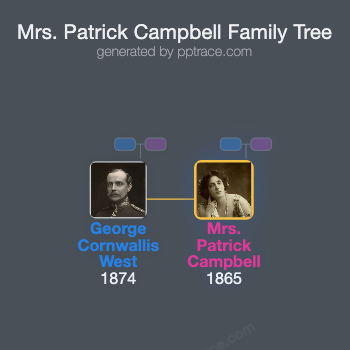
In 1909, Campbell produced *His Borrowed Plumes* by Lady Randolph Churchill. She married George Cornwallis-West on 6 April 1914, following his divorce. Despite her marriage, she continued using her stage name, Mrs Patrick Campbell.
**Death and Legacy**
Campbell died of pneumonia in Pau, France, on 9 April 1940 at the age of 75 and was buried in the Cimetière urbain de Pau. A notebook belonging to her is preserved at the University of Birmingham, and collections of her correspondence are held at Harvard University and the University of Texas at Austin. Her papers include letters to Shaw and annotated scripts, contributing to her documented legacy in theatrical history.