Ulick De Burgh, Lord Dunkellin
| Name | Ulick De Burgh, Lord Dunkellin |
| Title | British politician and military officer (1827–1867) |
| Gender | Male |
| Birthday | 1827-07-12 |
| nationality | United Kingdom of Great Britain and Ireland |
| Source | https://www.wikidata.org/wiki/Q7878979 |
| pptrace | View Family Tree |
| LastUpdate | 2025-11-26T12:34:08.171Z |
Family Tree
Tap  to expand more relatives
Introduction
Ulick Canning de Burgh, Lord Dunkellin (born 12 July 1827, died 16 August 1867), was an Anglo-Irish military officer and politician. He served during the Crimean War and held positions such as Military Secretary to the Viceroy of India and Member of Parliament (MP) for Galway Borough and County Galway.
Family Background and Education:
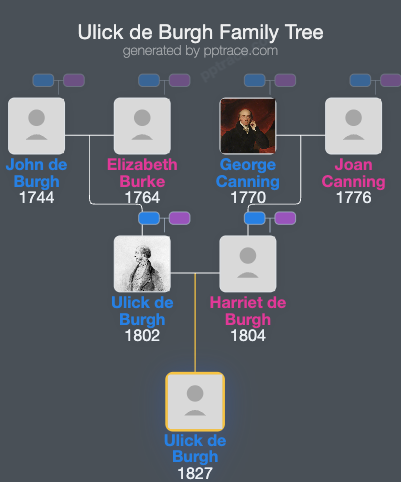
Dunkellin was the eldest son of Ulick de Burgh, 1st Marquess of Clanricarde, and the Honorable Harriet Canning, daughter of George Canning. He was educated at Eton College.
Military Career:
He entered the army in 1846, initially serving in the Coldstream Guards. During his military service, he was appointed Aide-de-Camp to the Lord Lieutenant of Ireland, serving under Lord Bessborough (1847–1848) and Lord Clarendon (1848–1852). He later served as State Steward to the Lord Lieutenant, Lord St Germans, from 1852 to 1854.
Dunkellin participated in the Crimean War, notably during the Siege of Sevastopol in October 1854, where he was taken prisoner. He was promoted to Lieutenant-Colonel in 1854 and was awarded the Order of the Medjidie by Sultan Abdulmejid I of the Ottoman Empire. In 1856, he became Military Secretary to the Viceroy of India, his maternal uncle, Lord Canning. During the Anglo-Persian War (1856–57), he also served on the staff as a volunteer. He retired from the Coldstream Guards in 1860.
Political Career:
Dunkellin was elected as MP for Galway Borough in 1857, serving until 1865, after which he became MP for County Galway from 1865 until his death in 1867. He was associated with the Adullamite faction and played a notable role in parliamentary debates, including moving an amendment on the Parliamentary Reform Bill on 18 June 1866, an action that contributed to the fall of Earl Russell's government.
Honours and Memorials:
A statue was erected in his honor in Eyre Square, Galway, in 1873, recognizing his contributions to military and political fields. However, the statue was removed after Irish independence in 1922 partly due to his familial associations, particularly because of his brother Hubert de Burgh-Canning, who was a notoriously unpopular landlord in County Galway.
Personal Life:
Lord Dunkellin experienced prolonged ill health and died in London at the age of 40 in August 1867. He did not marry and predeceased his father by seven years. His younger brother Hubert succeeded as the Marquess of Clanricarde.
Allied Information:
His lineage traces back to the House of Burgh, an Anglo-Norman and Hiberno-Norman dynasty established in 1193. His coat of arms and detailed ancestry are documented in heraldic references, including works by Burke and others.
References:
Sources include the Oxford Dictionary of National Biography, the Galway Advertiser, and heraldic encyclopedias. His parliamentary contributions are recorded in Hansard, the official report of debates in Parliament.