George Hay, 8th Marquess Of Tweeddale
| Name | George Hay, 8th Marquess Of Tweeddale |
| Title | British politician |
| Gender | Male |
| Birthday | 1787-02-01 |
| nationality | United Kingdom of Great Britain and Ireland |
| Source | https://www.wikidata.org/wiki/Q4494695 |
| pptrace | View Family Tree |
| LastUpdate | 2025-11-26T23:27:45.423Z |
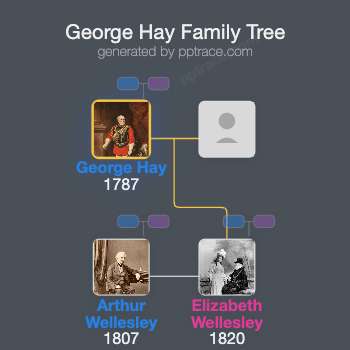
Family Tree
Tap  to expand more relatives
Introduction
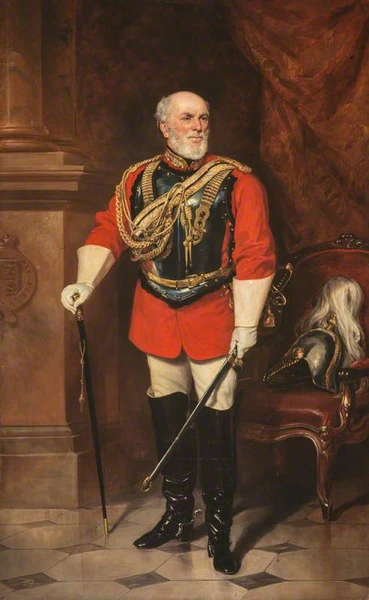
Field Marshal George Hay, 8th Marquess of Tweeddale, was born on 1 February 1787 at Yester House. He was the eldest son of George Hay, 7th Marquess of Tweeddale, and Lady Hannah Charlotte Maitland, daughter of James Maitland, 7th Earl of Lauderdale. Hay received his early education at the Royal High School in Edinburgh.
In June 1804, he was commissioned as an ensign in the 52nd Light Infantry. Following his inheritance of the marquessate in August 1804, he was promoted to lieutenant in October of the same year. He trained under Sir John Moore at Shorncliffe and served as an aide-de-camp in Sicily in 1806. On 12 May 1807, he transferred to the Grenadier Guards, holding the ranks of lieutenant in the regiment and captain in the Army.
Hay served as a staff officer during the Peninsular War, participating under Arthur Wellesley, later the Duke of Wellington. He was present at the Second Battle of Porto in May 1809, where he crossed the Douro River in a daylight coup de main and contributed to the victory over Marshal Soult’s French troops. He was wounded at the Battle of Bussaco in September 1810. Subsequently, he was promoted to major in the 41st Regiment of Foot and served as assistant quartermaster general at the Battle of Vitoria in June 1813, immediately receiving the rank of lieutenant colonel.
In the War of 1812 between Britain and the United States, Hay commanded the 100th Regiment of Foot at the Battle of Chippawa in July 1814. During this engagement, the British forces advanced into a heavy crossfire after American artillery shifted to canister shot, and Hay was captured by American forces.
He was appointed a Companion of the Order of the Bath in 1815. After the war, he returned to Scotland, where he improved the family estate at Yester. Between 1818 and 1820, he served as Pro-Grand Master of the Grand Lodge of Scotland and was elected a representative peer for Scotland in July 1818. In 1820, he was made a Knight of the Thistle, and in February 1823, he became Lord Lieutenant of East Lothian.
Hay was promoted to colonel on 27 May 1825 and to major-general on 10 May 1837. He developed a patented method for drainage tiles on his estate in 1839. In 1842, he was appointed governor of Madras and, through a special arrangement with the Duke of Wellington, also served as Commander-in-Chief of the Madras Army. His tenure included efforts to restore discipline within the army.
He achieved subsequent promotions, becoming lieutenant general on 9 November 1846, then retiring in 1848 to his Scottish estate. He was promoted to full general on 20 June 1854. In 1858, he was invited to join a Royal Commission concerning the organization of the army serving under the East India Company. Hay was made Knight Commander of the Order of the Bath (KCBE) on 9 November 1862, and elevated to Knight Grand Cross of the Order of the Bath (GCB) on 13 March 1867.
He was promoted to field marshal on 29 May 1875. Throughout his military career, he served as colonel of several regiments, including the 30th Regiment of Foot, the 42nd Regiment of Foot, and the 2nd Regiment of Life Guards. Known for his strength, he once drove a mail coach from London to Haddington without stopping.
Field Marshal Hay died on 10 October 1876 at Yester House due to injuries sustained in a fire at his residence. He was buried in the family vault at the Church of St. Cuthbert at Yester, Scotland.
In his family life, he married Lady Susan Montagu in 1816, daughter of the 5th Duke of Manchester. They had six sons and eight daughters. Notable children included Lord Arthur, who became the 9th Marquess of Tweeddale, and Lord William Montagu, who became the 10th Marquess. Among his daughters, Lady Hannah Charlotte married Simon Watson Taylor, and Lady Emily married Sir Robert Peel, 3rd Baronet.