Orson Bean
| Name | Orson Bean |
| Title | American actor (1928–2020) |
| Gender | Male |
| Birthday | 1928-07-22 |
| nationality | United States of America |
| Source | https://www.wikidata.org/wiki/Q1120700 |
| pptrace | View Family Tree |
| LastUpdate | 2025-11-29T01:01:04.940Z |
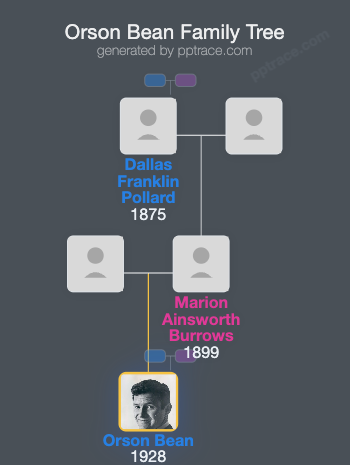
Family Tree
Tap  to expand more relatives
Introduction
Orson Bean, born Dallas Frederick Burrows on July 22, 1928, in Burlington, Vermont, was an American actor and comedian with a career spanning several decades. He passed away on February 7, 2020. Bean was the son of Marian Ainsworth (née Pollard) and George Frederick Burrows. His father was a founding member of the American Civil Liberties Union, contributed to the Scottsboro Boys' defense, and served for 20 years on the Harvard College campus police. Bean's early life included a period of military service in Japan after he graduated from Rindge Technical High School in Cambridge, Massachusetts, in 1946.
He left home at age 16 following the death by suicide of his mother. Post-military, Bean began performing as a stage magician before pursuing stand-up comedy in the early 1950s. He studied theatre at HB Studio. Throughout his career, he was involved extensively in theater, television, and film.
Bean adopted his stage name after a suggestion from a piano player named Val at "Hurley's Log Cabin," a Boston nightclub where Bean performed. According to Bean, Val would suggest silly names for him to use before performances, and the name "Orson Bean" became one such success, leading him to keep it. Bean explained that the name was a blend of the pompous and amusing, and recalled an anecdote involving Orson Welles joking about the name.
His first national exposure was in 1952 when NBC Radio revived its jazz series "The Chamber Music Society of Lower Basin Street," with Bean hosting as "Dr. Orson Bean." He also hosted a related TV special in 1952. Bean was the house comedian at New York's Blue Angel comedy club for ten years. In 1954, he hosted "The Blue Angel," a television show on CBS, which contributed to his recognition as a comedian.
During the 1950s, Bean faced professional challenges due to his attendance at Communist Party meetings, which led to him being placed on the Hollywood blacklist. Despite this, he continued working through the 1950s and 1960s. An appearance on "The Ed Sullivan Show" was canceled because of the blacklist, though the show was later rebooked after Sullivan acknowledged that it was Campbell's Soup, not CBS, that blacklisted him.
On Broadway, Bean starred in the original production of "Will Success Spoil Rock Hunter?" alongside Walter Matthau and Jayne Mansfield. He received a Tony Award nomination in 1961 for his role in "Subways Are for Sleeping." He also performed in "Never Too Late" in 1962 and produced the Off-Off-Broadway musical "Home Movies" in 1964, which won an Obie Award. Additionally, he appeared in other Broadway productions, including "I Was Dancing."
Bean was involved in voice acting; he voiced Charlie Brown and Linus in the 1966 and 1967 MGM musical adaptations of "You're a Good Man, Charlie Brown." He starred in the musical "Illya Darling" in 1967 and was a principal figure at The Pacific Resident Theatre in Venice, California.
In television, Bean played the title character in "Mr. Bevis," an unsuccessful pilot for "The Twilight Zone" in 1960. He also starred in "The DuPont Show with June Allyson" in 1961 and appeared in numerous other series such as "Dr. Quinn, Medicine Woman," "Desperate Housewives," "Mary Hartman, Mary Hartman," and its spinoff "Fernwood 2Nite." His roles included a recurring character on "Dr. Quinn" throughout its run in the 1990s.
Bean's voice roles included the main characters Bilbo and Frodo Baggins in Rankin/Bass animated adaptations of J.R.R. Tolkien's works in 1977 and 1980. His later television appearances ranged from "Will & Grace" to "Modern Family," "Teachers," "Superstore," and "Grace and Frankie," with his appearance in the "Grace and Frankie" episode "The Scent" in 2020 marking his final television performance.
In addition to acting, Bean was a familiar panelist on game shows such as "I've Got a Secret," "What's My Line?," and "To Tell the Truth." He also hosted a pilot for a revamped version of "Concentration" in 1985 that was not picked up.
Throughout his life, Bean maintained a continuous presence in entertainment, with notable contributions across multiple media.