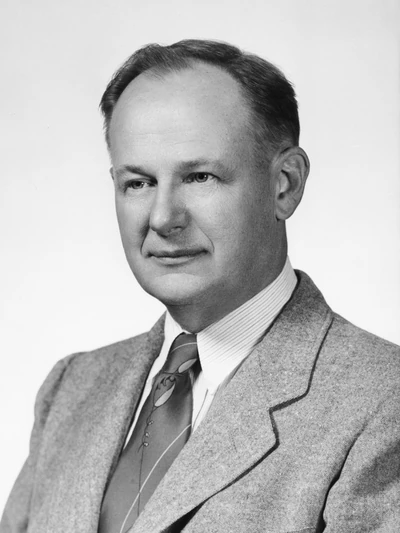
John G. Trump
| Name | John G. Trump |
| Title | American engineer and physicist (1907–1985) |
| Gender | Male |
| Birthday | 1907-08-21 |
| nationality | United States of America |
| Source | https://www.wikidata.org/wiki/Q1576675 |
| pptrace | View Family Tree |
| LastUpdate | 2025-11-27T10:44:08.621Z |
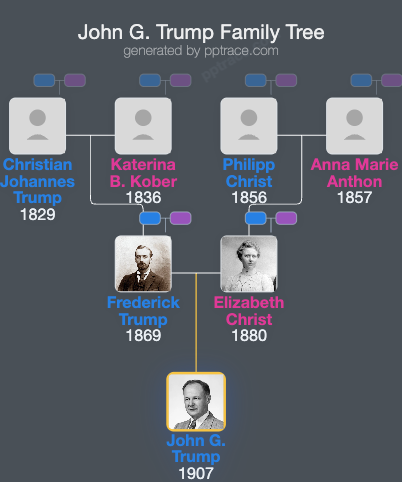
Family Tree
Tap  to expand more relatives
YouTube
Introduction
John George Trump (August 21, 1907 – February 21, 1985) was an American electrical engineer, inventor, and educator. He is known for designing high-voltage particle accelerators and pioneering their use in fields such as cancer treatment, nuclear science, and manufacturing.
Born in the Bronx, New York City, Trump was the youngest of three children born to German immigrants Frederick and Elizabeth Christ Trump. In 1910, his family moved to Queens, New York, settling in the Woodhaven neighborhood. Following the death of his father in the 1918 influenza pandemic, his mother supported the family. Trump attended Richmond Hill High School, where he was recognized as a gifted student. He began working with Western Electric's Manhattan engineering office in 1923, along with his older brother Fred, who was involved in the family real estate business.
Initially studying architecture at Brooklyn Polytechnic Institute, Trump later shifted his focus to engineering after graduating as valedictorian in 1929 with a bachelor's degree in electrical engineering. He earned a master's degree in physics from Columbia University in 1931. In the fall of 1931, he enrolled at the Massachusetts Institute of Technology (MIT) to pursue a PhD in electrical engineering. His doctoral advisor was physicist Robert J. Van de Graaff.
At MIT, Trump contributed to the development of vacuum-insulated high-voltage generators. His research included improving the design and operation of Van de Graaff generators, with a focus on vacuum insulation techniques. He received his doctorate in electrical engineering in 1933, with a thesis titled "Vacuum Electrostatic Engineering."
Following his graduation, Trump remained at MIT, initially as a research associate and later as an assistant professor from 1936. His early research centered on enhancing high-voltage generators and exploring industrial applications. Notably, he developed techniques for producing penetrating, high-voltage X-rays suitable for targeting deep-seated tumors, contributing to the field of cancer radiotherapy.
During the late 1930s and early 1940s, Trump designed and built high-voltage generators for medical use in hospitals, including units at Harvard's Huntington Memorial Hospital and Massachusetts General Hospital. These generators permitted more precise and deeper cancer treatments. He adopted gas-insulated systems utilizing sulfur hexafluoride (SF6) to improve the stability and size of the devices.
In 1940, Trump joined the National Defense Research Committee (NDRC), which oversaw wartime scientific research. He served as a technical aide to MIT President Karl Compton and participated in the formation of MIT's Radiation Laboratory (Rad Lab). During World War II, he played a significant role in radar development, organizing the deployment of radar systems in support of Allied military operations in Europe, including preparations for D-Day and V-1 missile interception. He also served as director of Rad Lab's field offices in England and France, advising military leaders on radar use in combat.
After World War II, Trump organized a company to manufacture Van de Graaff particle accelerators. The High Voltage Engineering Corporation (HVEC), co-founded with Van de Graaff and Dennis M. Robinson, initially produced compact accelerators for medical and industrial applications. The company became a leader in research accelerators globally, supported by government investments in nuclear science. HVEC was among the earliest recipients of venture capital investment and achieved significant commercial success.
Throughout his career, Trump contributed to advancements in high-voltage technology and its applications. He introduced novel techniques for tumor targeting in cancer therapy, treated approximately ten thousand cancer patients, and trained numerous radiologists. His work extended into applications such as food sterilization, spacecraft propulsion, wastewater treatment, and electrical power transmission.
In recognition of his scientific contributions, Trump received the National Medal of Science in Engineering Sciences in 1983, awarded by President Ronald Reagan. He also received war service commendations from both President Harry Truman and King George VI. Many of his innovations remain in active use today, including the original large-scale Van de Graaff generator installed at Boston Museum of Science, and numerous HVEC particle accelerators in laboratories worldwide. He passed away on February 21, 1985.
John Trump was the paternal uncle of President Donald Trump.