William Legge, 2nd Earl Of Dartmouth
| Name | William Legge, 2nd Earl Of Dartmouth |
| Title | British politician |
| Gender | Male |
| Birthday | 1731-06-20 |
| nationality | Great Britain |
| Source | https://www.wikidata.org/wiki/Q3568789 |
| pptrace | View Family Tree |
| LastUpdate | 2025-11-26T23:25:00.643Z |
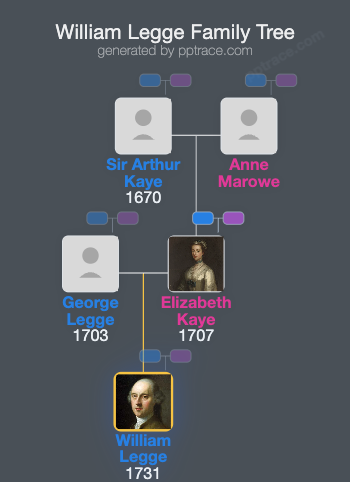
Family Tree
Tap  to expand more relatives
Introduction
William Legge, 2nd Earl of Dartmouth, PC, FRS (20 June 1731 – 15 July 1801), was a British aristocrat and politician. He was styled as Viscount Lewisham from 1732 until 1750, when he succeeded to the earldom. Born in 1731, Dartmouth was the son of George Legge, Viscount Lewisham, and Elizabeth Kaye, daughter of Sir Arthur Kaye, 3rd Baronet. His father died when he was one year old.
In 1748, Dartmouth matriculated at Trinity College, Oxford. He inherited the earldom in 1750 upon the death of his grandfather. In 1764, he recommended John Newton, a former slave trader and the author of "Amazing Grace," to Bishop Edmund Keene of Chester, facilitating Newton's acceptance into the Anglican clergy at the suggestion of Thomas Haweis.
Dartmouth's political career commenced with his role as President of the Board of Trade and Foreign Plantations from 1765 to 1766. He served as Secretary of State for the Colonies from 1772 to 1775, a period encompassing the events of the Boston Tea Party. During his tenure, he supported the Coercive Acts (also known as the Intolerable Acts) and the Quebec Act, policies enacted by the British government. In 1772, he corresponded with Sir William Johnson, the Superintendent of Northern Indian Affairs in America, discussing the challenges of enforcing trade regulations with Native Americans. In 1775, Dartmouth received letters from North Carolina's royal governor Josiah Martin, detailing preparations against Patriot militia activities.
From 1775 to 1782, Dartmouth served as Lord Privy Seal. His arrival in the American colonies was notably recognized in Phillis Wheatley's poem, "To the Right Honourable William, Earl of Dartmouth." Correspondence from colonial officials during this period includes reports on Loyalist preparations and the American Revolution.
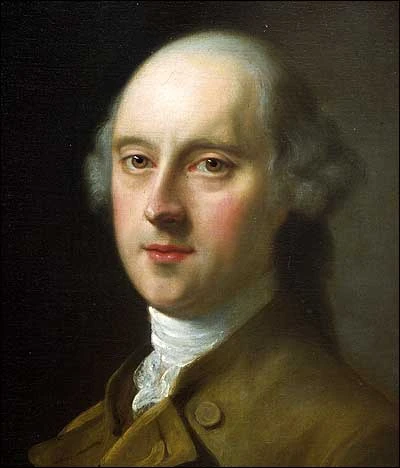
Apart from his political career, Dartmouth engaged in philanthropy. He was a major donor and trustee for the financial backing of the Moor's Charity School established by Eleazar Wheelock in Lebanon, Connecticut, to educate and convert Native Americans. This school was later renamed Dartmouth College in his honor, although he declined to provide financial support directly. In London, Dartmouth was a supporter of the Foundling Hospital, a charity serving abandoned children, serving as vice-president from 1755 until his death. Sir Joshua Reynolds painted his portrait, which is now part of the Foundling Hospital Collection and displayed at the Foundling Museum in London.
He was elected a Fellow of the Royal Society on 7 November 1754.
Dartmouth married Frances Catherine Nicholl, daughter of Sir Charles Gounter Nicoll, on 11 January 1755. The couple had nine children:
- George Legge, 3rd Earl of Dartmouth (b. 3 October 1755 – d. 10 November 1810)
- Hon William Legge (b. 4 February 1757)
- Hon Charles Gounter Legge (b. 18 May 1759)
- Hon Heneage Legge (b. 7 May 1761)
- Hon Henry Legge (b. 23 January 1765 – d. 19 April 1844)
- Admiral Sir Arthur Kaye Legge (b. 25 October 1766 – d. 12 May 1835)
- Rt Rev Edward Legge, Bishop of Oxford (b. 11 December 1767 – d. 27 January 1827)
- The Ven. Augustus George Legge (b. 21 April 1773 – d. 1828), Archdeacon of Winchester
- Lady Charlotte Legge (b. 5 October 1774 – d. 5 November 1848), married Charles Duncombe, 1st Baron Feversham
William Legge, 2nd Earl of Dartmouth, died in Blackheath, Kent, on 15 July 1801, aged 70. He was buried in Trinity Church in the Minories on 3 August 1801. His eldest son, George, succeeded him as Earl. Lady Dartmouth passed away in July 1805. The family resided at Sandwell Hall, which has since been demolished, located in Sandwell Valley.